
Twelve sacks of clothing
Eleven presents (padded)
Ten security restrictions
Nine hours of flying
Eight hour difference
Seven o'clock bus ride
Six checked bags bulging
Five nasty snacks
Four in-flight films
Three hour check-in
Two excess bags
And one day left until I move home
We're off to LA for a few days and will be hopping around Washington after that. Updates coming whenever I can. Catch you on the flip side.
Showing posts with label travel. Show all posts
Showing posts with label travel. Show all posts
Tuesday, December 05, 2006


Thursday, November 02, 2006
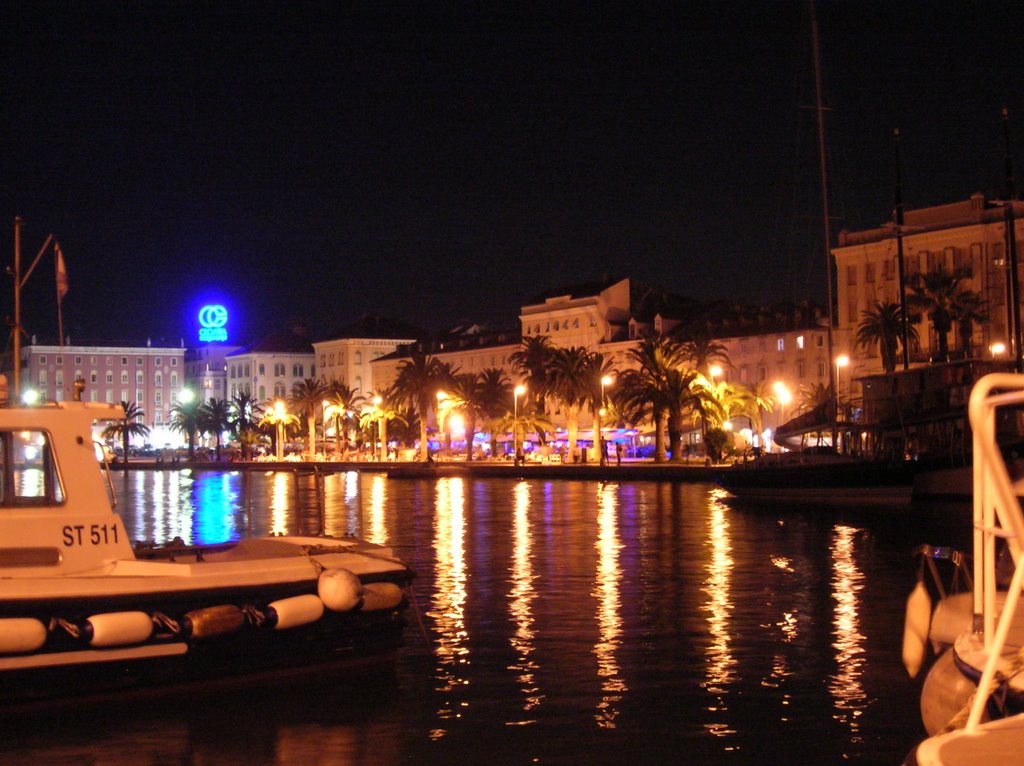
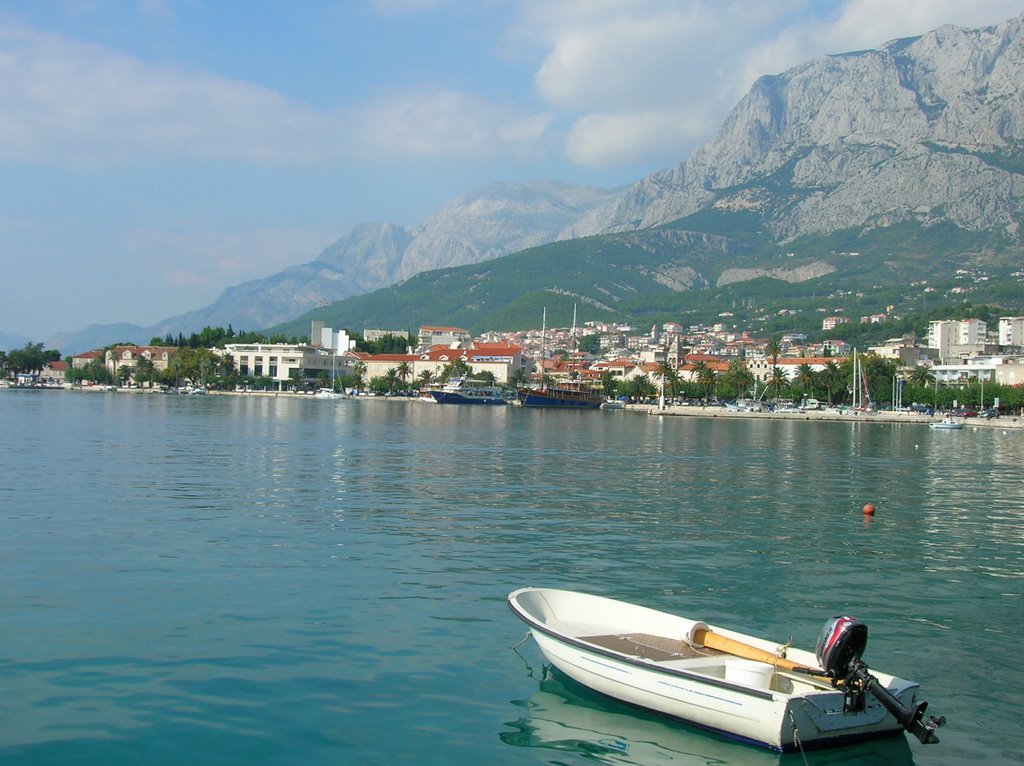
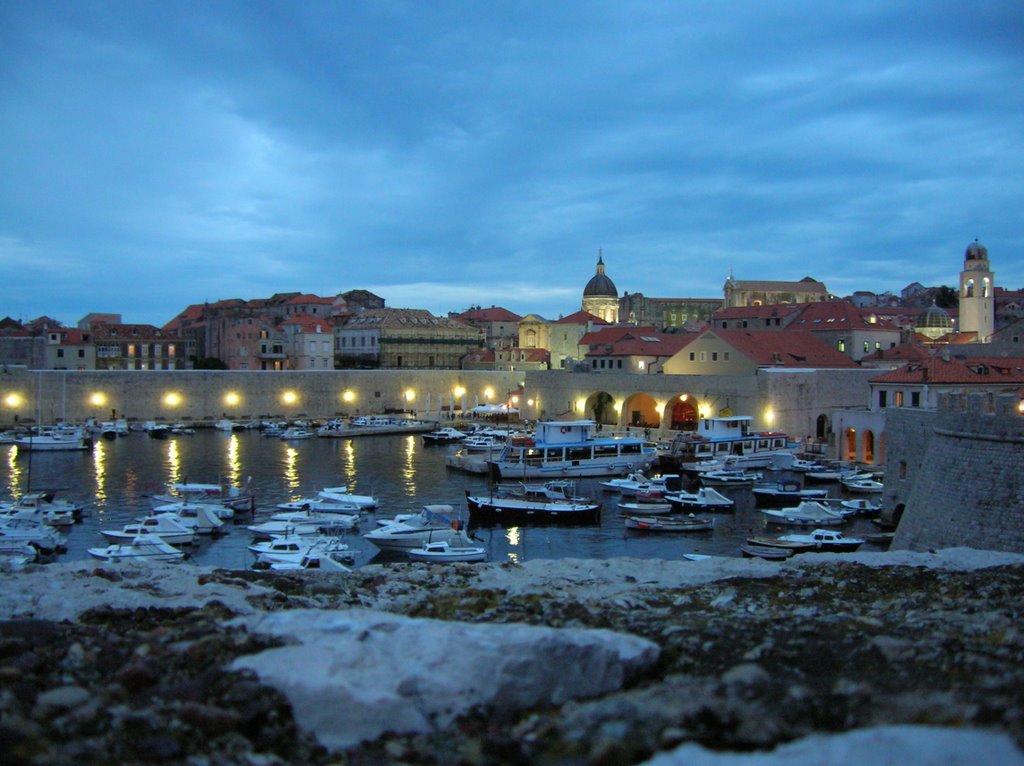
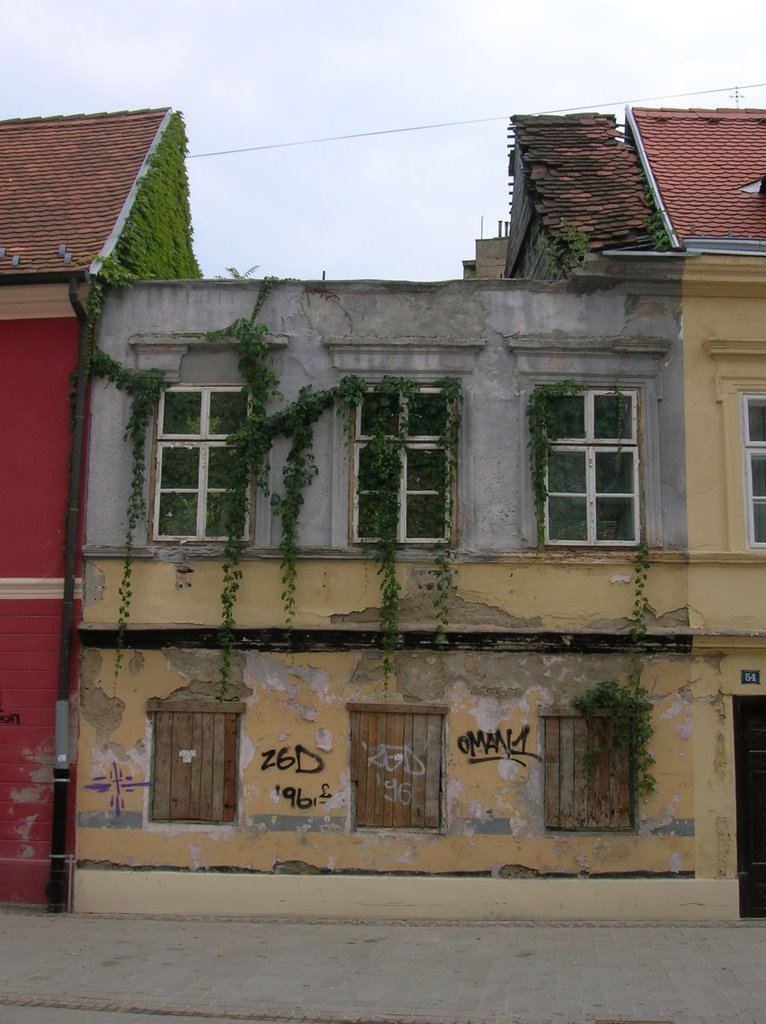
Dubrovnik in the gloaming
No writing tonight -- I'm a little burned out for no good reason. I blame the weather: it is sunny outside, but it is also cold enough for our toes to turn white on bike rides. Evil, evil northern climates.
I hit 40,000 words today on the novel -- a milestone both exciting and frightening. That's all I'm going to say.
I'll regale you with a few more photos, then I'm off to bed. More interesting posts coming soon!
Monday, October 23, 2006
Medeni mjesec 2
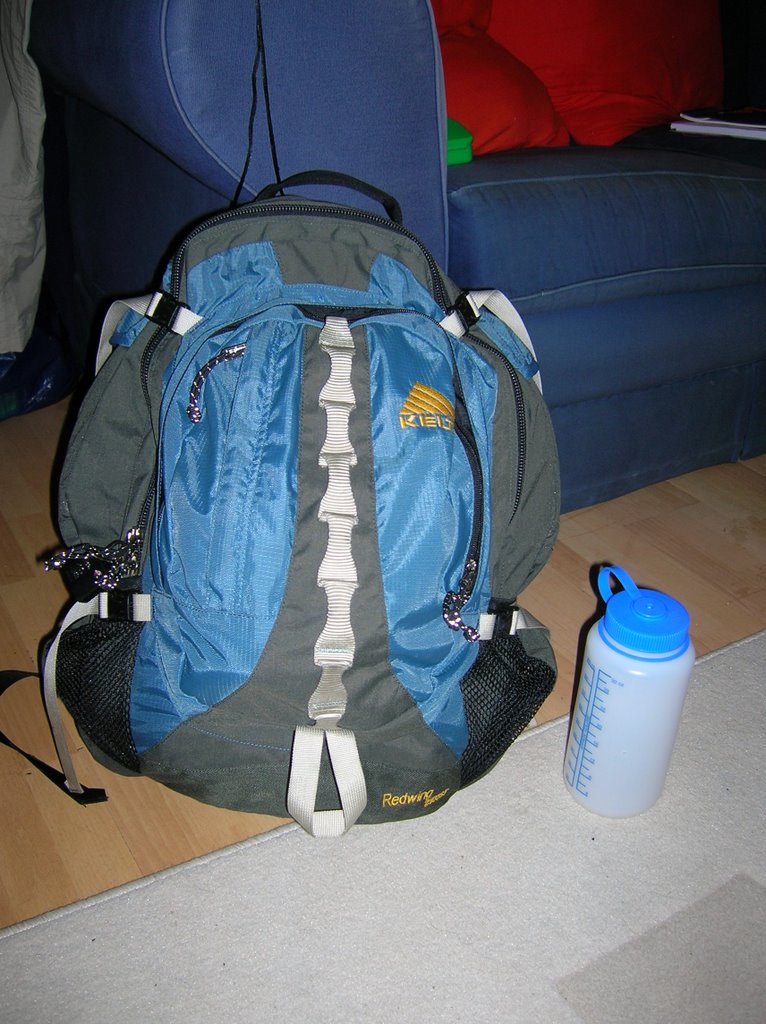
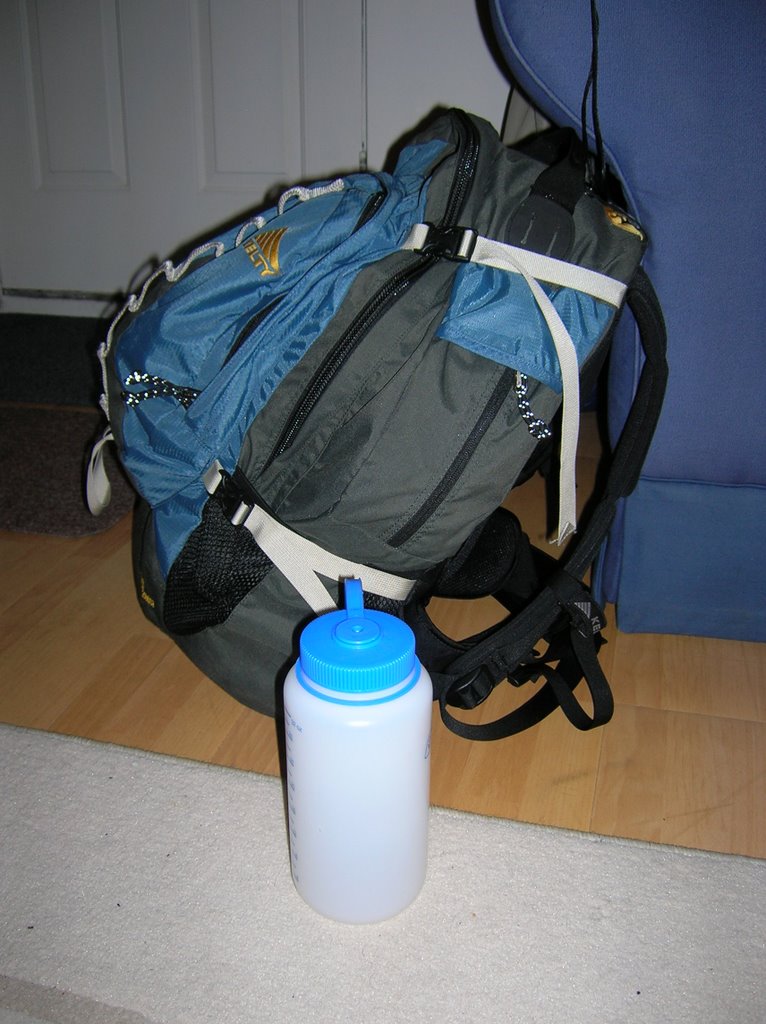 I forgot to mention, dear reader, that this trip was an experiment in "packing light." Observe the size of my backpack in comparison to your standard Nalgene bottle. Yes, that's two weeks of travel gear in there. Although I admit that I was a bit nervous about the prospect of traveling with two pairs of pants and one skirt TOTAL, it worked out quite well...apart from the incident on the island of Lopud, in which Ecogrrl and her spouse were caught out in the middle of a lightning storm and sprinted madly for home across pitch-black fields...leading to the skirt's untimely demise. Yeah, running pell-mell through a tempest with lightning so intense that the memory plays like the world-ending storm at the end of a black-and-white movie? Can't say I recommend it. Particularly because passports do not like water. At all.
But the bag was great. Its innards bloated a little at the end, when I crammed in an extra couple of books because I'm insane enough to plow through two novels in the first week of a trip, necessitating the purchase of two more at a Dubrovnik bookshop and the Dublin airport. Apart from that, I'm truly impressed with how well it performed; it even emerged unscathed from the belly of a Ryanair plane.
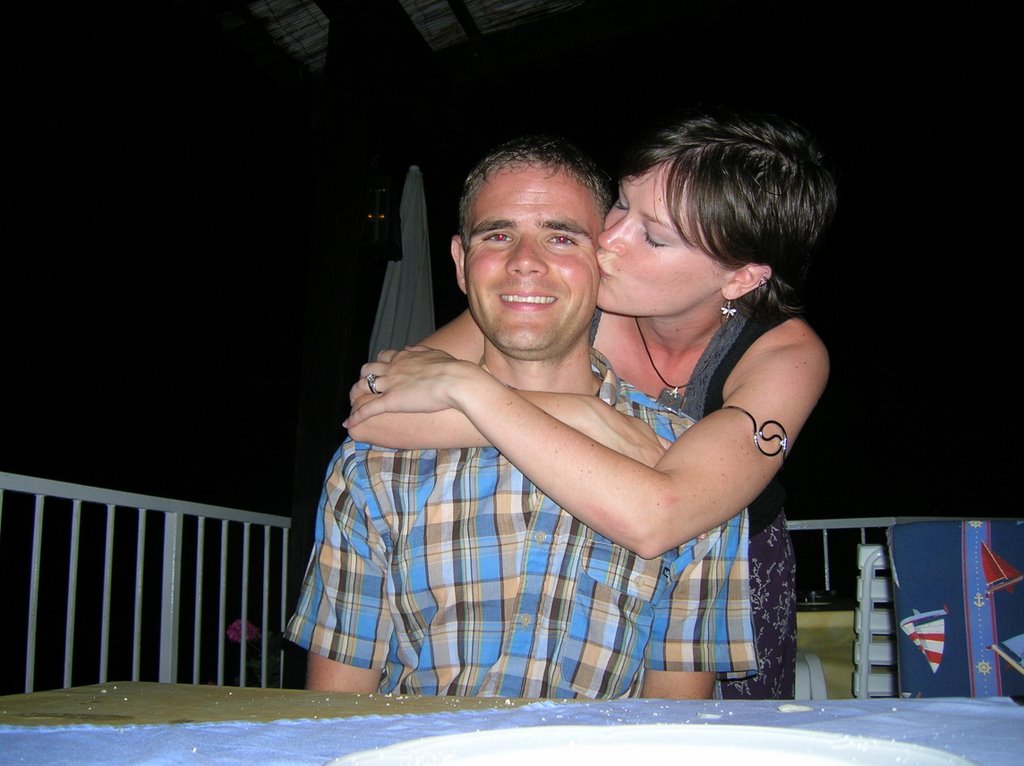 The only real downside to packing light is the need to recycle the same clothes every few days, as demonstrated by Coalescent Boy. As you can see, however, CB remains his same handsome self -- and no one on Lopud (left) knew we wore the same things in Dubrovnik (right).
As an aside, note the ridiculous height of the aloe plants. These were not the largest specimens we saw -- the biggest were almost CB's height. Based on casual observations, *everything* grows lush and massive in Croatia's climate: figs plummet from city walls in Dubrovnik; squashes vie for space on arbors with grapes bursting their skins; limes the size of softballs droop from trees.
The only other drawback to spartan packing is doing the laundry, or, "Oh hell, we are out of socks and the ones I washed have not line-dried yet and now I must tie them to the outside of my pack so they don't make other things in my bag wet." Hey, at least you receive some amused smiles from people when you're traipsing around city streets with clean laundry streaming out behind you.
Thursday, October 19, 2006
Medeni mjesec (honeymoon), part 1
"Erm, dobra večer," I said, clutching a grimy mobile phone to my ear. I stood at the side counter of a compact bar in Zagreb, having just begged and plead with the bartender to lend me his phone for a minute so I could call the owner of our private room at 10:30 pm to tell him we couldn't open the front door.
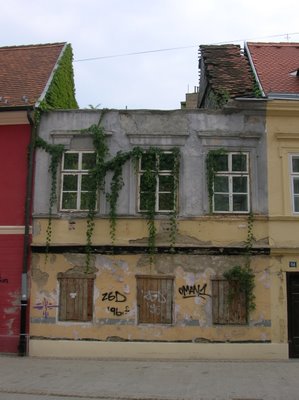
Coalescent Boy -- his adopted moniker, I'll have you know -- and I had been traveling since 5:30 that morning, when we trudged out to the cab that would take us to Stansted Airport. After a shorthaul flight to Trieste and a long bus ride to Croatia, in which we were stopped at the Slovenian border so bored Croatian guards could order us all of the bus, herd us on again, and then order us off with our bags to "search for drugs," we finally arrived in Zagreb. Exhausted and famished, we successfully navigated a bewildering tram system, the route maps of which were faded beyond legibility and written in Croatian. Furthermore, they relied upon some new space-time continuum in which hours like "36.5" and "19" coexisted, a state of affairs which Zagreb residents seemed to accept, leaving two f---ing confused tourists to run back and forth across the tracks, trying to figure out which side went the way they needed. Finally, we scrambled aboard the right tram, a dingy, graffiti-strewn box that looked older than the city itself. As it rocked on the track, emitting sharp, aggravated cracks whenever it turned, Coalescent Boy and I looked at each other and grinned. We made it.
Our success was short-lived. After finding our room, the first in a series of private accomodations or "sobes" which we occupied down the coast, we set out to find a late-night dinner. The lodging itself was fine, but we were just outside the city center in a roughish-looking neighborhood (hey, for less than 30 pounds per night, who's complaining?). On a whim, I decided to check the lock after we shut the door. I turned the key. The door handle remained fixed in place. CB jiggled the key. No go. Fueled by hunger and the prospect of sleeping on concrete steps in a dingy, draughty yellow hallway, we took turns hammering at the door. The overhead light flicked off.
Great. Nice planning, Ecogrrl. I'd managed to start off our honeymoon by forcing us to sleep on cold cement. Thankfully, the bartender spoke enough English to vaguely understand what I was saying -- that, or he was a little frightened by the frantic girl waving a phone number in his face. We reached our host and convinced him to drive back out again to help us with the door. Ten minutes later, he showed up, considerably more disgruntled than he had been during our initial meeting. I launched into a detailed explanation and apology while CB handed him the key. He slid the key into our lock, turned it until the latch clicked, twisted the handle and shoved the door open.
Oh sweet lord.
"We really aren't as stupid as we look right now," I said.
"Uh-huh," he responded. "I have to go now."
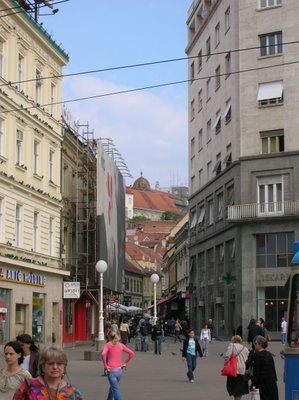 Having done our patriotic duty by convincing another European that Americans are blithering idiots, we raced out to find food before everything in the city shut down for the night. Thankfully, Croatia isn't England -- we may have found the only restaurant still serving food, but a plethora of outdoor cafes awaited after we finished our pizza. We collapsed underneath a canopy of umbrellas stretching end-on-end down a wide pedestrian walkway, ordered a couple of local beers, and sat watching the crowds. Most passers-by were young, drawn to Zagreb's extensive pedestrian zone, where you can walk for several blocks in any direction without dodging cars or mopeds. Music streams from cafes and bars; gelato shops serve huge, glistening scoops of toasted pistachio ice cream; people sit and talk and call to friends walking down side streets. I've never been anywhere with a night life like Zagreb's, except for Cuba. There, too, the warm climate and communal atmosphere created a vibrant nocturnal community. As the minutes slid by, I slipped into a blissful, gelato-induced stupor. Not a bad start to things. Not bad at all.
Coalescent Boy -- his adopted moniker, I'll have you know -- and I had been traveling since 5:30 that morning, when we trudged out to the cab that would take us to Stansted Airport. After a shorthaul flight to Trieste and a long bus ride to Croatia, in which we were stopped at the Slovenian border so bored Croatian guards could order us all of the bus, herd us on again, and then order us off with our bags to "search for drugs," we finally arrived in Zagreb. Exhausted and famished, we successfully navigated a bewildering tram system, the route maps of which were faded beyond legibility and written in Croatian. Furthermore, they relied upon some new space-time continuum in which hours like "36.5" and "19" coexisted, a state of affairs which Zagreb residents seemed to accept, leaving two f---ing confused tourists to run back and forth across the tracks, trying to figure out which side went the way they needed. Finally, we scrambled aboard the right tram, a dingy, graffiti-strewn box that looked older than the city itself. As it rocked on the track, emitting sharp, aggravated cracks whenever it turned, Coalescent Boy and I looked at each other and grinned. We made it.
Our success was short-lived. After finding our room, the first in a series of private accomodations or "sobes" which we occupied down the coast, we set out to find a late-night dinner. The lodging itself was fine, but we were just outside the city center in a roughish-looking neighborhood (hey, for less than 30 pounds per night, who's complaining?). On a whim, I decided to check the lock after we shut the door. I turned the key. The door handle remained fixed in place. CB jiggled the key. No go. Fueled by hunger and the prospect of sleeping on concrete steps in a dingy, draughty yellow hallway, we took turns hammering at the door. The overhead light flicked off.
Great. Nice planning, Ecogrrl. I'd managed to start off our honeymoon by forcing us to sleep on cold cement. Thankfully, the bartender spoke enough English to vaguely understand what I was saying -- that, or he was a little frightened by the frantic girl waving a phone number in his face. We reached our host and convinced him to drive back out again to help us with the door. Ten minutes later, he showed up, considerably more disgruntled than he had been during our initial meeting. I launched into a detailed explanation and apology while CB handed him the key. He slid the key into our lock, turned it until the latch clicked, twisted the handle and shoved the door open.
Oh sweet lord.
"We really aren't as stupid as we look right now," I said.
"Uh-huh," he responded. "I have to go now."
 Having done our patriotic duty by convincing another European that Americans are blithering idiots, we raced out to find food before everything in the city shut down for the night. Thankfully, Croatia isn't England -- we may have found the only restaurant still serving food, but a plethora of outdoor cafes awaited after we finished our pizza. We collapsed underneath a canopy of umbrellas stretching end-on-end down a wide pedestrian walkway, ordered a couple of local beers, and sat watching the crowds. Most passers-by were young, drawn to Zagreb's extensive pedestrian zone, where you can walk for several blocks in any direction without dodging cars or mopeds. Music streams from cafes and bars; gelato shops serve huge, glistening scoops of toasted pistachio ice cream; people sit and talk and call to friends walking down side streets. I've never been anywhere with a night life like Zagreb's, except for Cuba. There, too, the warm climate and communal atmosphere created a vibrant nocturnal community. As the minutes slid by, I slipped into a blissful, gelato-induced stupor. Not a bad start to things. Not bad at all.
Thursday, October 12, 2006
We're experiencing technical difficulties...
AKA, we have no freaking internet connection.
Check that: we have one slow-ass 36k link that disconnects every 30 seconds, while our ISP claims that it's working on the problem. Suffice it to say that I am now a cooped-up, cranky as hell unemployed person with no links to the outside world. Our ISP is about to get a taste of my wrath.
Croatia was fantastic, and I promise that I will regale you with stories and pictures as soon as I can sit at my own terminal for more than three minutes. The blog, she is NOT dead! She's just being held against her will.
Check that: we have one slow-ass 36k link that disconnects every 30 seconds, while our ISP claims that it's working on the problem. Suffice it to say that I am now a cooped-up, cranky as hell unemployed person with no links to the outside world. Our ISP is about to get a taste of my wrath.
Croatia was fantastic, and I promise that I will regale you with stories and pictures as soon as I can sit at my own terminal for more than three minutes. The blog, she is NOT dead! She's just being held against her will.
Monday, September 25, 2006
Croatia-bound
We're off on the honeymoon together, embarking from home around 6am to catch our morning flight to Trieste. (I do so love budget airline timetables.) I should have a real internet connection when I return, which means I will be able to post trip accounts right away...assuming we can find the ethernet cable under all of the boxes and miscellaneous belongings we haven't put away yet. I'm thinking about taking all of the random stuff and turning it into postmodern art: the final scene of Hamlet as depicted in two-pence coins and excess glassware, for example.
The trip is partially planned (e.g., three of 12 nights booked), just the way we like it. All should be well, provided we can learn how to pronounce mysterious phrases like, "Gdje je najbliža tramvajska stanica?" I think that has something to do with finding the nearest rail station. Mispronouncing it might result in being directed to a highly interesting species of gull.
Yes, I invented the last bit. I hope.
Regular communication will resume sometime after October 9th. Until then, zbogom!
The trip is partially planned (e.g., three of 12 nights booked), just the way we like it. All should be well, provided we can learn how to pronounce mysterious phrases like, "Gdje je najbliža tramvajska stanica?" I think that has something to do with finding the nearest rail station. Mispronouncing it might result in being directed to a highly interesting species of gull.
Yes, I invented the last bit. I hope.
Regular communication will resume sometime after October 9th. Until then, zbogom!
Monday, June 12, 2006
The heat is on
Whew! In a single week, England morphed from frozen, windswept tundra into humid, muggy oven. I actually have tan lines now -- real tan lines! -- and we've finally remembered what it's like to walk without carrying an umbrella or wearing a raincoat. My poorly insulated flat has adapted to the trend: I can't see my breath in the evenings anymore, but now I can lie on top of my sheets at night, sweating and wondering why no one in Cambridge considered proper ventilation when constructing student homes.
Unfortunately, England is scheduled to revert back into land of tepid downpours this week, and I've been warned by several Cambridge residents that this may be the only time I see the sun this summer.
Excuse me while I crawl back into my room and die now.
At least the presence of World Cup fanatics will keep the area warmer for awhile, surrounded as we are by hordes of shirtless, sweaty, ale-guzzling fans who invade the pubs with their faces painted and their England flags hoisted high.
On Saturday, we visited Stratford-upon-Avon, home to the one dead white male worth worshipping.
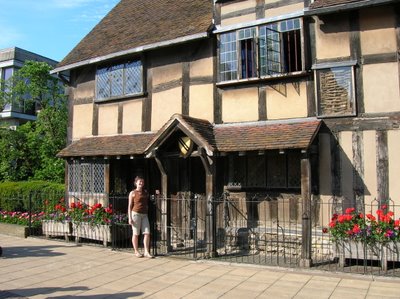
Yes, that is the Bard's Officially Rumored Birthplace, and that's me touching the railing in the desperate hope that talent radiates from the building and will transfer to passersby.
Naturally, the afternoon matinee of Romeo and Juliet didn't finish until
Shakespeare's Birthplace closed for the night, so we had to stand outside and oogle the dust-filled windows. It may not have mattered anyway. Since the entrance to the birthplace was three buildings down in a shiny new edifice blaring "Enter Shakespeare's Birthplace HERE!", I'm thinking perhaps the Bard's abode still has a lingering touch of the plague.
Alas, I'm afraid I've married someone who does not appreciate the Bard's wit, so it's probably just as well that I'm not an English PhD because I'd have to disown him. Over our pints after the show, he looked at me nervously and stutteringly said, "So, so you like this stuff. Can I ask: why?" Math people. Dropped at birth, I tell you. I suppose I can still find some redeeming qualities.
Granted, this performance didn't rank among Stratford's finest. A modernized rendition, it featured ambiguous period costumes that could have been 1920s Verona, although Juliet spent most of her time running around in a slip for no apparent reason. The low point had to be the avant-garde decision of the director to feature...Dance Fighting. That's right, Mercutio and Thibault perform some sort of Flamenco-Tap-Capoeira choreography and melodramatically swing giant bamboo poles at each other, occasionally pausing to hammer them on the ground, ape-like, and then are impaled/bludgeoned/embarrassed to death.
It was pretty awful. Ruined some otherwise fine acting, too. Alas, thanks to the dancing fools, the only way I'll ever get the husband back to Shakespeare involves a lot of lies and drugs.
Fortunately for us, we were able to experience more dancing fools at the Dirty Duck, a famous literary and theatric hangout. I'd hoped to see a famous Shakespearean actor or two while we nursed our pints, but this was the afternoon of England's first World Cup match, so instead we were treated to the sights and sounds of approximately 15 pale, shirtless men howling children's songs from picnic tabletops in the beer garden. England, it seemed, had won.
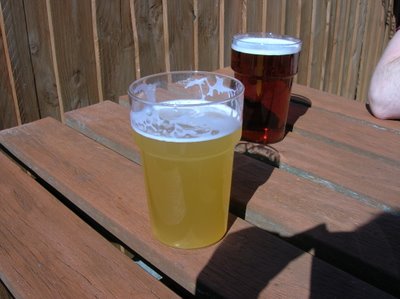
Clearly, the appearance of mandatory plastic cups was not a coincidence.
After being treated to about 11 cycles of "Sunshine Mountain," we were severely disappointed when a barkeep came out and asked them to leave. Frankly, I couldn't imagine a more interesting evening than one that involved trying to discuss postmodern literary theory to a chorus of "Going up Sunshine Mountain...Meee and youuuuuu!"
Naturally, I had to have a photo with one of the quotes on the bar walls. It had to be either Hamlet or King Lear, but the Lear quote wasn't spectacular and this somehow seemed appropriate for a grad student:
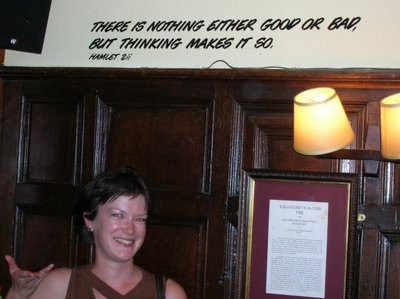
Note: I am neither bright red nor that sweaty in real life. I blame the questionable camera quality.
Stratford itself is charming: lots of shaded paths along the riverside, quiet side streets, quaint shops bearing every name ever found in a Shakespeare play...but alas, the trip ended too soon and today I am feeling completely overwhelmed by the ever-growing workload.
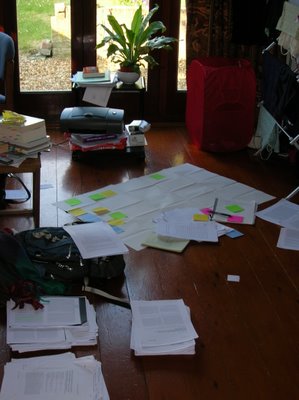
The thing in the middle is the conceptual map I'm trying to make for the "discussion" part of my thesis. My new problem is that my literature review and my fieldwork discussion aren't exactly matching up. I think I would like to quit now.
Two more months. I should be elated, but the very thought of time slipping away has me panicked...and next week is May Week, or the most Drunken of Debauched Summer Days, and there's no way I'm getting anything done then because I am either attending some sort of snooty soiree or recovering from the soiree. Oh yeah, and did I mention I had a lovely ant infestation this morning to top everything else off? Gotta love living with slobs for flatmates...I think I'm going to go drown my sorrows in a bowl of ice cream. Might as well get fat if I have to spend all summer inside...heh heh. Sigh.
Unfortunately, England is scheduled to revert back into land of tepid downpours this week, and I've been warned by several Cambridge residents that this may be the only time I see the sun this summer.
Excuse me while I crawl back into my room and die now.
At least the presence of World Cup fanatics will keep the area warmer for awhile, surrounded as we are by hordes of shirtless, sweaty, ale-guzzling fans who invade the pubs with their faces painted and their England flags hoisted high.
On Saturday, we visited Stratford-upon-Avon, home to the one dead white male worth worshipping.
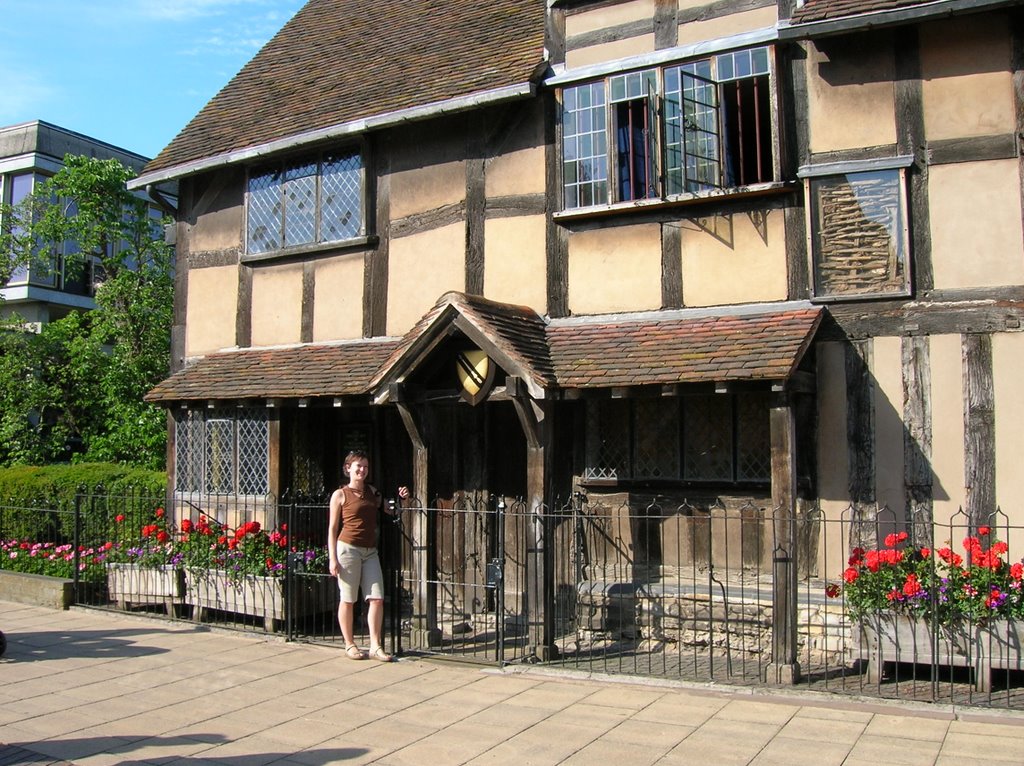
Yes, that is the Bard's Officially Rumored Birthplace, and that's me touching the railing in the desperate hope that talent radiates from the building and will transfer to passersby.
Naturally, the afternoon matinee of Romeo and Juliet didn't finish until
Shakespeare's Birthplace closed for the night, so we had to stand outside and oogle the dust-filled windows. It may not have mattered anyway. Since the entrance to the birthplace was three buildings down in a shiny new edifice blaring "Enter Shakespeare's Birthplace HERE!", I'm thinking perhaps the Bard's abode still has a lingering touch of the plague.
Alas, I'm afraid I've married someone who does not appreciate the Bard's wit, so it's probably just as well that I'm not an English PhD because I'd have to disown him. Over our pints after the show, he looked at me nervously and stutteringly said, "So, so you like this stuff. Can I ask: why?" Math people. Dropped at birth, I tell you. I suppose I can still find some redeeming qualities.

Granted, this performance didn't rank among Stratford's finest. A modernized rendition, it featured ambiguous period costumes that could have been 1920s Verona, although Juliet spent most of her time running around in a slip for no apparent reason. The low point had to be the avant-garde decision of the director to feature...Dance Fighting. That's right, Mercutio and Thibault perform some sort of Flamenco-Tap-Capoeira choreography and melodramatically swing giant bamboo poles at each other, occasionally pausing to hammer them on the ground, ape-like, and then are impaled/bludgeoned/embarrassed to death.
It was pretty awful. Ruined some otherwise fine acting, too. Alas, thanks to the dancing fools, the only way I'll ever get the husband back to Shakespeare involves a lot of lies and drugs.
Fortunately for us, we were able to experience more dancing fools at the Dirty Duck, a famous literary and theatric hangout. I'd hoped to see a famous Shakespearean actor or two while we nursed our pints, but this was the afternoon of England's first World Cup match, so instead we were treated to the sights and sounds of approximately 15 pale, shirtless men howling children's songs from picnic tabletops in the beer garden. England, it seemed, had won.

Clearly, the appearance of mandatory plastic cups was not a coincidence.
After being treated to about 11 cycles of "Sunshine Mountain," we were severely disappointed when a barkeep came out and asked them to leave. Frankly, I couldn't imagine a more interesting evening than one that involved trying to discuss postmodern literary theory to a chorus of "Going up Sunshine Mountain...Meee and youuuuuu!"
Naturally, I had to have a photo with one of the quotes on the bar walls. It had to be either Hamlet or King Lear, but the Lear quote wasn't spectacular and this somehow seemed appropriate for a grad student:
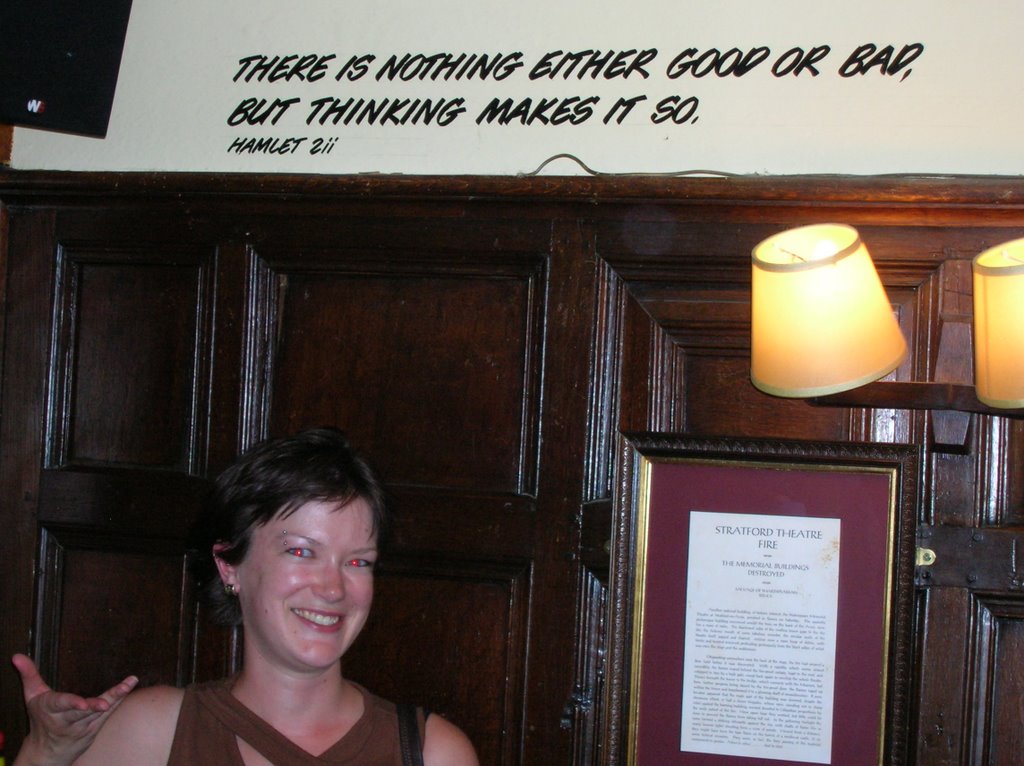
Note: I am neither bright red nor that sweaty in real life. I blame the questionable camera quality.
Stratford itself is charming: lots of shaded paths along the riverside, quiet side streets, quaint shops bearing every name ever found in a Shakespeare play...but alas, the trip ended too soon and today I am feeling completely overwhelmed by the ever-growing workload.
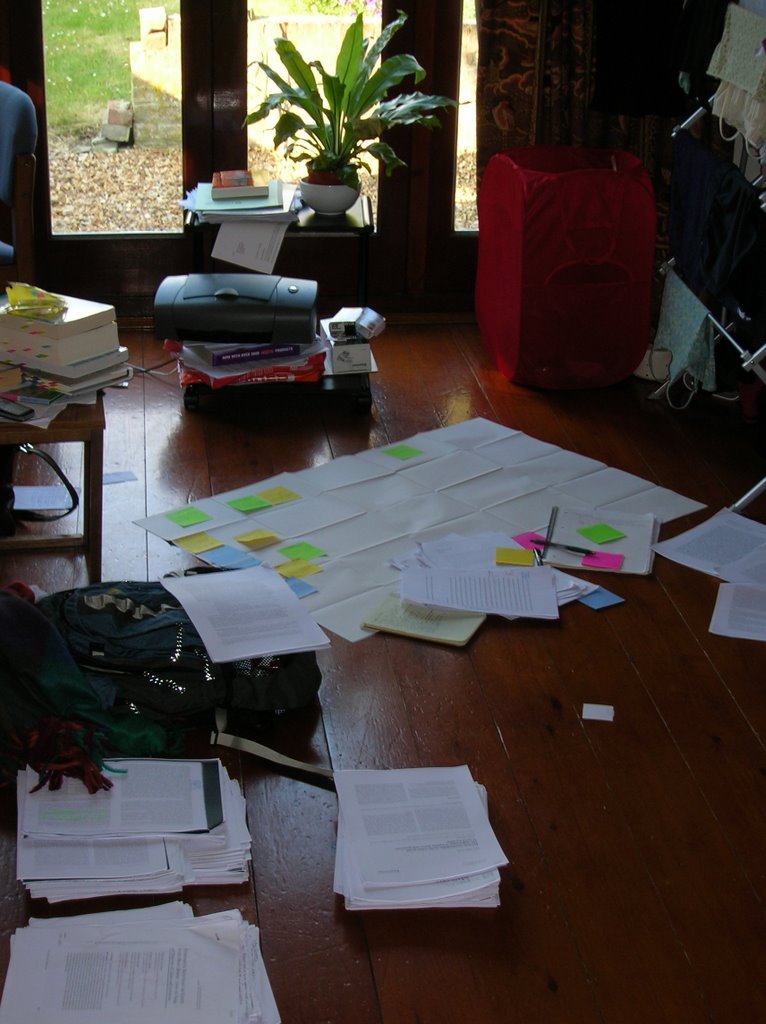
The thing in the middle is the conceptual map I'm trying to make for the "discussion" part of my thesis. My new problem is that my literature review and my fieldwork discussion aren't exactly matching up. I think I would like to quit now.
Two more months. I should be elated, but the very thought of time slipping away has me panicked...and next week is May Week, or the most Drunken of Debauched Summer Days, and there's no way I'm getting anything done then because I am either attending some sort of snooty soiree or recovering from the soiree. Oh yeah, and did I mention I had a lovely ant infestation this morning to top everything else off? Gotta love living with slobs for flatmates...I think I'm going to go drown my sorrows in a bowl of ice cream. Might as well get fat if I have to spend all summer inside...heh heh. Sigh.
Monday, May 22, 2006
God's country
 Crap. Well, this was the best I could do considering I was going about 60 mph when I tried taking this (oops, Mom, don't read that part). Anyway, what you can't really make out here, through my wildlife-splattered windshield, is a bumper sticker on the back of that truck that seriously says, "Viva Bush." Yep. Viva. Bush.
Water officials here have shared their frustration with me over the county's politics. There probably aren't many other places on earth which have been hurt so badly by pro-growth, pro-development policies that put the almight dollar first, and yet this area remains Republican owned-and-run. Only 5% of the county votes, and they're the 5% who happen to be white and conservative (and it is true that most white folks here are conservative). A large proportion of people here are illegal, according to everyone I've talked to -- not so much in
Calexico, but further north where the Border Patrol isn't quite so visible. Still, you see empty cars strewn up and down the highways here, signs that la migra pulled over a car full of migrants on its way to safer ground.
The majority of elected officials live in San Diego and other areas out of the county; this is changing slowly, but not fast enough to alter the political terrain before the Salton Sea dries up and blows down the valley.
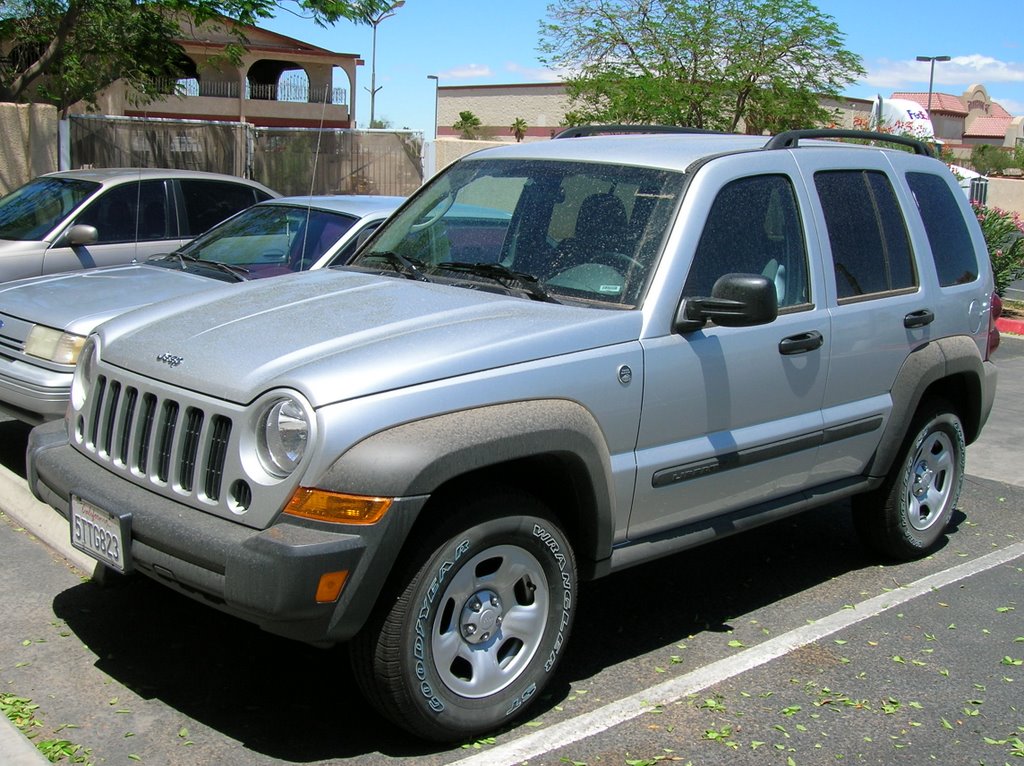
I'm really disappointed, by the way, that you can't see how much dirt is on my car right now. I'll have to take a picture from the right angle so you can see the full speckling on the exterior. I'm not sure what's gotten into me, but there's something addicting about rolling around in the dirt. It helps that this car isn't much bigger than my Jetta, which makes it easy to spin around offroad.

At the same time, Calexico is a happening place. On Saturday, I went to the 15th Annual Mariachi sin Fronteras festival, which brought in famous mariachi acts from around Latin America. My two favorites? Los Reyes del Valle and Mariachi Divas. I'd highly recommend checking out either, even if you don't like mariachi -- I hadn't realized how diverse the contemporary sound could be. This very blurred photo is of Mariachi Divas. I had to shoot it from about 1000 feet away, through a fence and without a flash...so you get what you can at that point, especially when you're working with a mediocre digital camera. Anyway, they were a fantastic group. Gotta go get some CDs before I leave...but that requires another trip to the g-d Walmart, and I'm trying to avoid that. I'm actually running low on food, but I refuse to go back there again, and I've taken to shopping at the highly questionable dollar (peso) grocery store in town. I've also developed a strong predilection for sangria, which I blame entirely on that store, as it sells the stuff at a ridiculously low price.
The festival drew people from all over Imperial County, the Mexicali Valley, southern California and Baja California, Mexico. I was outside the actual event, sitting with a lot of families and couples in the section for people who were too cheap (or too confused) to buy tickets, and the atmosphere was incredibly relaxed. Lots of kids kicking soccerballs around, friends passing beers, overly eager young security guys pacing the perimeter like they expected us to dash across en masse...then again, we are on the border, so maybe they're just jumpy...
Back to work for me (not really, but I'm trying). Tomorrow, I get to interview Mexican water officials en español, which should be fantastic since my Spanish isn't good enough to discuss policy. Add in the fact that my guide only speaks Spanish, AND the officials are probably guarded already because of a recent international incident involving an LA television crew, and you're pretty much guaranteed an interesting evening. Wish me luck. If I wind up in jail, send sangria.
Sunday, May 21, 2006
Thesis agony (and a REALLY long post)
This is the way my summer is going to go, I know. I hammered out around 2000 words this weekend but feel like that wasn't much. The joys of being completely overly obsessed with perfection. Trust me, it's not worth it!
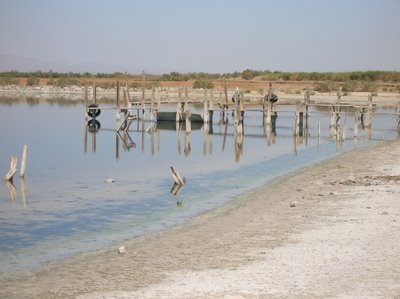
On Thursday, I visited the Salton Sea with a couple of local authorities and advocates for saving what remains of this vast inland body of water. The bad news for the Sea is that "saving" it is almost impossible. The plan to restore it costs upward of $50 billion, and there's just no money available that could ever meet the cost. The Salton has been our dumping ground for sewage and agricultural chemicals and pesticides since the turn of the last century; with the decision to divert vast quantities of local water to San Diego and central California, what little flow it still receives will be reduced almost entirely over the next 15 years. Because the Salton is an inland waterway dependent on ag off-flow, it can't replenish itself. The toxins build and build until the combination precipitates massive avian die-offs, made worse because the sea is also the only layover for migratory birds now that the Colorado Delta runs dry. (The United States utilizes almost all of the Colorado, and what little remains goes to Mexico for agriculture -- the great river of old is now a muddy brown trickle miles before its original delta begins.)
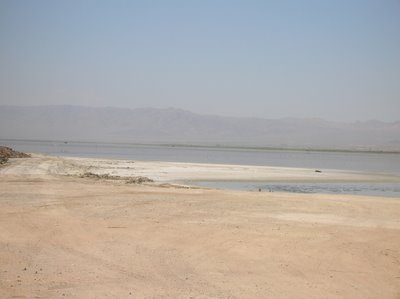
Out in the distance there? That dark spot? Yeah, that's a tire someone dumped. After careful scientific inquiry, I've concluded that there is no place on earth too ludicrous or remote that it can avoid becoming a tire dumping ground. Who the hell drives all the way out over a gravel berm in the middle of absolutely nowhere in 100+ degree heat to dump a tire by the seashore?
That white area used to be covered by the Sea, but because the body of water is so shallow, the smallest change reduces its total surface area dramatically. The 15 year water plan is meant to reduce its depth by about 10 feet, but this will actually move the water's edges about 1 mile away from where they currently lap the shores. The water is also going to become hypersaline as freshwater inflows disappear, meaning that it will become a super-salty body of water that works for some migratory birds...but not for all.
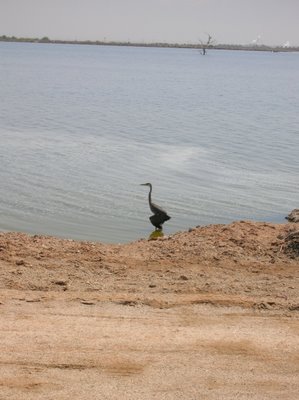
Blue herons should be okay, although this juvenile's wing indicates that he had an awful run-in with a boat (apparently it happens a lot) or a coyote. We called the refuge to see if they'd come pick it up, but who knows. The water is so shallow that he could run far from the shoreline if he decided that people were getting too close, so a rescue seems difficult.
The migratory birds are a huge issue, but the greater concern is over air quality. See that white stuff around the edges of the lake in the picture before the heron? That's a crust of chemicals, salt, and toxins left behind when the water level dropped. When you walk on it, the earth crunches like bubble wrap. It's extremely windy around Imperial Valley, and the constant breezes pick that stuff up and carry it over local communities and crops. Your California produce likely comes from the IV, and now some of it risks being dusted with a toxic powder every day. The air quality in the area is already some of the worst in the state (note how the sky isn't actually blue in this photo -- actually, the mountains are more visible here than they've been anywhere else I've driven). The "do nothing" scenario to "save" the Salton Sea still costs about $5 billion, largely because of mitigation measures required to reduce the risks from airbourne pollutants. Some people argue that it won't be that bad, but look at how quickly the earth blows away when we drive through it:
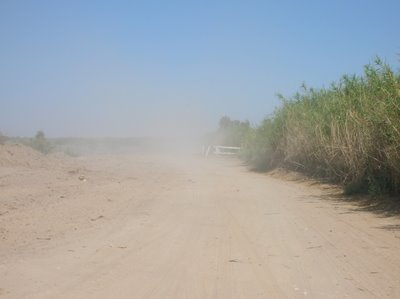
This is at least 30 seconds after the truck in front of us passed my Jeep. At first, you can't even open the car doors because the dust is so thick. Want to inhale these particles every day? Move to one of the towns downwind from the sea.
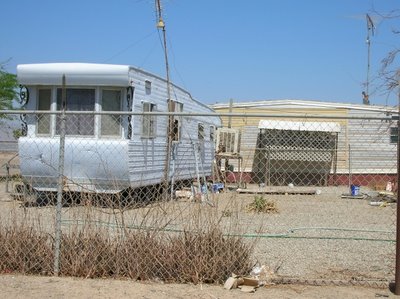
Perhaps a town like Bombay Beach, home to many ancient, dilapidated, rusting hulks like these. About 30 years ago, these towns were supposed to be the next big thing for retirement communities whose residents wanted year-round sun in the great outdoors. Then, the funding dried up, the sea grew more polluted, and people realized it wasn't such a great place to live after all. Still, die-hard residents hold out, peering from the doors of their sweltering metal boxes when newcomers roll down the streets.
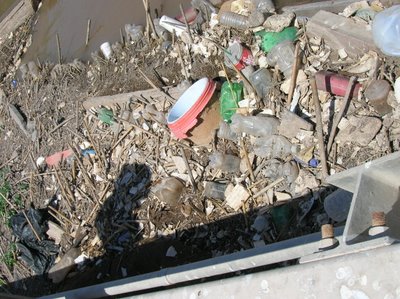
But hey, it could be worse. You could live along the banks of the Alamo River! The Alamo isn't as polluted as the New, but it receives a LOT of pesticides and pollution from the IV's farms...and its condition isn't being helped by the refuse dumped into it, all of which appears to have jammed up against this low-lying bridge next to the Salton Sea. Don't worry, there are tires here, too -- they're just out of my camera's lens.
The quality of the Alamo is further degraded by the dark lumpy blob underneath the shadow of the man standing on the bridge. I know you can't see it, but crushed against the bridge supports is a very dead, very much decaying horse. I tell you, I'm taking the complete olfactory tour of the Imperial Valley. Ridiculously briney, toxic-smelling Salton Sea? Check. Noxious New River? Check. Stomach-turning equine carcass? Oh yeah, baby. I don't really want to think about how long that horse had been there or what the hell had leached into the water from its remains, but one of my companions just about went out of his skull when he saw it. He's been working on water issues in the IV for years, and as he said, "You think you're worried about the sea? Who cares until we clean this shit up! This is absolutely inexcusable, to have this going on in the United States while we blame Mexico for what's going on." The Alamo does come into the US from Mexico, but it's so small at the international boundary that there's no way a fully grown dead horse could wash all the way up to the end of the river. This is godforsaken country...
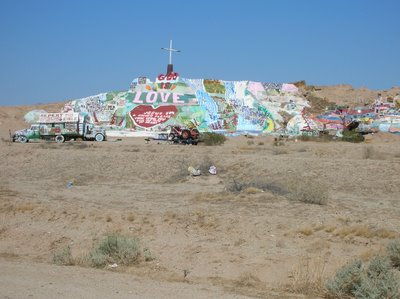
...except not for everyone. Meet Sacred Mountain, aka Salvation Mountain, located just outside the remarkably post-apocalyptic town of Niland, California, home of Deliverance's cousins. Niland, population 1200 or so, will forever exist in my memory as the place where I met a guy wearing pant fragments. He had on denium cutoffs that were split all the way to the waistband on both legs. This east-of-Salton style was accentuated by a stained, mussed t-shirt and a wild-eyed stare, accompanied by a litany of "God Bless you's" and rambling commentary only somewhat directed at me as I left the local convenience store ("Thank you very much, are you having a good day 'cause I'm having a good day you know you're just like the doctor what he ordered I mean God bless you, no God bless you...") This is after I spent 10 minutes inside the store having one of the strangest "conversations" of my life with the desk clerk and a wizened middle-aged man buying a 24-pack. Both of them materialized from the store's dark interior after I walked in and saw absolutely no one inside the shadowy cavern -- no lights, of course, because having lights on in the store would imply normalcy, and that's not the image the good people of Niland want to project. The conversation went something like this:
Me (to the Latino clerk): "Hola. Esto es todo."
Clerk: What?
Me: Sorry, I just want to buy this
Clerk: (silence)
Me: Um. Can I buy this?
Clerk: ...Do you speak English?
Me, backpedaling slowly and wondering if I can sprint out the door before he gets me: Um. Yep.
Clerk: Oh, I thought you were German or something.
Finally, we went over to the counter, where the beer-toting customer was waiting. He was a short Asian American man in worn jeans and a cowboy-style shirt, wearing a cowboy hat (of course).
Me: Go ahead.
Beer Guy: (silence, followed by suspicious staring in my direction)
Me: (confused silence)
Beer Guy: She can go first.
Beer Guy then directed all of his comments to the clerk, even though I was standing approximately 18 inches away.
Me: Hey, do you know where Sacred Mountain is?
Clerk: Sacred Mountain?
Me: Sacred Mountain.
Clerk: Sacred Mountain?
Me: (give up speaking. nod.)
Beer Guy: What's she looking for?
Clerk: Yeah, it's about two miles from here. Just take a right.
Me: Take a right? Where?
Beer Guy: Why would she want to go to Sacred Mountain?
Beer Guy is now looking at the clerk as though I am some sort of threatening alien life form sent to rob him of his alcohol. He also looks just scary enough for me to think I should leave and drive roughly 15 miles north to ask directions from the slightly less frightening trailer folk at Bombay Beach. At least there, most of them are old enough to outrun.
Clerk: Take a right.
Me: WHERE?!?
Beer Guy: What's she want?
Clerk: Anywhere.
I give up, snatch my stupid Gatorade off the counter -- which I only purchased to avoid being rude by asking for directions without buying anything -- and start to head out the door. Finally, Beer Guy turns and asks me why I don't know where the mountain is.
Me: Well, I just want to see it. I'm not from here. (winning smile)
Beer Guy: Oh. You aren't? (withering glare that sends smile to my toes)
I don't even bother with a response, instead electing to run for the door. Alas, as I reach the smeary glass door with its rusty iron bars, the spectre of Semi-Shredded Shorts Man looms on the other side...
So the deal with Salvation Mountain is laid out in a great book called Salt Dreams, which I highly recommend reading. It also goes into great detail about Slab City, the other Niland attraction and the only pseudo-town to rival Bombay Beach and Niland for the most authentic post-apocalyptic atmosphere. Slab City is basically a jumble of concrete and half-destroyed trailers now inhabited by anti-government anarchists and survivalists from the US and Canada. I really wanted to find it, but after the Niland Encounter I decided maybe I should wait until I owned a large, potentially rabid Doberman. The Niland Encounter wasn't finished, of course, because I still had to reach Salvation Mountain (sculpted and painted entirely by one man's hands -- and, of course, the man decided to use lead paint for most of his work). This entailed driving through one of Niland's main streets, where I saw a church which had what I almost swear was a beer keg on the front porch.
As soon as I got onto the street, the handful of people in it stopped and stared. Most of them were kids on bicycles, which meant that I now had to maneuver the car around a bunch of squinty-eyed children who were sitting in the middle of the goddamned road looking at my car like they'd never seen one in their lives and didn't know if they should worship it or kill it. Naturally, a whole flock of Niland residents started coming out of the shadows of their front porches and moving towards their fences (if they had fences), also staring at my car in some sort of trance-like state.
By this point, I was essentially ready to turn around and burn rubber all the way to Calexico. My gas gauge looked a little low, but I decided I'd rather brave the desert on foot than step outside my car again. Finally, I bumped over the train tracks and saw a scattering of trailers (and discarded tires!) in the distance...and a garish mound rising from the earth.
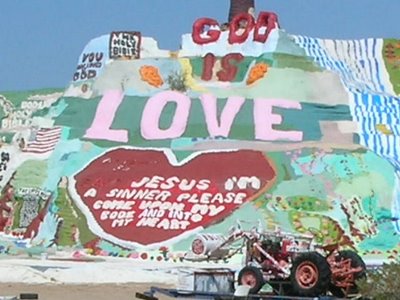
The guy who did this is supposed to be harmless, genuine, and interesting, but heads are peering from trailer interiors again and I decide I'm perfectly happy snapping a few pictures and getting the hell out of the area forever. The Jeep and I roared back over the train tracks, shot through town (more gaping kids on bikes) and straight back onto the highway.
I hope no one from Niland ever reads this, but if they do I just want to advise you that it might be wise to chain half the population up inside when strangers come through town, unless you really think that "Niland: Deliverance, but Warmer" is a good tourism slogan.
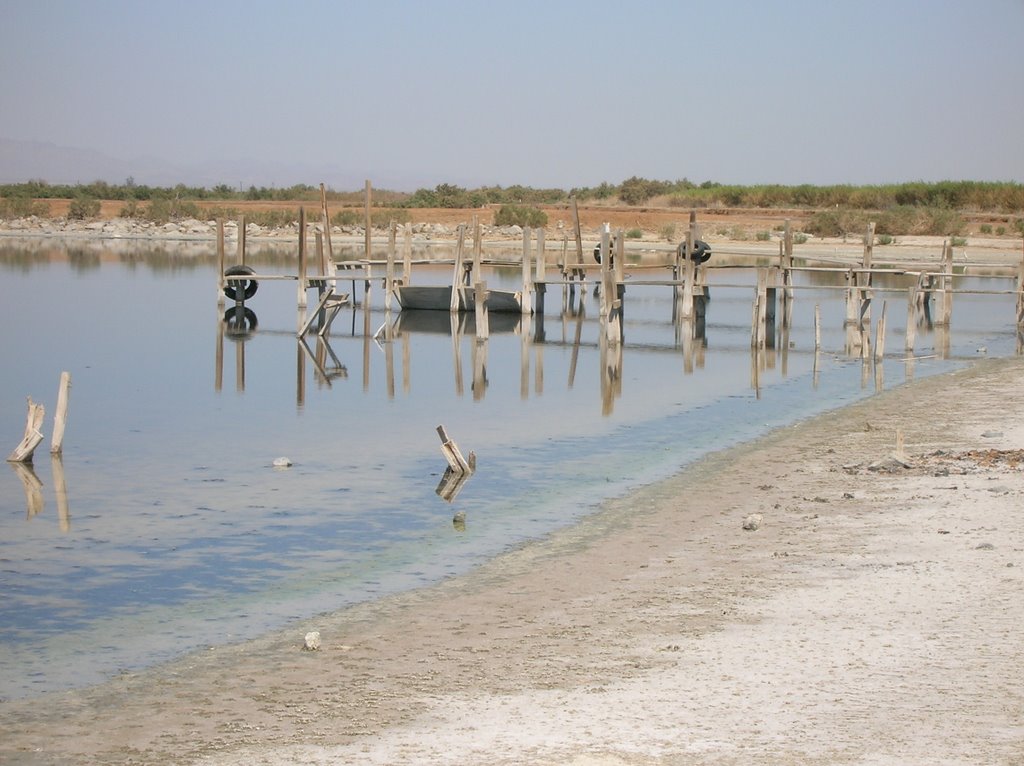
On Thursday, I visited the Salton Sea with a couple of local authorities and advocates for saving what remains of this vast inland body of water. The bad news for the Sea is that "saving" it is almost impossible. The plan to restore it costs upward of $50 billion, and there's just no money available that could ever meet the cost. The Salton has been our dumping ground for sewage and agricultural chemicals and pesticides since the turn of the last century; with the decision to divert vast quantities of local water to San Diego and central California, what little flow it still receives will be reduced almost entirely over the next 15 years. Because the Salton is an inland waterway dependent on ag off-flow, it can't replenish itself. The toxins build and build until the combination precipitates massive avian die-offs, made worse because the sea is also the only layover for migratory birds now that the Colorado Delta runs dry. (The United States utilizes almost all of the Colorado, and what little remains goes to Mexico for agriculture -- the great river of old is now a muddy brown trickle miles before its original delta begins.)
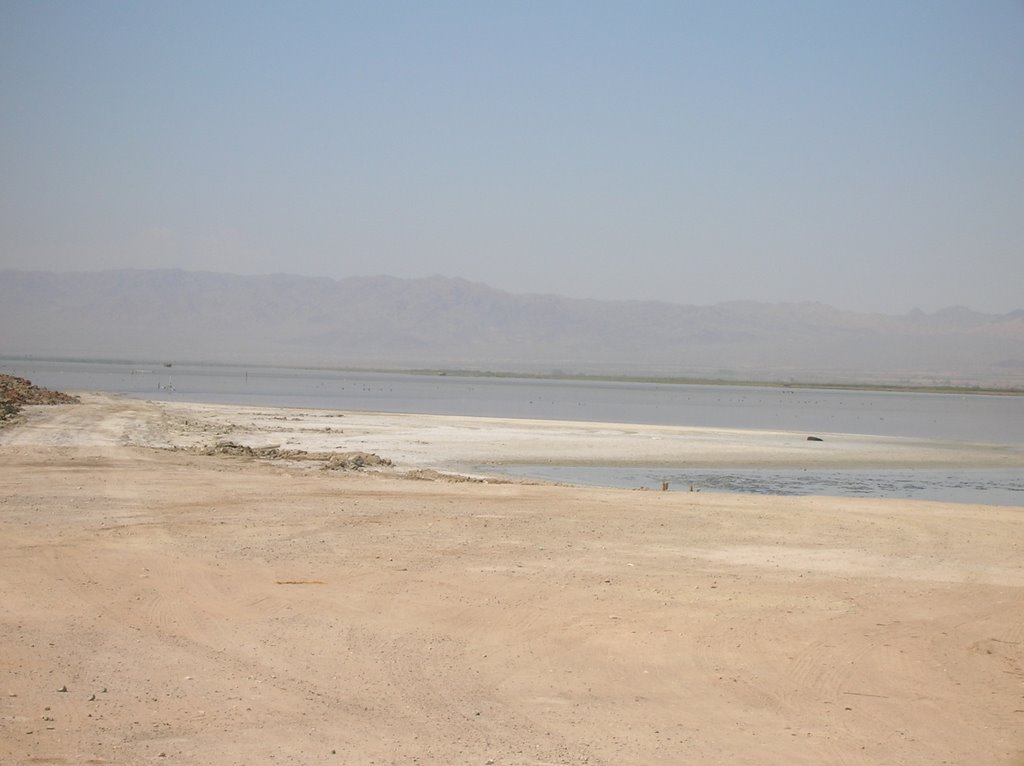
Out in the distance there? That dark spot? Yeah, that's a tire someone dumped. After careful scientific inquiry, I've concluded that there is no place on earth too ludicrous or remote that it can avoid becoming a tire dumping ground. Who the hell drives all the way out over a gravel berm in the middle of absolutely nowhere in 100+ degree heat to dump a tire by the seashore?
That white area used to be covered by the Sea, but because the body of water is so shallow, the smallest change reduces its total surface area dramatically. The 15 year water plan is meant to reduce its depth by about 10 feet, but this will actually move the water's edges about 1 mile away from where they currently lap the shores. The water is also going to become hypersaline as freshwater inflows disappear, meaning that it will become a super-salty body of water that works for some migratory birds...but not for all.

Blue herons should be okay, although this juvenile's wing indicates that he had an awful run-in with a boat (apparently it happens a lot) or a coyote. We called the refuge to see if they'd come pick it up, but who knows. The water is so shallow that he could run far from the shoreline if he decided that people were getting too close, so a rescue seems difficult.
The migratory birds are a huge issue, but the greater concern is over air quality. See that white stuff around the edges of the lake in the picture before the heron? That's a crust of chemicals, salt, and toxins left behind when the water level dropped. When you walk on it, the earth crunches like bubble wrap. It's extremely windy around Imperial Valley, and the constant breezes pick that stuff up and carry it over local communities and crops. Your California produce likely comes from the IV, and now some of it risks being dusted with a toxic powder every day. The air quality in the area is already some of the worst in the state (note how the sky isn't actually blue in this photo -- actually, the mountains are more visible here than they've been anywhere else I've driven). The "do nothing" scenario to "save" the Salton Sea still costs about $5 billion, largely because of mitigation measures required to reduce the risks from airbourne pollutants. Some people argue that it won't be that bad, but look at how quickly the earth blows away when we drive through it:
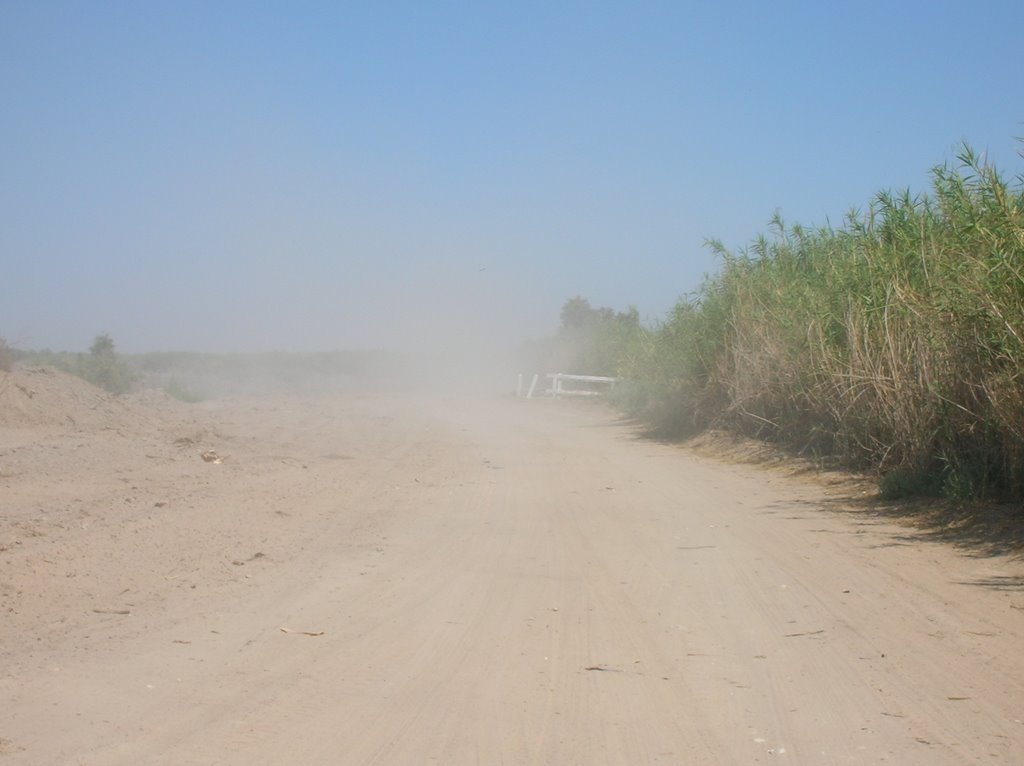
This is at least 30 seconds after the truck in front of us passed my Jeep. At first, you can't even open the car doors because the dust is so thick. Want to inhale these particles every day? Move to one of the towns downwind from the sea.

Perhaps a town like Bombay Beach, home to many ancient, dilapidated, rusting hulks like these. About 30 years ago, these towns were supposed to be the next big thing for retirement communities whose residents wanted year-round sun in the great outdoors. Then, the funding dried up, the sea grew more polluted, and people realized it wasn't such a great place to live after all. Still, die-hard residents hold out, peering from the doors of their sweltering metal boxes when newcomers roll down the streets.

But hey, it could be worse. You could live along the banks of the Alamo River! The Alamo isn't as polluted as the New, but it receives a LOT of pesticides and pollution from the IV's farms...and its condition isn't being helped by the refuse dumped into it, all of which appears to have jammed up against this low-lying bridge next to the Salton Sea. Don't worry, there are tires here, too -- they're just out of my camera's lens.
The quality of the Alamo is further degraded by the dark lumpy blob underneath the shadow of the man standing on the bridge. I know you can't see it, but crushed against the bridge supports is a very dead, very much decaying horse. I tell you, I'm taking the complete olfactory tour of the Imperial Valley. Ridiculously briney, toxic-smelling Salton Sea? Check. Noxious New River? Check. Stomach-turning equine carcass? Oh yeah, baby. I don't really want to think about how long that horse had been there or what the hell had leached into the water from its remains, but one of my companions just about went out of his skull when he saw it. He's been working on water issues in the IV for years, and as he said, "You think you're worried about the sea? Who cares until we clean this shit up! This is absolutely inexcusable, to have this going on in the United States while we blame Mexico for what's going on." The Alamo does come into the US from Mexico, but it's so small at the international boundary that there's no way a fully grown dead horse could wash all the way up to the end of the river. This is godforsaken country...

...except not for everyone. Meet Sacred Mountain, aka Salvation Mountain, located just outside the remarkably post-apocalyptic town of Niland, California, home of Deliverance's cousins. Niland, population 1200 or so, will forever exist in my memory as the place where I met a guy wearing pant fragments. He had on denium cutoffs that were split all the way to the waistband on both legs. This east-of-Salton style was accentuated by a stained, mussed t-shirt and a wild-eyed stare, accompanied by a litany of "God Bless you's" and rambling commentary only somewhat directed at me as I left the local convenience store ("Thank you very much, are you having a good day 'cause I'm having a good day you know you're just like the doctor what he ordered I mean God bless you, no God bless you...") This is after I spent 10 minutes inside the store having one of the strangest "conversations" of my life with the desk clerk and a wizened middle-aged man buying a 24-pack. Both of them materialized from the store's dark interior after I walked in and saw absolutely no one inside the shadowy cavern -- no lights, of course, because having lights on in the store would imply normalcy, and that's not the image the good people of Niland want to project. The conversation went something like this:
Me (to the Latino clerk): "Hola. Esto es todo."
Clerk: What?
Me: Sorry, I just want to buy this
Clerk: (silence)
Me: Um. Can I buy this?
Clerk: ...Do you speak English?
Me, backpedaling slowly and wondering if I can sprint out the door before he gets me: Um. Yep.
Clerk: Oh, I thought you were German or something.
Finally, we went over to the counter, where the beer-toting customer was waiting. He was a short Asian American man in worn jeans and a cowboy-style shirt, wearing a cowboy hat (of course).
Me: Go ahead.
Beer Guy: (silence, followed by suspicious staring in my direction)
Me: (confused silence)
Beer Guy: She can go first.
Beer Guy then directed all of his comments to the clerk, even though I was standing approximately 18 inches away.
Me: Hey, do you know where Sacred Mountain is?
Clerk: Sacred Mountain?
Me: Sacred Mountain.
Clerk: Sacred Mountain?
Me: (give up speaking. nod.)
Beer Guy: What's she looking for?
Clerk: Yeah, it's about two miles from here. Just take a right.
Me: Take a right? Where?
Beer Guy: Why would she want to go to Sacred Mountain?
Beer Guy is now looking at the clerk as though I am some sort of threatening alien life form sent to rob him of his alcohol. He also looks just scary enough for me to think I should leave and drive roughly 15 miles north to ask directions from the slightly less frightening trailer folk at Bombay Beach. At least there, most of them are old enough to outrun.
Clerk: Take a right.
Me: WHERE?!?
Beer Guy: What's she want?
Clerk: Anywhere.
I give up, snatch my stupid Gatorade off the counter -- which I only purchased to avoid being rude by asking for directions without buying anything -- and start to head out the door. Finally, Beer Guy turns and asks me why I don't know where the mountain is.
Me: Well, I just want to see it. I'm not from here. (winning smile)
Beer Guy: Oh. You aren't? (withering glare that sends smile to my toes)
I don't even bother with a response, instead electing to run for the door. Alas, as I reach the smeary glass door with its rusty iron bars, the spectre of Semi-Shredded Shorts Man looms on the other side...
So the deal with Salvation Mountain is laid out in a great book called Salt Dreams, which I highly recommend reading. It also goes into great detail about Slab City, the other Niland attraction and the only pseudo-town to rival Bombay Beach and Niland for the most authentic post-apocalyptic atmosphere. Slab City is basically a jumble of concrete and half-destroyed trailers now inhabited by anti-government anarchists and survivalists from the US and Canada. I really wanted to find it, but after the Niland Encounter I decided maybe I should wait until I owned a large, potentially rabid Doberman. The Niland Encounter wasn't finished, of course, because I still had to reach Salvation Mountain (sculpted and painted entirely by one man's hands -- and, of course, the man decided to use lead paint for most of his work). This entailed driving through one of Niland's main streets, where I saw a church which had what I almost swear was a beer keg on the front porch.
As soon as I got onto the street, the handful of people in it stopped and stared. Most of them were kids on bicycles, which meant that I now had to maneuver the car around a bunch of squinty-eyed children who were sitting in the middle of the goddamned road looking at my car like they'd never seen one in their lives and didn't know if they should worship it or kill it. Naturally, a whole flock of Niland residents started coming out of the shadows of their front porches and moving towards their fences (if they had fences), also staring at my car in some sort of trance-like state.
By this point, I was essentially ready to turn around and burn rubber all the way to Calexico. My gas gauge looked a little low, but I decided I'd rather brave the desert on foot than step outside my car again. Finally, I bumped over the train tracks and saw a scattering of trailers (and discarded tires!) in the distance...and a garish mound rising from the earth.
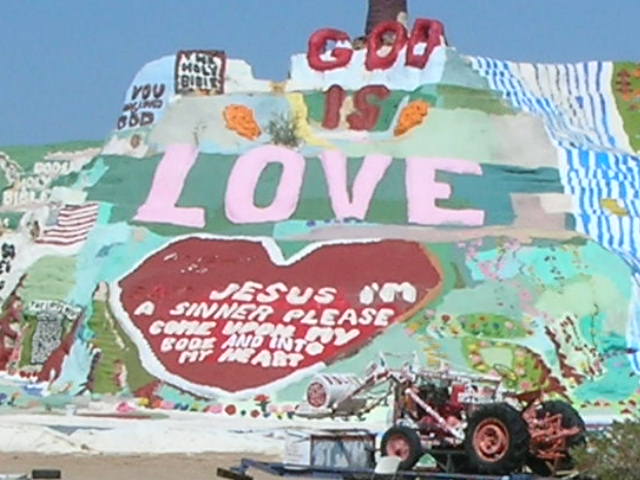
The guy who did this is supposed to be harmless, genuine, and interesting, but heads are peering from trailer interiors again and I decide I'm perfectly happy snapping a few pictures and getting the hell out of the area forever. The Jeep and I roared back over the train tracks, shot through town (more gaping kids on bikes) and straight back onto the highway.
I hope no one from Niland ever reads this, but if they do I just want to advise you that it might be wise to chain half the population up inside when strangers come through town, unless you really think that "Niland: Deliverance, but Warmer" is a good tourism slogan.
Friday, May 19, 2006
Sweating it up in low-down California
Yesterday, I drank two liters of water and didn't use the bathroom once. This concerned me until I found out today that yesterday's high was 109 degrees. Considering that I spent about four hours of that tramping around outside, I think my camel-like consumption was probably a good thing.
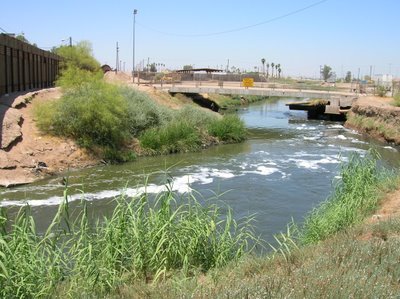
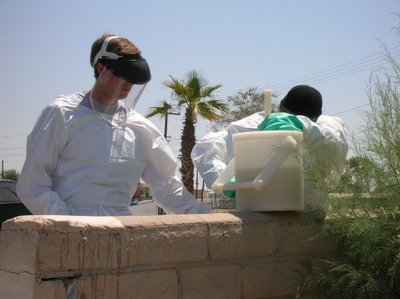
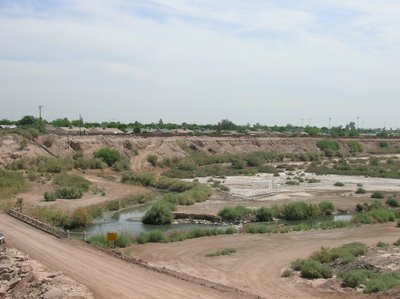
Welcome to Imperial County, California, the poorest, hottest, heaviest water-consuming county in the state. I've been here for a week and will be in town for one more, studying the New River, which has earned the dubious distinction of being the dirtiest river in the United States (some also say it's the dirtiest in North America, but the jury has yet to reach a verdict). Those are phosphates flowing across the international boundary with Mexico, which is just to the left of my photo. In Mexico, it's still acceptable to use phosphates in detergent and other products, which wouldn't actually be a huge deal...except that the toxicity of the river means the foam has come into contact with all sorts of nasty viruses, fecal coliform, VOCs (volatile organic compounds) and chemicals...which still wouldn't be too much of a problem, except that it's windy here in the IC, and the foam tends to blow across the street into the parking lot of the adjacent grocery store. When the foam blobs are house-sized and blat onto produce stands by the front door, people tend to get upset.
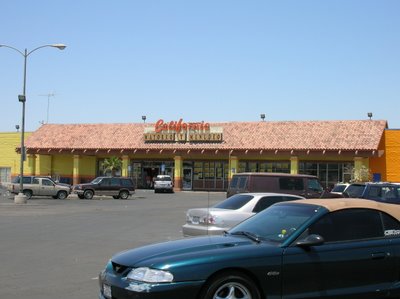
This is the grocery store with the foam blat problem. I'm incredibly disappointed that I haven't seen any house-sized blobs yet, but I don't really want to stick around until one rolls across the pavement, since the summertime highs here get into the 120-range. What have I seen in the river? Well...
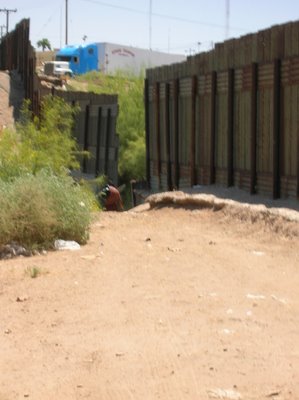
It's a terrible shot, but I was in a sprint to snap the photo before he disappeared back across the border. There was a film crew in town from PBS in LA, and I joined them to listen in as they shot a documentary on the pollution situation here. Apparently, as we worked near the border, we flushed a migrant who'd been hiding in the bushes next to the river. He trudged out slowly, clad only in a pair of maroon shorts, holding a black plastic garbage bag filled with belongings. None of us even noticed him until one of the local water experts, Jose, said, "Hey, look what we found!" Most of Calexico, the town where I'm staying, is Latino; the majority are recent immigrants from Mexicali, Guadalajara, or further south -- but they have ambivalent feelings about the influx of illegal immigrants who cross the New River every night. Anyway, Jose told me to go take a picture, so I started towards him, which is when he started running. Before we knew it, he'd splashed straight into the river and waded back into Mexico. See, the river is so toxic that the Border Patrol won't go in after you, so it's a popular aquatic highway for migrants to use. I've been bugging the patrol all week to let me ride along and watch people cross, but I think I'm just going to drive down to the bridge myself and sit there for a couple of hours tomorrow night.
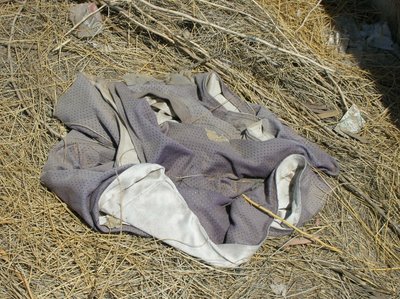
The banks of the river are lined with discarded clothing, underwear, plastic bags and garbage. The Border Patrol estimates that 40 - 60 people cross here each night, with a peak of 100 - 150 during the cooler season. Right now, it's getting brutal outside during the day (although people here think it's pretty cool, all things considered). It won't be long before the weather takes its toll on people crossing; each year, several dozen immigrants die in the deserts. I've driven within walking distance of places where it's happened.
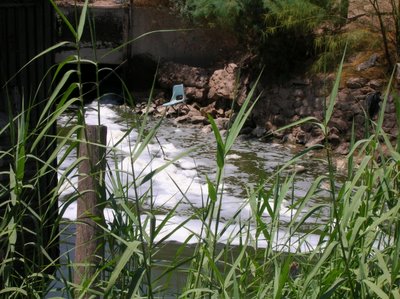
This is the international boundary. The area where the foam originates is actually not the New River -- it's an outlet for a lot of the wastewater from Mexicali. Right now, they're completing a wastewater treatment plant with help from BECC and NADBank, two environmental development agencies created by side agreements in NAFTA. Once that goes online at the end of the year, pollution should decline to a level where it will be easier to confront on the US side. Everyone here talks about Mexican sewage, but it's easy to forget that an equal number of problems originate in the US. The IC is the heart of agriculture country -- and where there's ag land, there are pesticides by the ton. I've driven past fields of melons, onions, sawgrass, sugar beets, oranges, lettuce...you name it, it's grown here. You buy it? It probably came from here, too. On every field, I've seen men clad in heavy gloves and protective clothing, spraying a brightly colored assortment of liquids onto the food. Between that and the endless feedlots with thousands upon thousands of cattle, it's enough to make me swear off eating for life.
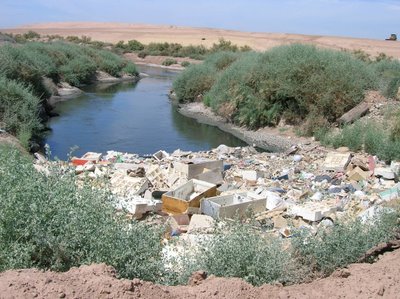
The chemicals and sewage are problematic, but dumping is another problem. The PBS crew filmed in Mexicali on Wednesday and saw huge trucks pumping gallons of murky brown substances into the water...but this shot is from Calexico, and there's a river under all that crap that flows north to the Salton Sea. Everyone treats this river like an open sewer, a place to get rid of all the refuse you don't want anymore. They've put up fences to block dumpers from throwing their refrigerators into the river, but so far it seems like people just peel back the chain link and drive right up to the shore. Or, they go around the fence. IC has unique attitudes about the environment that are too complex to parse out here without a lot of writing. Long story short, the Imperial Valley has long had access to the cheapest water in the world, thanks to its reliance on Colorado River water. I think the IV uses something like 75% of the water allocated to California, and it's all for 500,000 acres of farmland. With increasing demand for water in urban areas like San Diego and Los Angeles, pressure's on for the state to pay farmers not to farm, diverting water to the cities. See, Cali's exceeded its share of the Colorado by an incredible amount, and now the other basin states are forcing it to stick to its original allocation. This means that people here are feeling incredibly defensive about their water. The county may be poor, but some people are very, very rich, and they're used to the environment doing whatever they want it to do. The population is growing, the water is diminishing...the area is a powder keg in many ways, and dumping is only one indication of the work that needs to be done to teach residents that there's just nothing left to abuse anymore.
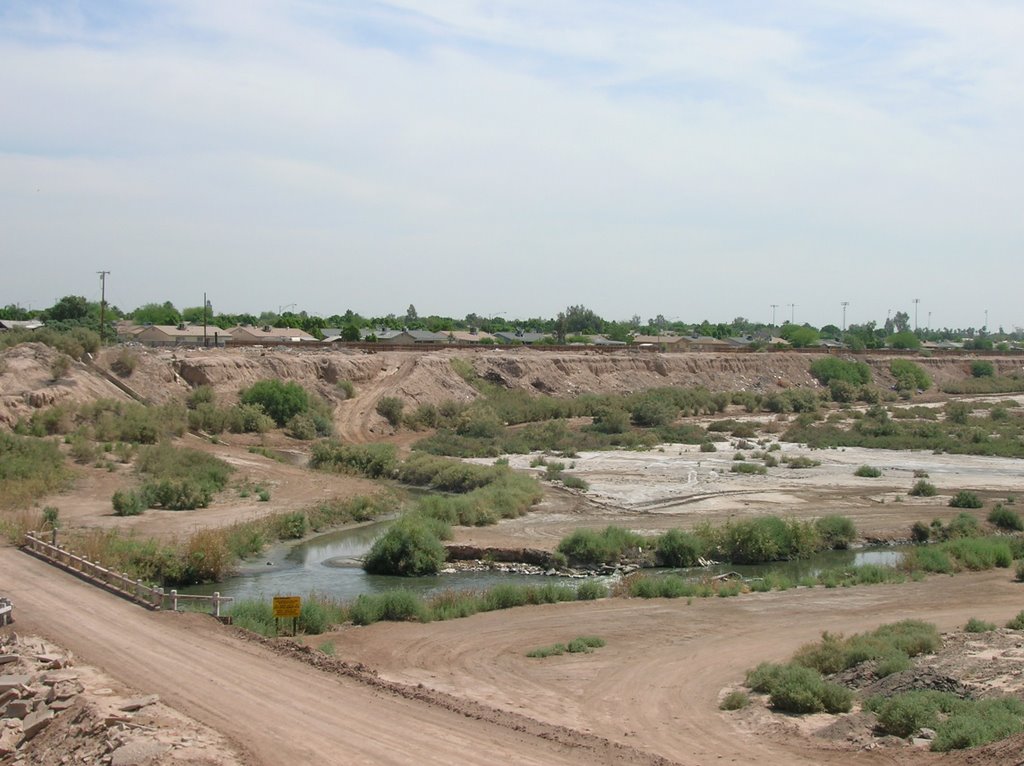
Alas, what you can't experience through these photos is the smell of the New River. It's a legendary odor, cited for decades by Calexico developers who blame it for their stagnant growth. I have a terrible sense of smell, but even I grew a little ill when I spent an afternoon touring sites around Calexico (in sandals, because I am stupid -- I'm sure my feet classify as a Superfund site now). I couldn't get the smell out of my clothes, my skin, my nose for two days. It's a combination of tar, garbage, sewage, decay and chemicals that scorches the back of your nasal passages. It takes your breath away, but you can't hold it long enough to avoid getting a whiff. In the stifling late spring heat, when the wind blows the right way, it's enough to make you feel light-headed within minutes. There are people who live within 200 feet of the river. When they go on vacation, they literally seal off their houses: tape the windows, block the doors. It doesn't work. Upon their return, the houses reek of the river, and there's nothing they can do about the odor once it gets inside. Maybe that's why there are so many household items in the makeshift dumps...
The up-side to all of this? I'm learning a ton, perversely enjoying the experience....and I get to offroad all the time. I had no idea that driving a 4x4 around a bunch of sandy, rutted "roads" and spinning out in the dirt could be so damned fun. After a few days, I'm now on a mission to see how filthy the exterior of a rental Jeep can become. So far, I'm doing pretty well. People here have gone from giving my car a double-take because it's new (trust me, I wanted an old one) to looking twice because I'm pretty sure it resembles a ball of dirt on wheels. I'll get a photo before I'm forced to wash the windshield, which has so many bug splatters on it that I'm having trouble seeing at dusk.
I've also been forced to use my Spanish like never before, and it's been great. I went to Calexico's sister city of Mexicali (Baja California, Mexico) last night and managed to carry on a very long conversation with Jose and his friend without completely embarrassing myself. Speaking Spanish is important here: as a white person, I already stand out in a fairly negative way. If I can speak both languages, I've been told, it lets people know that I'm "not a racist." It's always awkward deciding which language I should use when I have to initiate a conversation -- I don't want to offend anyone by assuming they don't speak English, but at the same time I don't want them to feel like they have to speak English because there's another dumb gringa who just wandered into the local store. So far, I've managed to get by without too many problems...except for that first afternoon, when I ordered bread and wound up eating something that was either pumpkin or dead animal. I'm still not sure.
There's so, so much to write. I saw colonias in Mexicali, the makeshift shantytowns on the edges of the maquiladoras, and I want to describe them because I think it helps people understand why water quality really isn't a top priority there right now. I want to write about how this region feels like a country unto itself, somehow both American and Mexican, completely amazing and entirely integrated. I want to write about the Salton Sea and its slow, painful demise; about the efforts people are making to save what they can; about Niland, California, which you sort of have to see to believe (let's just say Deliverance, but tanner). So I promise to write more this weekend, in between study breaks. Tomorrow night, I'm off to the 15th annual Mariachi sin Fronteras (Mariachi without borders) festival in Calexico. I have no idea what to expect, but apparently it's a gigantic event that draws people from all over the region. Full report coming soon.

Welcome to Imperial County, California, the poorest, hottest, heaviest water-consuming county in the state. I've been here for a week and will be in town for one more, studying the New River, which has earned the dubious distinction of being the dirtiest river in the United States (some also say it's the dirtiest in North America, but the jury has yet to reach a verdict). Those are phosphates flowing across the international boundary with Mexico, which is just to the left of my photo. In Mexico, it's still acceptable to use phosphates in detergent and other products, which wouldn't actually be a huge deal...except that the toxicity of the river means the foam has come into contact with all sorts of nasty viruses, fecal coliform, VOCs (volatile organic compounds) and chemicals...which still wouldn't be too much of a problem, except that it's windy here in the IC, and the foam tends to blow across the street into the parking lot of the adjacent grocery store. When the foam blobs are house-sized and blat onto produce stands by the front door, people tend to get upset.
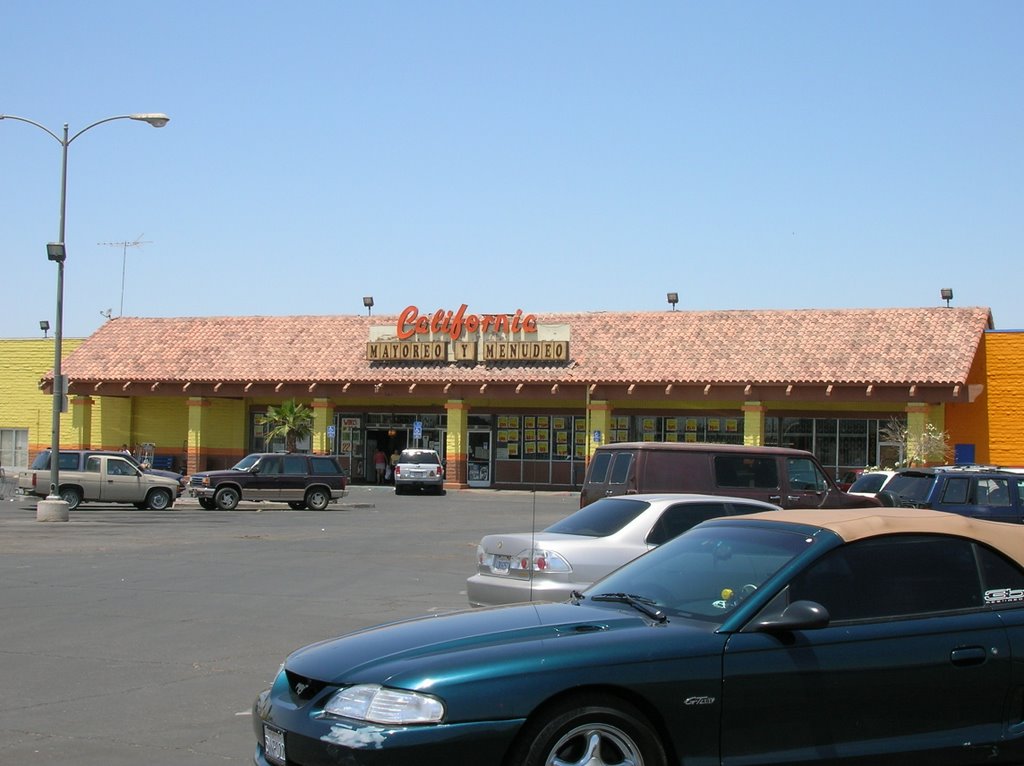
This is the grocery store with the foam blat problem. I'm incredibly disappointed that I haven't seen any house-sized blobs yet, but I don't really want to stick around until one rolls across the pavement, since the summertime highs here get into the 120-range. What have I seen in the river? Well...
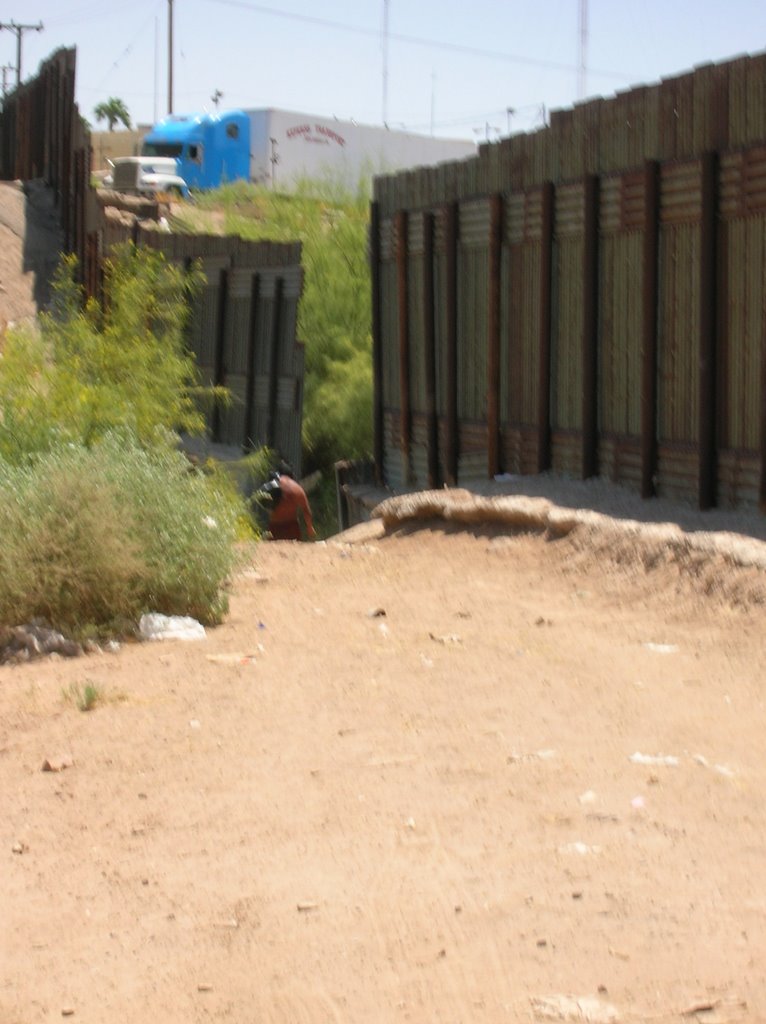
It's a terrible shot, but I was in a sprint to snap the photo before he disappeared back across the border. There was a film crew in town from PBS in LA, and I joined them to listen in as they shot a documentary on the pollution situation here. Apparently, as we worked near the border, we flushed a migrant who'd been hiding in the bushes next to the river. He trudged out slowly, clad only in a pair of maroon shorts, holding a black plastic garbage bag filled with belongings. None of us even noticed him until one of the local water experts, Jose, said, "Hey, look what we found!" Most of Calexico, the town where I'm staying, is Latino; the majority are recent immigrants from Mexicali, Guadalajara, or further south -- but they have ambivalent feelings about the influx of illegal immigrants who cross the New River every night. Anyway, Jose told me to go take a picture, so I started towards him, which is when he started running. Before we knew it, he'd splashed straight into the river and waded back into Mexico. See, the river is so toxic that the Border Patrol won't go in after you, so it's a popular aquatic highway for migrants to use. I've been bugging the patrol all week to let me ride along and watch people cross, but I think I'm just going to drive down to the bridge myself and sit there for a couple of hours tomorrow night.

The banks of the river are lined with discarded clothing, underwear, plastic bags and garbage. The Border Patrol estimates that 40 - 60 people cross here each night, with a peak of 100 - 150 during the cooler season. Right now, it's getting brutal outside during the day (although people here think it's pretty cool, all things considered). It won't be long before the weather takes its toll on people crossing; each year, several dozen immigrants die in the deserts. I've driven within walking distance of places where it's happened.
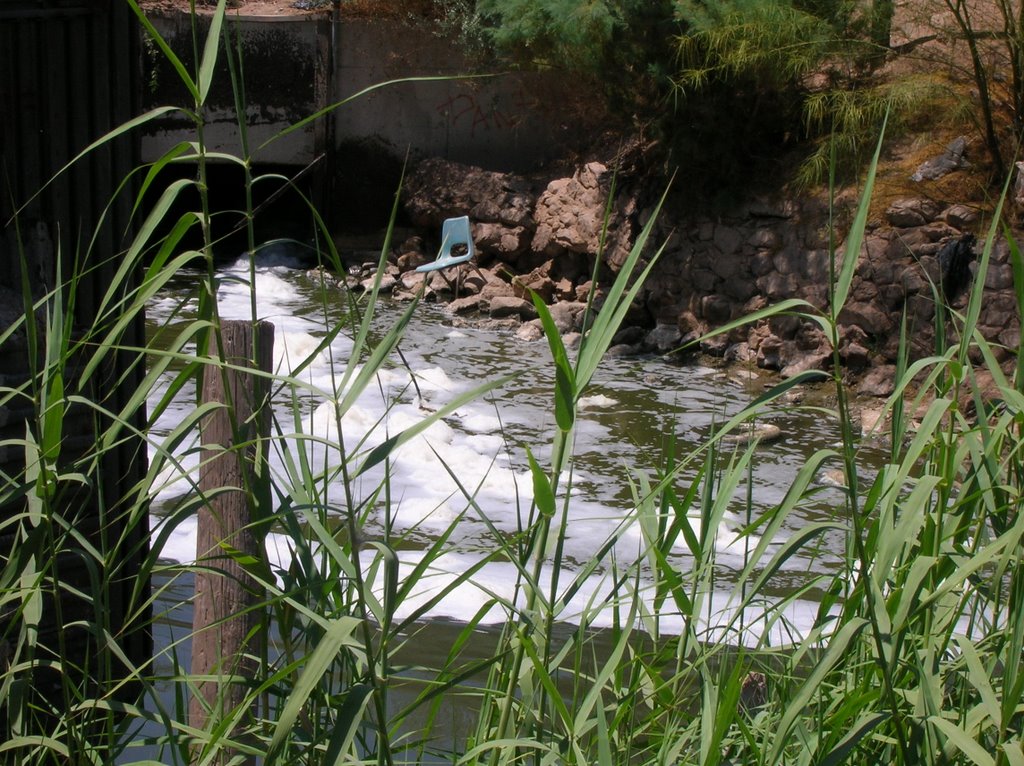
This is the international boundary. The area where the foam originates is actually not the New River -- it's an outlet for a lot of the wastewater from Mexicali. Right now, they're completing a wastewater treatment plant with help from BECC and NADBank, two environmental development agencies created by side agreements in NAFTA. Once that goes online at the end of the year, pollution should decline to a level where it will be easier to confront on the US side. Everyone here talks about Mexican sewage, but it's easy to forget that an equal number of problems originate in the US. The IC is the heart of agriculture country -- and where there's ag land, there are pesticides by the ton. I've driven past fields of melons, onions, sawgrass, sugar beets, oranges, lettuce...you name it, it's grown here. You buy it? It probably came from here, too. On every field, I've seen men clad in heavy gloves and protective clothing, spraying a brightly colored assortment of liquids onto the food. Between that and the endless feedlots with thousands upon thousands of cattle, it's enough to make me swear off eating for life.
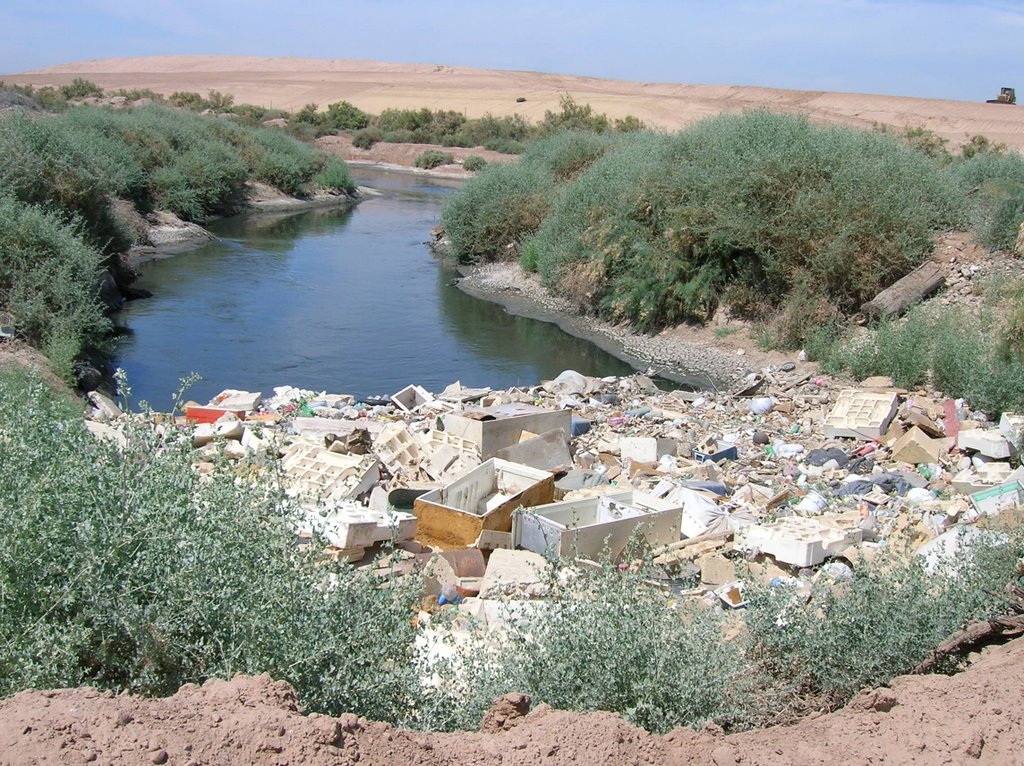
The chemicals and sewage are problematic, but dumping is another problem. The PBS crew filmed in Mexicali on Wednesday and saw huge trucks pumping gallons of murky brown substances into the water...but this shot is from Calexico, and there's a river under all that crap that flows north to the Salton Sea. Everyone treats this river like an open sewer, a place to get rid of all the refuse you don't want anymore. They've put up fences to block dumpers from throwing their refrigerators into the river, but so far it seems like people just peel back the chain link and drive right up to the shore. Or, they go around the fence. IC has unique attitudes about the environment that are too complex to parse out here without a lot of writing. Long story short, the Imperial Valley has long had access to the cheapest water in the world, thanks to its reliance on Colorado River water. I think the IV uses something like 75% of the water allocated to California, and it's all for 500,000 acres of farmland. With increasing demand for water in urban areas like San Diego and Los Angeles, pressure's on for the state to pay farmers not to farm, diverting water to the cities. See, Cali's exceeded its share of the Colorado by an incredible amount, and now the other basin states are forcing it to stick to its original allocation. This means that people here are feeling incredibly defensive about their water. The county may be poor, but some people are very, very rich, and they're used to the environment doing whatever they want it to do. The population is growing, the water is diminishing...the area is a powder keg in many ways, and dumping is only one indication of the work that needs to be done to teach residents that there's just nothing left to abuse anymore.
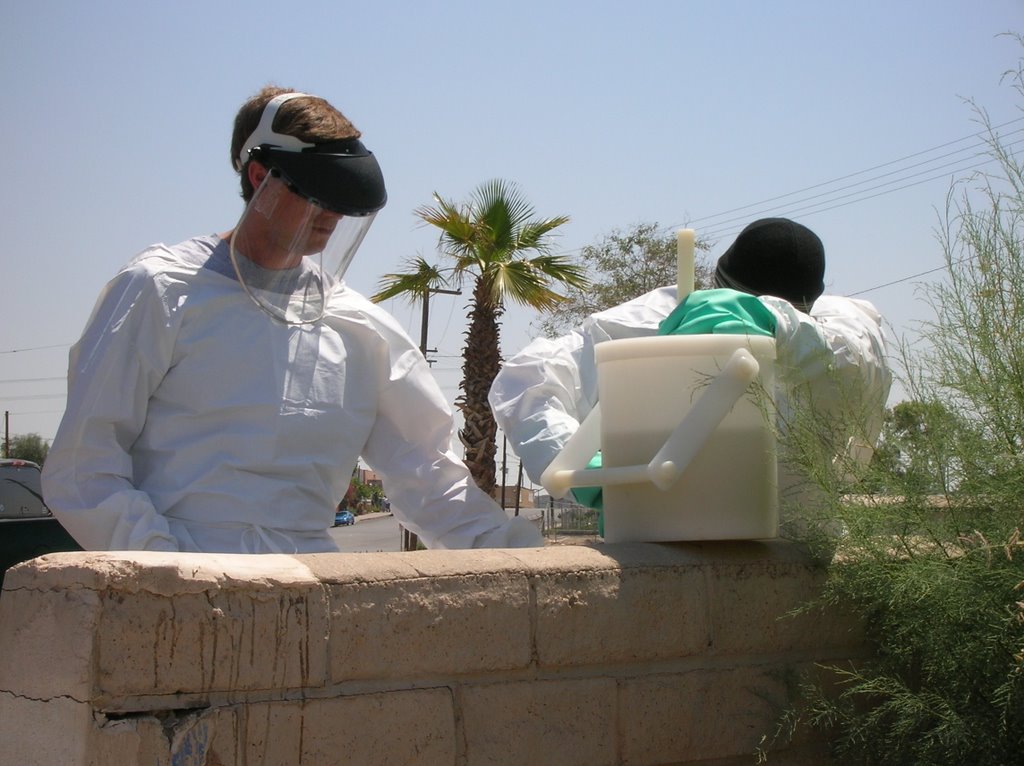
Alas, what you can't experience through these photos is the smell of the New River. It's a legendary odor, cited for decades by Calexico developers who blame it for their stagnant growth. I have a terrible sense of smell, but even I grew a little ill when I spent an afternoon touring sites around Calexico (in sandals, because I am stupid -- I'm sure my feet classify as a Superfund site now). I couldn't get the smell out of my clothes, my skin, my nose for two days. It's a combination of tar, garbage, sewage, decay and chemicals that scorches the back of your nasal passages. It takes your breath away, but you can't hold it long enough to avoid getting a whiff. In the stifling late spring heat, when the wind blows the right way, it's enough to make you feel light-headed within minutes. There are people who live within 200 feet of the river. When they go on vacation, they literally seal off their houses: tape the windows, block the doors. It doesn't work. Upon their return, the houses reek of the river, and there's nothing they can do about the odor once it gets inside. Maybe that's why there are so many household items in the makeshift dumps...
The up-side to all of this? I'm learning a ton, perversely enjoying the experience....and I get to offroad all the time. I had no idea that driving a 4x4 around a bunch of sandy, rutted "roads" and spinning out in the dirt could be so damned fun. After a few days, I'm now on a mission to see how filthy the exterior of a rental Jeep can become. So far, I'm doing pretty well. People here have gone from giving my car a double-take because it's new (trust me, I wanted an old one) to looking twice because I'm pretty sure it resembles a ball of dirt on wheels. I'll get a photo before I'm forced to wash the windshield, which has so many bug splatters on it that I'm having trouble seeing at dusk.
I've also been forced to use my Spanish like never before, and it's been great. I went to Calexico's sister city of Mexicali (Baja California, Mexico) last night and managed to carry on a very long conversation with Jose and his friend without completely embarrassing myself. Speaking Spanish is important here: as a white person, I already stand out in a fairly negative way. If I can speak both languages, I've been told, it lets people know that I'm "not a racist." It's always awkward deciding which language I should use when I have to initiate a conversation -- I don't want to offend anyone by assuming they don't speak English, but at the same time I don't want them to feel like they have to speak English because there's another dumb gringa who just wandered into the local store. So far, I've managed to get by without too many problems...except for that first afternoon, when I ordered bread and wound up eating something that was either pumpkin or dead animal. I'm still not sure.
There's so, so much to write. I saw colonias in Mexicali, the makeshift shantytowns on the edges of the maquiladoras, and I want to describe them because I think it helps people understand why water quality really isn't a top priority there right now. I want to write about how this region feels like a country unto itself, somehow both American and Mexican, completely amazing and entirely integrated. I want to write about the Salton Sea and its slow, painful demise; about the efforts people are making to save what they can; about Niland, California, which you sort of have to see to believe (let's just say Deliverance, but tanner). So I promise to write more this weekend, in between study breaks. Tomorrow night, I'm off to the 15th annual Mariachi sin Fronteras (Mariachi without borders) festival in Calexico. I have no idea what to expect, but apparently it's a gigantic event that draws people from all over the region. Full report coming soon.
Thursday, May 11, 2006
Warming up
It's 7am and already 70 degrees where I'm headed on Saturday.
Doing research in your own country: $4000. Having your shoes stick to the asphalt in May? Priceless.
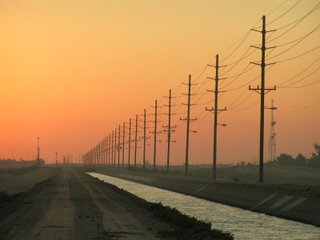
Sure, it looks pretty. This is the calm before the 100+ degree storm. It's supposed to reach 104 degrees today and stay around 100 the rest of the week. So much for the 93 degree average in May.
A population of 30,000 a downtown boasting little more than a McDonalds and a WalMart, and more people passing through the border each day than live in the town. Yippee.
Doing research in your own country: $4000. Having your shoes stick to the asphalt in May? Priceless.

Sure, it looks pretty. This is the calm before the 100+ degree storm. It's supposed to reach 104 degrees today and stay around 100 the rest of the week. So much for the 93 degree average in May.
A population of 30,000 a downtown boasting little more than a McDonalds and a WalMart, and more people passing through the border each day than live in the town. Yippee.
Monday, April 17, 2006
T-Minus 10 Days
To-do list:
1. Rent hotel. Preferably other than the "Don Juan Motel," which apart from its name has the utter misfortune to be located within smelling distance of the most polluted river in North America.
2. Discover destination is so overlooked that both Travelocity and Hotwire do not list it. Learn that none of the hotels are online. Reconsider Don Juan. Reconsider olfactory-offending river. Stop considering Don Juan.
3. Rent car. Look at rental car company reviews online and discard every affordable option because reviews of budget companies run the gamut from, "Threatened to sue me!" to "Car broke down in the middle of a swamp," to "Broke my knees when I returned the car with a scratch it already had." Wonder if highly overpriced but well-reviewed rental company will be angry if one takes a small compact offroading in the desert.
4. Write interview questions. Mentally lobotomize self for failing to read literature before choosing case study, thereby requiring sprain-inducing mental gymnastics to make questions fit newly discovered, completely inappropriate gaps in aforementioned literature. Silently curse prospective interviewees for wanting to know what I'd like to learn before I've figured it out.
5. Buy tape recorder that can survive 100+ degree heat, caustic chemicals in river, and blows from rocks I throw when batteries die in the middle of a key interview.
6. Figure out if there's a bug spray on this planet that protects the wearer from disease-ravaged, encephalitis-carrying, rabid mosquitoes without causing the wearer's skin to turn interesting shades of gray.
7. Purchase pay-as-you-go cell phone for communication needs when car overheats, mosquitoes corner in alley, desert roads begin looking identical, etc. Delight in words of wisdom from sage ex-San Diego resident who says that reception in destination area can be "patchy."
8. Commiserate with fellow program sufferer, soon to depart for Mozambique. Feel slightly better that land mines and crocodiles are not on my risk assessment form.
9. Contact potential interviewees to schedule meetings. Hear nothing. Wonder in mild state of panic if it is possible to spend two weeks in the field and obtain no results.
10. Check weather forecast and climate history for destination. Purchase SPF-50 sunblock and curl up in small corner of bedroom.
11. Realize that only choice of supermarkets in area is limited to a Walmart and a local store noted in many documents for the large, bacteria-laden foam blobs from river that blat onto produce during breezy days. Consider adopting a no-food diet for duration of trip. Choose foam blats and voluntary abstention from produce over manic smiley-faced spawn of Satan.
12. Contemplate chucking degree and moving to Croatia to work in national park chasing bears away from tourists.
1. Rent hotel. Preferably other than the "Don Juan Motel," which apart from its name has the utter misfortune to be located within smelling distance of the most polluted river in North America.
2. Discover destination is so overlooked that both Travelocity and Hotwire do not list it. Learn that none of the hotels are online. Reconsider Don Juan. Reconsider olfactory-offending river. Stop considering Don Juan.
3. Rent car. Look at rental car company reviews online and discard every affordable option because reviews of budget companies run the gamut from, "Threatened to sue me!" to "Car broke down in the middle of a swamp," to "Broke my knees when I returned the car with a scratch it already had." Wonder if highly overpriced but well-reviewed rental company will be angry if one takes a small compact offroading in the desert.
4. Write interview questions. Mentally lobotomize self for failing to read literature before choosing case study, thereby requiring sprain-inducing mental gymnastics to make questions fit newly discovered, completely inappropriate gaps in aforementioned literature. Silently curse prospective interviewees for wanting to know what I'd like to learn before I've figured it out.
5. Buy tape recorder that can survive 100+ degree heat, caustic chemicals in river, and blows from rocks I throw when batteries die in the middle of a key interview.
6. Figure out if there's a bug spray on this planet that protects the wearer from disease-ravaged, encephalitis-carrying, rabid mosquitoes without causing the wearer's skin to turn interesting shades of gray.
7. Purchase pay-as-you-go cell phone for communication needs when car overheats, mosquitoes corner in alley, desert roads begin looking identical, etc. Delight in words of wisdom from sage ex-San Diego resident who says that reception in destination area can be "patchy."
8. Commiserate with fellow program sufferer, soon to depart for Mozambique. Feel slightly better that land mines and crocodiles are not on my risk assessment form.
9. Contact potential interviewees to schedule meetings. Hear nothing. Wonder in mild state of panic if it is possible to spend two weeks in the field and obtain no results.
10. Check weather forecast and climate history for destination. Purchase SPF-50 sunblock and curl up in small corner of bedroom.
11. Realize that only choice of supermarkets in area is limited to a Walmart and a local store noted in many documents for the large, bacteria-laden foam blobs from river that blat onto produce during breezy days. Consider adopting a no-food diet for duration of trip. Choose foam blats and voluntary abstention from produce over manic smiley-faced spawn of Satan.
12. Contemplate chucking degree and moving to Croatia to work in national park chasing bears away from tourists.
Thursday, April 13, 2006
Wrapping up Dublin
Ugh, this is going to be one of those weeks where on every night, around 11pm, I'm going to sit down and think, "Damn it, I didn't write my Dublin blog again! Well, tomorrow I'm writing it!" Then, the next night, around 11pm, I will think, "Damn it..."
I leave in two weeks for fieldwork, and consequently everything's a bit of a madhouse right now. However, I finally received the two pictures of the Liberties (the Dublin neighborhood through which I wandered), about a week after I emailed them to myself from my phone. Not so swift, this technology. Their arrival makes me feel like I'd better write this stuff down now, so here it goes.
After two days in Dublin, I needed a change. In my notes, I scribbled: "Without meaning to, I find myself tiring of my travel companions. I long to slip away and find some corner bar where I can sit, silent, anonymous, soaking up the surroundings." Instead, we toured the Guinness factory, which was fun, but the walk back became more interesting. We took a detour to reach a restaurant on the other side of town, and in doing so we wound up in a "rough" neighborhood. My Brit friend grew uneasy. She's cautious to the point of paranoia about being English in Dublin, even when I'm fairly convinced that they couldn't tell by sight (most of her family's Irish anyway). She wouldn't let me stop to photograph the banner celebrating Sinn Fein's 100th anniversary, even though I'm pretty sure any local members would be moderately flattered by the fact that a tourist knew what SF was. I was more interested in the picture's ironic value: their headquarters was located next to a large pile of rubble that presumably had been a building. Rather than alluding to its dark past, to me it indicated something about where SF has put itself: it's teetering on the edge of oblivion, and no one in Dublin seems to care.
Getting back to the point, once we left the factory, there was a distinct change in the environment. The streets suddenly grew very quiet, without the traffic noise, shops and bustling pedestrians of the city center. (Oh lord, I almost wrote "centre.") Across the street, kids played on a discarded mattress in a bare asphalt parking lot ringed by chain link. Others in school uniforms were kicking a dirty soccerball between compact cars on a dead-end street as adults watched from front stoops above the curb. The most striking change was the presence of laundry. In Dub, entire neighborhoods seem delineated by the presence of absence of washlines, strung between buildings, hanging from window ledges to fences, drooping precariously between trees and other lines. Invariably, they are decorated end-to-end with small childrens' clothing, plaid skirts, work uniforms, dresses. Against the grey, black or red brick facades of looming apartment complexes clustered by the dozen, they pop out, swaying in the light breeze. The futher we traveled, the more I found myself itching to get out into these areas more, to stuff my bloody "Look, I'm a tourist!!" Guinness bag behind a dumpster and learn to blend into the fabric. Before then, there were only fleeting moments when it felt like you might recapture the feel of the old city, rising up from between the smooth, worn stones lining an 18th-century alley where oppressive brick buildings stand guard, casting long shadows at your feet. But then, we'd turn a corner to find a tour bus, a chain store, a high-end restaurant, and the street's memory seeped back beneath the paving. Now, the smell of the city itself was changing: burning peat, brewing beer. While my friends planned a last day of shopping and museums, I concocted a different plan. My idea became firmly entrenched when we spent the next day visiting Dalkey, a seaside suburb of Dublin that I swear to the freaking heavens could have been Carmel if there weren't an ancient Celtic church off the coast. Seriously, they had freaking palm trees. Palm trees! Oh yeah, and Spanish-style villas, and imitation castles...you wish I was kidding. C'mon, look at the picture below and tell me that doesn't look like California:
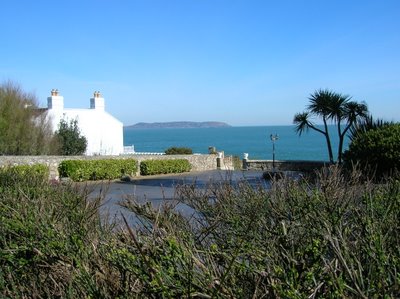
At least there was one shop in town with fresh-caught cod and chips (and that's how both Guinness and fish and chips were ruined forever in the same trip). Overall, though, I seriously wanted to run screaming onto the nearest train. So, on our final morning, I memorized my intended route and shoved my guidebook into my purse until I could conceal it entirely. As mentioned previously, I went for the slightly scruffy look: olive drab hat pulled low, worn jeans. I'm sure the stupid rain slicker gave me away anyway, but I tried.
It didn't take long to get into the old town. The Liberties actually used to be a wealthy, almost autonomous neighborhood of weavers back in the 18th Century, until the British authorities tried to exert a little more control over it. Residents resisted and the neighborhood was basically destroyed, and it's still not fully recovered (this is not me making this claim, this is your Lonely Planet guidebook, which is pretty awesome if you ever need one). Anyway, the area is reputed for having problems, shall we say, but it's also said to be one of the few places left that the city looks on with growing nostalgia in the face of rapid change. This isn't to say that it's a good place, per se, but there are certainly things about it you don't find elsewhere, like a tight-knit sense of community. And Irish people. Those are nice, too.
I didn't have time to write much while I was there, but I took a break at a small corner bakery partway through to sip a cheap (!) cup of tea and note a few impressions. The things that stood out: concertina wire strung across high cement walls. Garbage blowing down quiet streets. Bleak buildings. Nameless shops that were absolutely spotless. An ancient (and frankly awful-looking) hospital. Tall, graffiti-tagged housing blocks. More families than I saw anywhere else. More elderly people, too. A charge in the air, not dangerous but just alive: there were neighbors talking to each other, kids playing with beat-up toys, a vibrancy running along the streets. Changing graffiti -- it's not about the IRA anymore. The resentment now is around what you see in the city, reflected in angry tagging like, "No War But Class War."
One of the images I wish I could share is one of the more striking things I've seen traveling so far. On a long, empty road, a high cement wall with a rounded top walled off a neighborhood from the street. It was a cloudy day, threatening to rain, but the sun momentarily broke through at my back, and the wall began to shimmer. Along the top, running the length of the block, jagged shards and pieces of glass glinted dully like seaglass. The polished greens, browns and clear triangular chunks looked strangely beautiful and at the same time felt ominous. Who put them there? Who were they meant to keep out? Or in? As I walked, I wound up seeing more of that in the center of the neighborhood. I've read that a lot of the 1916 rebels came from the area, so perhaps it remained the site of Irish-English conflict afterwards. Whatever the reason, it's hard to explain why it made such an impression. I thought about pulling out the camera phone, but then I looked around and decided that innocuous anonymity was the mantra of the day.
I can't elucidate why this neighborhood was so evocative and intriguing. Maybe it was just because I finally felt like I'd seen something beyond the average tourist's take on Dublin. I'm not sure. I've always been drawn to the outskirts -- Bryan and I spent a full day wandering around the edges of Prague's central area, and we felt like we learned more about the city than we had in the previous three days. I felt the same way about Kilmainham and the Liberties, I suppose. Anyway, here are the two photos I did feel okay taking. The color is terrible, but the resolution is better than I expected. I don't know if they'll be of any interest because they really aren't as good as they should be, but here they are anyway:

There was something out-of-this-world about seeing a brand new BMW parked on what might have been the second-dingiest block I encountered. It's hard to make out in this picture, but the brick building behind the car and the one to its left are both crumbling to rubble: roofless, windowless, boarded-up and sprouting with weeds. The weeds feel almost trimphant, in a way, perhaps because they're the only living green things in the neighborhood...except for the tidy flowerboxes beneath each window of the house on the right. The house itself is pretty standard: aging roof, deteriorating side walls...but the front...That's what I wish you could see, those defiant splashes of red, blue and yellow in spotless white containers, stubbornly refusing to be consumed by the grime and dirt and decay around them. There's pride and community in the streets of the Libertines, even if it manifests in something as simple as a splash of color.

Damn, you can't see this one, either, but it's on the outskirts of the Liberties, just before you head back towards the river. I will eventually write about how construction projects are springing up everywhere to wipe the blight of the housing projects off the face of the city. This one was huge: this is one building in a full block of identical structures with black, tar-and-cement looking exteriors, stacked row upon row like dominoes in a blacktop lot devoid of play equipment or trees. When I saw it, the area was crawling with machinery, rumbling over adult-sized piles of crushed concrete and twisted rebar. An old man across the street stood watching for as long as I was there. I think he'd been standing there for awhile, and it looked like he wasn't leaving anytime soon. I wondered if he'd lived there, or if he lived in the slightly less depressing blocks behind us. Maybe those were scheduled for demolition, too.
What really got me, though, were the interiors of the apartments. This is what you can't see, again, but every single room inside that building is painted a different color. There are blues, greens, aquamarines, pinks, violets, marigolds, lilacs...and maybe it's because the developer bought cheap cans of paint wherever he could find them, but somehow it looked like it was intentional, like residents decided to create their own sense of vibrancy among the drab statement of the projects. I stood there for awhile, peering into each room, trying to make out the outlines of posters or the regular patterns of stencils on walls.
Where did all of these people go? That day, I saw project upon project with names like Lourdes' Place or St. Mary's Shelter, every one of them shuttered, every one slated for demolition or already ground beneath the bulldozer's wheels. There were traces of the people who once called them home: Irish flags painted across decks or sprayed in outlines on the naked elevator shafts; down by a rapidly gentrifying section of the rail station, a three-story banner proclaiming one of the largest complexes to be "Gone But Not Forgotten," with a picture of uniformed schoolchildren smiling shyly in the complex courtyard. Where did they put them all? Maybe they wound up in nicer neighborhoods, somewhere outside the city center. But then I think about what's happening to Seattle, how the CD keeps getting more like Madison Park, how few traces remain of the neighorhood that was so complex, troubled but alive in a way other places weren't. I looked at that banner for a long time, wanted to take its picture but hesitated -- there were a lot of photo opportunities that day, and very few where I wouldn't instantly betray my disguise as just another local. That, and it felt intrusive, too. Whatever was going on here, I was not a part of it. I couldn't understand it in an afternoon, so what story would a photo really tell?
Then again, I took these two. I still don't know why.
I leave in two weeks for fieldwork, and consequently everything's a bit of a madhouse right now. However, I finally received the two pictures of the Liberties (the Dublin neighborhood through which I wandered), about a week after I emailed them to myself from my phone. Not so swift, this technology. Their arrival makes me feel like I'd better write this stuff down now, so here it goes.
After two days in Dublin, I needed a change. In my notes, I scribbled: "Without meaning to, I find myself tiring of my travel companions. I long to slip away and find some corner bar where I can sit, silent, anonymous, soaking up the surroundings." Instead, we toured the Guinness factory, which was fun, but the walk back became more interesting. We took a detour to reach a restaurant on the other side of town, and in doing so we wound up in a "rough" neighborhood. My Brit friend grew uneasy. She's cautious to the point of paranoia about being English in Dublin, even when I'm fairly convinced that they couldn't tell by sight (most of her family's Irish anyway). She wouldn't let me stop to photograph the banner celebrating Sinn Fein's 100th anniversary, even though I'm pretty sure any local members would be moderately flattered by the fact that a tourist knew what SF was. I was more interested in the picture's ironic value: their headquarters was located next to a large pile of rubble that presumably had been a building. Rather than alluding to its dark past, to me it indicated something about where SF has put itself: it's teetering on the edge of oblivion, and no one in Dublin seems to care.
Getting back to the point, once we left the factory, there was a distinct change in the environment. The streets suddenly grew very quiet, without the traffic noise, shops and bustling pedestrians of the city center. (Oh lord, I almost wrote "centre.") Across the street, kids played on a discarded mattress in a bare asphalt parking lot ringed by chain link. Others in school uniforms were kicking a dirty soccerball between compact cars on a dead-end street as adults watched from front stoops above the curb. The most striking change was the presence of laundry. In Dub, entire neighborhoods seem delineated by the presence of absence of washlines, strung between buildings, hanging from window ledges to fences, drooping precariously between trees and other lines. Invariably, they are decorated end-to-end with small childrens' clothing, plaid skirts, work uniforms, dresses. Against the grey, black or red brick facades of looming apartment complexes clustered by the dozen, they pop out, swaying in the light breeze. The futher we traveled, the more I found myself itching to get out into these areas more, to stuff my bloody "Look, I'm a tourist!!" Guinness bag behind a dumpster and learn to blend into the fabric. Before then, there were only fleeting moments when it felt like you might recapture the feel of the old city, rising up from between the smooth, worn stones lining an 18th-century alley where oppressive brick buildings stand guard, casting long shadows at your feet. But then, we'd turn a corner to find a tour bus, a chain store, a high-end restaurant, and the street's memory seeped back beneath the paving. Now, the smell of the city itself was changing: burning peat, brewing beer. While my friends planned a last day of shopping and museums, I concocted a different plan. My idea became firmly entrenched when we spent the next day visiting Dalkey, a seaside suburb of Dublin that I swear to the freaking heavens could have been Carmel if there weren't an ancient Celtic church off the coast. Seriously, they had freaking palm trees. Palm trees! Oh yeah, and Spanish-style villas, and imitation castles...you wish I was kidding. C'mon, look at the picture below and tell me that doesn't look like California:

At least there was one shop in town with fresh-caught cod and chips (and that's how both Guinness and fish and chips were ruined forever in the same trip). Overall, though, I seriously wanted to run screaming onto the nearest train. So, on our final morning, I memorized my intended route and shoved my guidebook into my purse until I could conceal it entirely. As mentioned previously, I went for the slightly scruffy look: olive drab hat pulled low, worn jeans. I'm sure the stupid rain slicker gave me away anyway, but I tried.
It didn't take long to get into the old town. The Liberties actually used to be a wealthy, almost autonomous neighborhood of weavers back in the 18th Century, until the British authorities tried to exert a little more control over it. Residents resisted and the neighborhood was basically destroyed, and it's still not fully recovered (this is not me making this claim, this is your Lonely Planet guidebook, which is pretty awesome if you ever need one). Anyway, the area is reputed for having problems, shall we say, but it's also said to be one of the few places left that the city looks on with growing nostalgia in the face of rapid change. This isn't to say that it's a good place, per se, but there are certainly things about it you don't find elsewhere, like a tight-knit sense of community. And Irish people. Those are nice, too.
I didn't have time to write much while I was there, but I took a break at a small corner bakery partway through to sip a cheap (!) cup of tea and note a few impressions. The things that stood out: concertina wire strung across high cement walls. Garbage blowing down quiet streets. Bleak buildings. Nameless shops that were absolutely spotless. An ancient (and frankly awful-looking) hospital. Tall, graffiti-tagged housing blocks. More families than I saw anywhere else. More elderly people, too. A charge in the air, not dangerous but just alive: there were neighbors talking to each other, kids playing with beat-up toys, a vibrancy running along the streets. Changing graffiti -- it's not about the IRA anymore. The resentment now is around what you see in the city, reflected in angry tagging like, "No War But Class War."
One of the images I wish I could share is one of the more striking things I've seen traveling so far. On a long, empty road, a high cement wall with a rounded top walled off a neighborhood from the street. It was a cloudy day, threatening to rain, but the sun momentarily broke through at my back, and the wall began to shimmer. Along the top, running the length of the block, jagged shards and pieces of glass glinted dully like seaglass. The polished greens, browns and clear triangular chunks looked strangely beautiful and at the same time felt ominous. Who put them there? Who were they meant to keep out? Or in? As I walked, I wound up seeing more of that in the center of the neighborhood. I've read that a lot of the 1916 rebels came from the area, so perhaps it remained the site of Irish-English conflict afterwards. Whatever the reason, it's hard to explain why it made such an impression. I thought about pulling out the camera phone, but then I looked around and decided that innocuous anonymity was the mantra of the day.
I can't elucidate why this neighborhood was so evocative and intriguing. Maybe it was just because I finally felt like I'd seen something beyond the average tourist's take on Dublin. I'm not sure. I've always been drawn to the outskirts -- Bryan and I spent a full day wandering around the edges of Prague's central area, and we felt like we learned more about the city than we had in the previous three days. I felt the same way about Kilmainham and the Liberties, I suppose. Anyway, here are the two photos I did feel okay taking. The color is terrible, but the resolution is better than I expected. I don't know if they'll be of any interest because they really aren't as good as they should be, but here they are anyway:
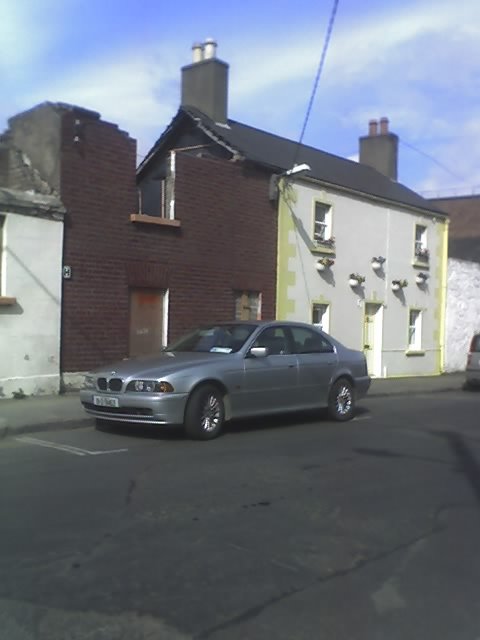
There was something out-of-this-world about seeing a brand new BMW parked on what might have been the second-dingiest block I encountered. It's hard to make out in this picture, but the brick building behind the car and the one to its left are both crumbling to rubble: roofless, windowless, boarded-up and sprouting with weeds. The weeds feel almost trimphant, in a way, perhaps because they're the only living green things in the neighborhood...except for the tidy flowerboxes beneath each window of the house on the right. The house itself is pretty standard: aging roof, deteriorating side walls...but the front...That's what I wish you could see, those defiant splashes of red, blue and yellow in spotless white containers, stubbornly refusing to be consumed by the grime and dirt and decay around them. There's pride and community in the streets of the Libertines, even if it manifests in something as simple as a splash of color.

Damn, you can't see this one, either, but it's on the outskirts of the Liberties, just before you head back towards the river. I will eventually write about how construction projects are springing up everywhere to wipe the blight of the housing projects off the face of the city. This one was huge: this is one building in a full block of identical structures with black, tar-and-cement looking exteriors, stacked row upon row like dominoes in a blacktop lot devoid of play equipment or trees. When I saw it, the area was crawling with machinery, rumbling over adult-sized piles of crushed concrete and twisted rebar. An old man across the street stood watching for as long as I was there. I think he'd been standing there for awhile, and it looked like he wasn't leaving anytime soon. I wondered if he'd lived there, or if he lived in the slightly less depressing blocks behind us. Maybe those were scheduled for demolition, too.
What really got me, though, were the interiors of the apartments. This is what you can't see, again, but every single room inside that building is painted a different color. There are blues, greens, aquamarines, pinks, violets, marigolds, lilacs...and maybe it's because the developer bought cheap cans of paint wherever he could find them, but somehow it looked like it was intentional, like residents decided to create their own sense of vibrancy among the drab statement of the projects. I stood there for awhile, peering into each room, trying to make out the outlines of posters or the regular patterns of stencils on walls.
Where did all of these people go? That day, I saw project upon project with names like Lourdes' Place or St. Mary's Shelter, every one of them shuttered, every one slated for demolition or already ground beneath the bulldozer's wheels. There were traces of the people who once called them home: Irish flags painted across decks or sprayed in outlines on the naked elevator shafts; down by a rapidly gentrifying section of the rail station, a three-story banner proclaiming one of the largest complexes to be "Gone But Not Forgotten," with a picture of uniformed schoolchildren smiling shyly in the complex courtyard. Where did they put them all? Maybe they wound up in nicer neighborhoods, somewhere outside the city center. But then I think about what's happening to Seattle, how the CD keeps getting more like Madison Park, how few traces remain of the neighorhood that was so complex, troubled but alive in a way other places weren't. I looked at that banner for a long time, wanted to take its picture but hesitated -- there were a lot of photo opportunities that day, and very few where I wouldn't instantly betray my disguise as just another local. That, and it felt intrusive, too. Whatever was going on here, I was not a part of it. I couldn't understand it in an afternoon, so what story would a photo really tell?
Then again, I took these two. I still don't know why.
Thursday, April 06, 2006
Drunken lullabies
Flogging Molly lyrics ran through my head a lot this week, although their Ireland exists largely in memories and whispers rising from the River Liffey.
The trip was a whirlwind four days, full of the usual misadventures: one early cab, which resulted in one forgotten 35mm camera (mine); one lost cellphone (friend's); one piece of crap digital camera which offed itself two days into the trip (mine, of course); one return bus to the airport struck by building materials just before boarding (ours).
The camera really annoyed me, as I am a photography addict who likes nothing better than wandering around new places looking for unique shots. On Tuesday, it decided that it wasn't going to recognize fresh batteries anymore. I cajoled it, threatened it, bought a couple of new packs in case the other ones I purchased had been damaged...finally, tonight, as I desperately tried to retrieve the few photos I had taken, I resorted to an old Nintendo trick: when in doubt, blow on the bastard. The gods of archaic gadgets smiled on me, and I at least managed to keep it on long enough to grab the photos.
 (A view of Christ's Church from the ground. Turn right past the church to head back to the city center, but go straight if you're feeling adventurous.)
Naturally, all of the best moments were lost because the real picture moments happened today, when I parted ways with my travel buddies and spent the day roaming the streets of Dublin's less-frequented areas. Three of us went to Dublin together, but our British companion was uncomfortable moving much beyond the city core, and the other was completely happy to go clothes shopping with her, so I pulled a cap low over my eyes, adopted the best swaggering, rolling slouch of disaffected Irish youth that I could imitate, and forayed off to Kilmainham and the Libertines, neighborhoods that have seen better days...and which, consequently, impart far more about the city than did the glimmering new commercial district.
After a few days in Dublin, I had to visit the "rare auld days" that locals say still lingers in the Libertines. The city center is a dizzying mix of old and new, but it's largely the new that dominates. Old pubs, local haunts, are still around, but they remind me of the last fishermen in Ballard, doggedly clinging to their docks as the yachts close in on them. As a result, the pubs are very insular. In other words, the exteriors look like crap for a specific reason: to keep tourists and "New Dublin" away. We were recognized as outsiders almost immediately, even though we usually hadn't said a word; accents regardless, the very unfamiliarity of your face marks you out in Dub's pubs. The regulars tolerated us, probably resigned to our presence, although we did our best to keep quiet in a corner, making sure the clipped American accents didn't drown out the rich brogues around us. Occasionally, though, an older, shabbily dressed patron would snarl something derisive in our direction. Our reactions were diverse: the British friend grew uneasy; I swallowed it as the momentary swell of general frustration with Dublin's changing faces; the East Coaster felt annoyed. The correct emotion was probably some combination of the three -- it's true that we hadn't done anything to deserve their contempt, but at the same time, our presence wasn't really benign. We were part of the huge changes coming through the city, the same ones which made portions of Dublin feel more like London (and what on earth would Padraig Pearse, Joseph Plunkett and Michael Collins think of that??). In places, there's nary an Irish accent to be heard amid the Mandarin, Italian, Polish, Eritrean, Croatian. You can (as I did) actually spend two days in the city and realize that you haven't spoken with a single Irish person -- everyone in the shops is Eastern European, and Croatians ran our hostel. There are as many Eastern European grocers as there are Irish ones, if not more.
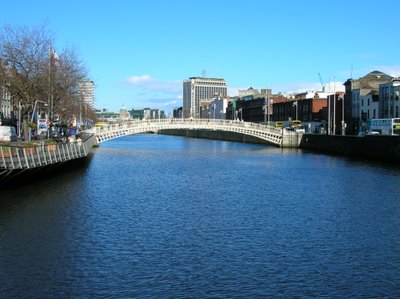 (The view from the River Liffey. The area on each side has been transformed into a cosmopolitan mix of international shops and restaurants. It could be Ireland...It could also be London, Seattle, New York, Italy or France.)
It doesn't seem to be the diversity itself that bothers old Dubliners, as much as the speed with which that diversity exploded. Dublin's undergone a complete transformation since it joined the EU and went from being one of Europe's poorest countries to one of its wealthiest. As one might imagine, a decade or so of rapid-fire change has created as many curses as blessings. Dublin's arts scene, long one of the world's grandest, is in crisis. Think about it: on what do Irish writers muse? On poverty. On pride. On dignity in the face of oppression, dark mirth dredged from the dingy gutter. What happens when the cornerstone of your tradition begins to crumble? The only thing left now's the alcohol, and there's a reason Dublin is now one of the more violent cities in Europe. When the bars let out, it's best to go home (and we made sure to tuck in long before that happened, as Americans and Brits are less-than-popular, even when people are sober). So sure, the city's wealth has grown, but there's a palpable edge to it: beggars sit outside the fancy shops, and there's a portion of the male population trudging about with a visible chip on its shoulder. Plus, there's something out of synche with the worn cobblestone alleys, now home to trendy boutiques and Urban Outfitters.
 (This is the Official First Pint, which makes up for the Official Awful Plane-Ride Hair. I haven't been this happy since Gale Norton resigned.)
Still, Dublin's worth a visit. When you do find the old pubs (and I can give you hints about a few), they'll be small and dark, filled with bantering patrons. There's a warmth you don't find in English pubs; it radiates from the walls and fills the room with a sense of camraderie. In the neighborhood pubs, there aren't any bar menus: if you don't know what pub food is, why are you trying to order? We staggered into our first pub as soon as we'd arrived in Dublin -- it was a small, narrow, dimly lit room with the requisite telly on in the corner. A row of men lined the narrow bar counter, and they were the most quintessential Irish-looking elderly men I'd ever seen: florid, weathered faces, laughing eyes, elfin smiles. They treated our entrance with momentary curiosity -- this clearly was a bar stocked with a daily regular crowd -- and then turned back to the bar. Following my Brit pal's lead, I ordered a cheese sandwich from the no-nonsense, matronly bartender. She turned to a table full of middle-aged men drinking lager and started ordering them around, instructing them to go to the folding table beside the bar so they could make sandwiches from the packet of white bread and the packages of cheese. A small griller sat beside the store-bought goods; it was like having your mom make you a cheese sandwich for lunch! Since it was exactly noon, I figured it was late enough in the day to try my first Irish Guinness, which is deservedly reputed as the Best Guinness Anywhere. Ordering the Guinness also clearly impressed the bar crowd, and two of the elderly men offered to help me carry my drink to the table...although this reaction may have been amplified by my friends' decisions to order tea and coffee at a freaking Irish pub. I will NOT get started on the number of highly embarrassing episodes in which they went into frigging pubs and came out with espresso. Dear Lord, I wanted to crawl under the table and die.
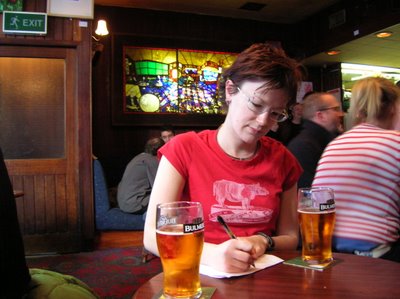 (Me in one of those truly Irish pubs, with a rare pint of cider to keep me company as I scribbled down first impressions on the only piece of paper in my bag. In my defense, I'd had a pint of Guinness before this and followed it up with a couple more that evening.)
I can confirm that I will *never* be able to drink Guinness again without feeling a pang for what I drank in Dublin. The Guinness there is smoother, somehow, with a more distinct flavor and a fuller head. In four days, I established that you can in fact live off pints of Guinness, with the occasional Bulmer's cider or Smithwicks thrown in for good measure. I think I drank about a pony's worth of Guinness on my own (that's a half-keg), or at least managed to put away enough to feel I'd taken full advantage of the opportunity. (Guinness is particularly nice with suitably low-key pub fare, like a cheese sandwich with HP Sauce. Seriously, that stuff is fantastic.) It's also amazing to look around an Irish pub and realize that every single male in the establishment drinks Guinness -- and ONLY Guinness. At every pub we visited, this single standard held true. It was remarkable, and actually sort of cool. The ladies seem to stick to cider, but there's also a core who can down their Guinness with the lads. I count myself as an honorary member of that contingent...although I'm sure my Brit friend wasn't too happy about its side effects (walking slightly sideways past the GPO -- post office -- where the 1916 Easter Rising occurred, I pointed out the bullet holes and started on an impassioned but possibly incoherent diatribe about the bloody eedjits who'd oppressed Ireland until then and who'd starved out my family...Hey, I'm patriotic.)
 (This is me at the completely worthwhile tour of the Guinness Factory. That maniacal grin indicates my awareness that a free pint awaits at the end of our visit.)
There's so much more to post, but I have a feeling this is long enough for now. So, tomorrow I begin Part Two of the Irish Adventure, in which I see many interesting and somewhat overrated tourist attractions before chucking the whole thing for the slums.
The trip was a whirlwind four days, full of the usual misadventures: one early cab, which resulted in one forgotten 35mm camera (mine); one lost cellphone (friend's); one piece of crap digital camera which offed itself two days into the trip (mine, of course); one return bus to the airport struck by building materials just before boarding (ours).
The camera really annoyed me, as I am a photography addict who likes nothing better than wandering around new places looking for unique shots. On Tuesday, it decided that it wasn't going to recognize fresh batteries anymore. I cajoled it, threatened it, bought a couple of new packs in case the other ones I purchased had been damaged...finally, tonight, as I desperately tried to retrieve the few photos I had taken, I resorted to an old Nintendo trick: when in doubt, blow on the bastard. The gods of archaic gadgets smiled on me, and I at least managed to keep it on long enough to grab the photos.
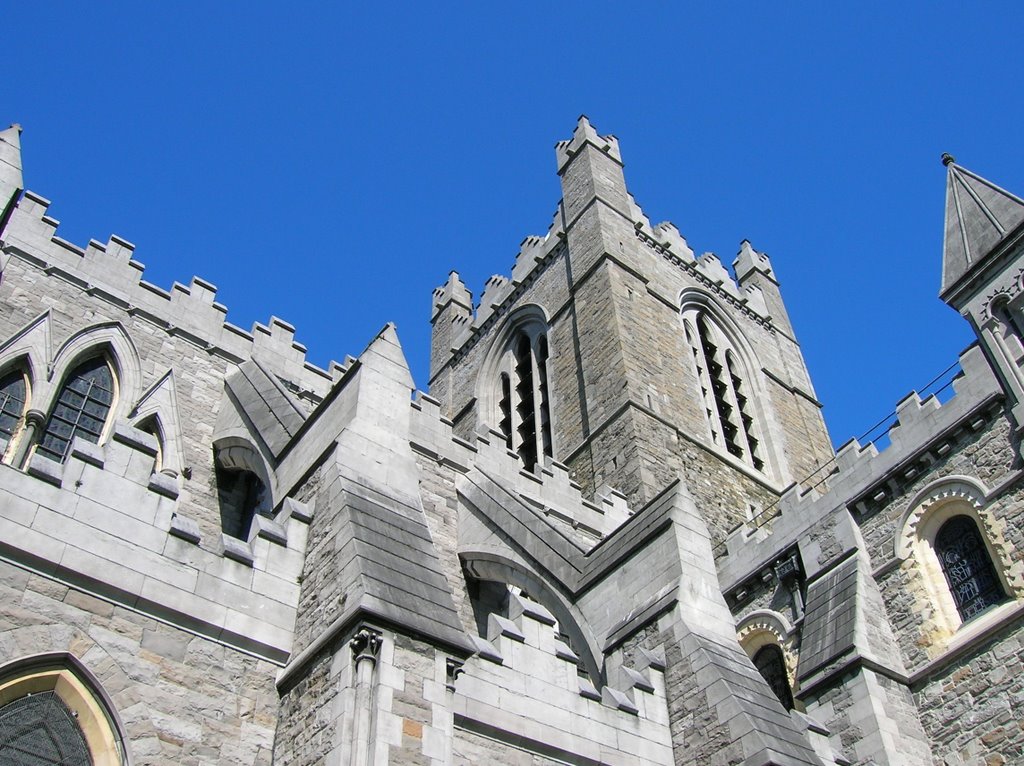 (A view of Christ's Church from the ground. Turn right past the church to head back to the city center, but go straight if you're feeling adventurous.)
Naturally, all of the best moments were lost because the real picture moments happened today, when I parted ways with my travel buddies and spent the day roaming the streets of Dublin's less-frequented areas. Three of us went to Dublin together, but our British companion was uncomfortable moving much beyond the city core, and the other was completely happy to go clothes shopping with her, so I pulled a cap low over my eyes, adopted the best swaggering, rolling slouch of disaffected Irish youth that I could imitate, and forayed off to Kilmainham and the Libertines, neighborhoods that have seen better days...and which, consequently, impart far more about the city than did the glimmering new commercial district.
After a few days in Dublin, I had to visit the "rare auld days" that locals say still lingers in the Libertines. The city center is a dizzying mix of old and new, but it's largely the new that dominates. Old pubs, local haunts, are still around, but they remind me of the last fishermen in Ballard, doggedly clinging to their docks as the yachts close in on them. As a result, the pubs are very insular. In other words, the exteriors look like crap for a specific reason: to keep tourists and "New Dublin" away. We were recognized as outsiders almost immediately, even though we usually hadn't said a word; accents regardless, the very unfamiliarity of your face marks you out in Dub's pubs. The regulars tolerated us, probably resigned to our presence, although we did our best to keep quiet in a corner, making sure the clipped American accents didn't drown out the rich brogues around us. Occasionally, though, an older, shabbily dressed patron would snarl something derisive in our direction. Our reactions were diverse: the British friend grew uneasy; I swallowed it as the momentary swell of general frustration with Dublin's changing faces; the East Coaster felt annoyed. The correct emotion was probably some combination of the three -- it's true that we hadn't done anything to deserve their contempt, but at the same time, our presence wasn't really benign. We were part of the huge changes coming through the city, the same ones which made portions of Dublin feel more like London (and what on earth would Padraig Pearse, Joseph Plunkett and Michael Collins think of that??). In places, there's nary an Irish accent to be heard amid the Mandarin, Italian, Polish, Eritrean, Croatian. You can (as I did) actually spend two days in the city and realize that you haven't spoken with a single Irish person -- everyone in the shops is Eastern European, and Croatians ran our hostel. There are as many Eastern European grocers as there are Irish ones, if not more.
 (The view from the River Liffey. The area on each side has been transformed into a cosmopolitan mix of international shops and restaurants. It could be Ireland...It could also be London, Seattle, New York, Italy or France.)
It doesn't seem to be the diversity itself that bothers old Dubliners, as much as the speed with which that diversity exploded. Dublin's undergone a complete transformation since it joined the EU and went from being one of Europe's poorest countries to one of its wealthiest. As one might imagine, a decade or so of rapid-fire change has created as many curses as blessings. Dublin's arts scene, long one of the world's grandest, is in crisis. Think about it: on what do Irish writers muse? On poverty. On pride. On dignity in the face of oppression, dark mirth dredged from the dingy gutter. What happens when the cornerstone of your tradition begins to crumble? The only thing left now's the alcohol, and there's a reason Dublin is now one of the more violent cities in Europe. When the bars let out, it's best to go home (and we made sure to tuck in long before that happened, as Americans and Brits are less-than-popular, even when people are sober). So sure, the city's wealth has grown, but there's a palpable edge to it: beggars sit outside the fancy shops, and there's a portion of the male population trudging about with a visible chip on its shoulder. Plus, there's something out of synche with the worn cobblestone alleys, now home to trendy boutiques and Urban Outfitters.
 (This is the Official First Pint, which makes up for the Official Awful Plane-Ride Hair. I haven't been this happy since Gale Norton resigned.)
Still, Dublin's worth a visit. When you do find the old pubs (and I can give you hints about a few), they'll be small and dark, filled with bantering patrons. There's a warmth you don't find in English pubs; it radiates from the walls and fills the room with a sense of camraderie. In the neighborhood pubs, there aren't any bar menus: if you don't know what pub food is, why are you trying to order? We staggered into our first pub as soon as we'd arrived in Dublin -- it was a small, narrow, dimly lit room with the requisite telly on in the corner. A row of men lined the narrow bar counter, and they were the most quintessential Irish-looking elderly men I'd ever seen: florid, weathered faces, laughing eyes, elfin smiles. They treated our entrance with momentary curiosity -- this clearly was a bar stocked with a daily regular crowd -- and then turned back to the bar. Following my Brit pal's lead, I ordered a cheese sandwich from the no-nonsense, matronly bartender. She turned to a table full of middle-aged men drinking lager and started ordering them around, instructing them to go to the folding table beside the bar so they could make sandwiches from the packet of white bread and the packages of cheese. A small griller sat beside the store-bought goods; it was like having your mom make you a cheese sandwich for lunch! Since it was exactly noon, I figured it was late enough in the day to try my first Irish Guinness, which is deservedly reputed as the Best Guinness Anywhere. Ordering the Guinness also clearly impressed the bar crowd, and two of the elderly men offered to help me carry my drink to the table...although this reaction may have been amplified by my friends' decisions to order tea and coffee at a freaking Irish pub. I will NOT get started on the number of highly embarrassing episodes in which they went into frigging pubs and came out with espresso. Dear Lord, I wanted to crawl under the table and die.
 (Me in one of those truly Irish pubs, with a rare pint of cider to keep me company as I scribbled down first impressions on the only piece of paper in my bag. In my defense, I'd had a pint of Guinness before this and followed it up with a couple more that evening.)
I can confirm that I will *never* be able to drink Guinness again without feeling a pang for what I drank in Dublin. The Guinness there is smoother, somehow, with a more distinct flavor and a fuller head. In four days, I established that you can in fact live off pints of Guinness, with the occasional Bulmer's cider or Smithwicks thrown in for good measure. I think I drank about a pony's worth of Guinness on my own (that's a half-keg), or at least managed to put away enough to feel I'd taken full advantage of the opportunity. (Guinness is particularly nice with suitably low-key pub fare, like a cheese sandwich with HP Sauce. Seriously, that stuff is fantastic.) It's also amazing to look around an Irish pub and realize that every single male in the establishment drinks Guinness -- and ONLY Guinness. At every pub we visited, this single standard held true. It was remarkable, and actually sort of cool. The ladies seem to stick to cider, but there's also a core who can down their Guinness with the lads. I count myself as an honorary member of that contingent...although I'm sure my Brit friend wasn't too happy about its side effects (walking slightly sideways past the GPO -- post office -- where the 1916 Easter Rising occurred, I pointed out the bullet holes and started on an impassioned but possibly incoherent diatribe about the bloody eedjits who'd oppressed Ireland until then and who'd starved out my family...Hey, I'm patriotic.)
 (This is me at the completely worthwhile tour of the Guinness Factory. That maniacal grin indicates my awareness that a free pint awaits at the end of our visit.)
There's so much more to post, but I have a feeling this is long enough for now. So, tomorrow I begin Part Two of the Irish Adventure, in which I see many interesting and somewhat overrated tourist attractions before chucking the whole thing for the slums.
Sunday, April 02, 2006
A new adventure
Tomorrow, I'm off to Dublin until Thursday with a couple of girlfriends, and I'm eager to write about what I see. Riding the Celtic Tiger has been a mixed bag for the city, which apparently is swimming in skyrocketing prices, higher crime rates and some of the worst suburban sprawl Europe's seen. At the same time, it's still Dublin -- it's still the homeland, and I am pathetically excited to reach its shores for the first time. This is the initial four-day foray, and then hopefully we'll travel there for a couple of weeks next summer...After all, I have family to find!
Will be sure to post when I return, and I'll raise a glass to ye from Dublin!
Will be sure to post when I return, and I'll raise a glass to ye from Dublin!
Saturday, March 18, 2006
Prague, continued
Upon emerging from the depths of Prague's metro system, having navigated successfully through Czech language-only bus and tube lines, the city lay beneath a modest snowfall, wrapped in a transluscent mesh of fog and smog that floated over the Vltava. From every vantage point along the river, Prague Castle's ancient spires rose above the mix of modern, Baroque, Rennaisance and medieval buildings that gathered at its feet.
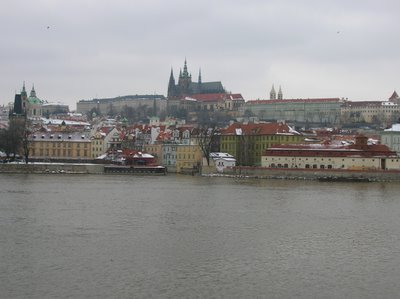
The city is an agglomeration of old and new; beyond the tourist-centric neighborhoods of Josefov and Stare Mesto, ancient, proudly decaying towers stand beside glass-and-cement office buildings. On our third day, we traversed Nove Mesto and Mala Stranska, two neighborhoods bordered by the Vltava, but outside the areas where most visitors journey. In these places, it becomes clear that Prague is in the midst of a vigorous growth spurt after the end of its Communist occupiers. Everywhere, backhoes and bulldozers shovel aside mounds of rubble from demolished buildings to make way for new apartments, condos, office parks and transit centers. The city exudes a quiet sense of forward-motion, of transition away from a bitter past. It's a quirky, lighthearted, beautiful place where many of the streets are meticulously tiled with hand-sown black, white and red cubes of stone from another era. Coffee bars, beer halls and restaurants line the narrow, winding alleyways, competing for space with cluttered souvenier shops offering an endless array of glassware, beer steins, ceramics, nested dolls, jewelry and t-shirts that only the tackiest of visitors could love ("To Beer or Not to Beer?"). For the most part, locals are extremely friendly, patient with people who stumble over the dearth of vowels in Czech words. Life is sweet...
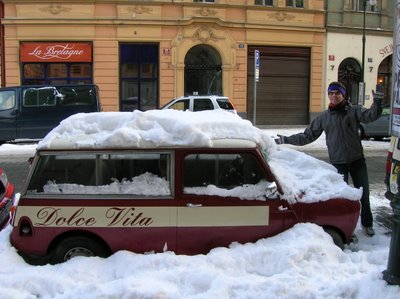
We had our share of memorable experiences, including an illustrative episode in the joys of working with different languages. I'd reserved tickets to a Mozart concert online before we left England, and we arrived at the Rudolfinum box office with a printout bearing the reservation number and instructions for paying. The woman behind the counter seemed extremely flustered and kept insisting that our reservation wasn't in her computer. I tried to show her the reservation number, but she just repeated, "The tickets paid already...I show no number in my computer." To us, this sounded like someone had nabbed our tickets -- and it didn't help that neither of us really spoke the other language. My Czech is limited to hello, yes, no, thank you, you're welcome, pardon me, and please. Her grasp of written English was small, but she laboriously struggled to read through the paper, only to sigh in consternation and repeat, "Tickets paid." Finally, after about 10 minutes of this, we resorted to shouting at each other really loudly and really slowly, as though somehow that would make it easier to understand the problem. One last time, she said, "Tickets paid?" in more of an inquisitive tone than before. I gave up, shrugged and said, "Yeah, sure." She turned, pressed a button, printed our tickets and said, "Goodbye." The concert was nice, I have to say. I still don't know if I actually paid for those tickets or not.
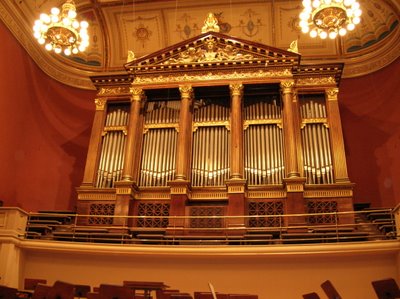
It was a wonderful trip, and I think we managed to avoid too many Americanisms...although we did offend/bemuse one waiter by completely failing our etiquette test. He brought out a huge slab of bruchetta, which we cut in half and ate by hand. A few minutes later, he returned and raised an eyebrow as he removed the untouched, extra knife and fork from each of our place settings. Oops...Seriously, I've learned from both England and Prague that we Americans have the most unrefined table manners of any group on the planet. Switching our knife and fork hands, daring to cut things with forks when they don't require a knife, eating "too fast" (which in Prague meant taking less than an entire night to finish a meal, apparently)...
I have a few more pictures to post, but I'll save those for later. If you ever get the chance, I definitely recommend visiting Prague...or in the immortal words of another bad t-shirt hanging in a window, "Czech it out!"
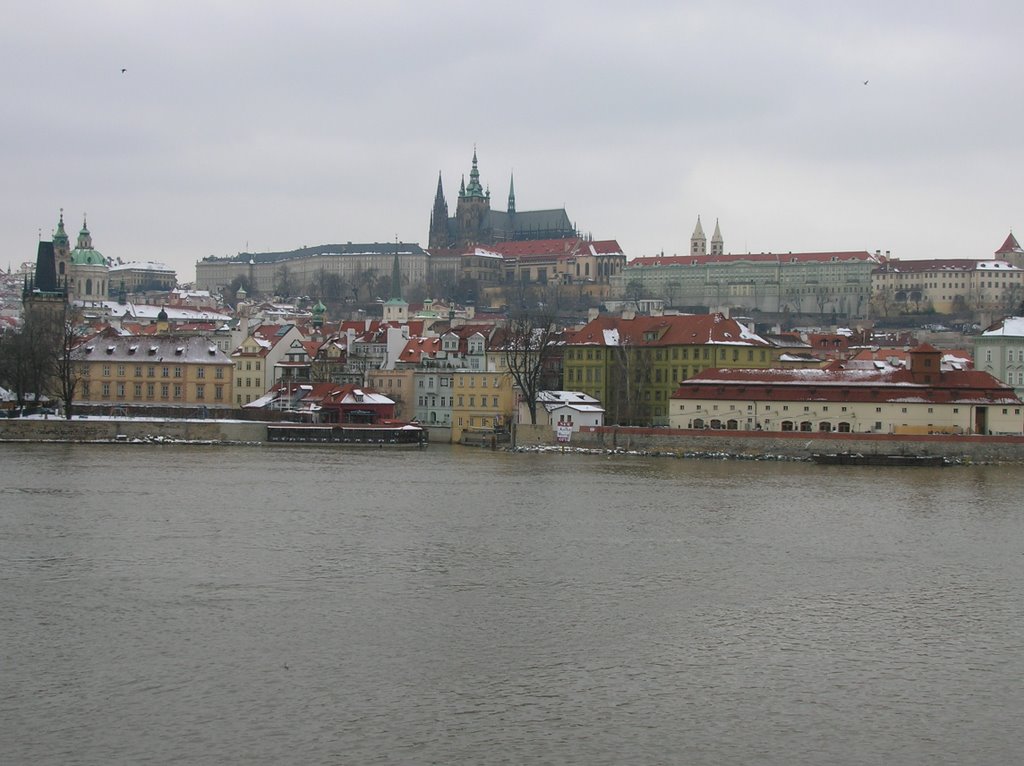
The city is an agglomeration of old and new; beyond the tourist-centric neighborhoods of Josefov and Stare Mesto, ancient, proudly decaying towers stand beside glass-and-cement office buildings. On our third day, we traversed Nove Mesto and Mala Stranska, two neighborhoods bordered by the Vltava, but outside the areas where most visitors journey. In these places, it becomes clear that Prague is in the midst of a vigorous growth spurt after the end of its Communist occupiers. Everywhere, backhoes and bulldozers shovel aside mounds of rubble from demolished buildings to make way for new apartments, condos, office parks and transit centers. The city exudes a quiet sense of forward-motion, of transition away from a bitter past. It's a quirky, lighthearted, beautiful place where many of the streets are meticulously tiled with hand-sown black, white and red cubes of stone from another era. Coffee bars, beer halls and restaurants line the narrow, winding alleyways, competing for space with cluttered souvenier shops offering an endless array of glassware, beer steins, ceramics, nested dolls, jewelry and t-shirts that only the tackiest of visitors could love ("To Beer or Not to Beer?"). For the most part, locals are extremely friendly, patient with people who stumble over the dearth of vowels in Czech words. Life is sweet...
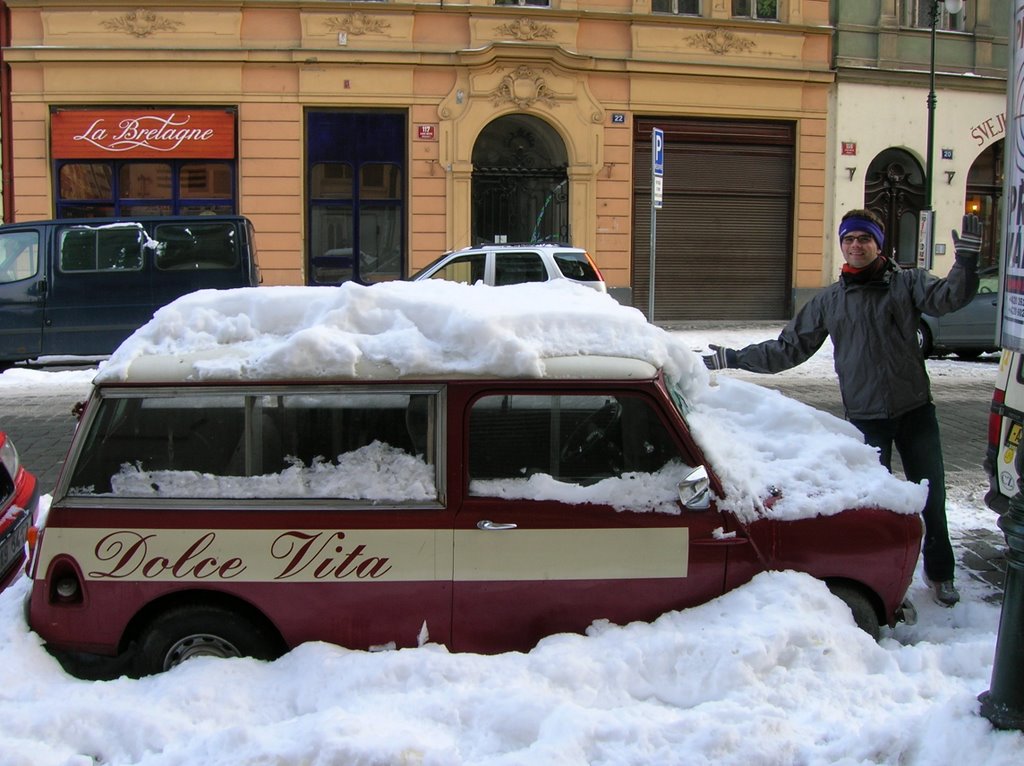
We had our share of memorable experiences, including an illustrative episode in the joys of working with different languages. I'd reserved tickets to a Mozart concert online before we left England, and we arrived at the Rudolfinum box office with a printout bearing the reservation number and instructions for paying. The woman behind the counter seemed extremely flustered and kept insisting that our reservation wasn't in her computer. I tried to show her the reservation number, but she just repeated, "The tickets paid already...I show no number in my computer." To us, this sounded like someone had nabbed our tickets -- and it didn't help that neither of us really spoke the other language. My Czech is limited to hello, yes, no, thank you, you're welcome, pardon me, and please. Her grasp of written English was small, but she laboriously struggled to read through the paper, only to sigh in consternation and repeat, "Tickets paid." Finally, after about 10 minutes of this, we resorted to shouting at each other really loudly and really slowly, as though somehow that would make it easier to understand the problem. One last time, she said, "Tickets paid?" in more of an inquisitive tone than before. I gave up, shrugged and said, "Yeah, sure." She turned, pressed a button, printed our tickets and said, "Goodbye." The concert was nice, I have to say. I still don't know if I actually paid for those tickets or not.
It was a wonderful trip, and I think we managed to avoid too many Americanisms...although we did offend/bemuse one waiter by completely failing our etiquette test. He brought out a huge slab of bruchetta, which we cut in half and ate by hand. A few minutes later, he returned and raised an eyebrow as he removed the untouched, extra knife and fork from each of our place settings. Oops...Seriously, I've learned from both England and Prague that we Americans have the most unrefined table manners of any group on the planet. Switching our knife and fork hands, daring to cut things with forks when they don't require a knife, eating "too fast" (which in Prague meant taking less than an entire night to finish a meal, apparently)...
I have a few more pictures to post, but I'll save those for later. If you ever get the chance, I definitely recommend visiting Prague...or in the immortal words of another bad t-shirt hanging in a window, "Czech it out!"
Thursday, March 16, 2006
Blogging Prague
We've just returned from our Prague excursion, and I'm in love with the city of 1000 spires. Although I'm too tired to write much now, I'll blog about it over the weekend. Many of my photos are on the 35 mm, as I'm still stubbornly clinging to film -- I enjoy using my Canon too much to part with it, and I couldn't afford a similar digital camera if I wanted one...for now, here's my favorite shot from the digital array. These are icicles hanging from the gutter of a former military barracks on the Golden Lane in Prague Castle.


Monday, March 06, 2006
Getting into the spirit
Can you tell it's the end of term by the way my posts are dwindling?
Despite the fact that I'm slammed as hell before my trip home for fieldwork and, well, an excuse to GO HOME!!!, I've decided to do a very un-me thing: schedule nonacademic trips.
In one week, we're off to Prague for four days of bone-chilling adventures as we shiver our way through the ancient city and attempt to decipher menus. I thought about learning a few Czech phrases, but that was before I realized "Good morning" takes several seconds to say and contains approximately one vowel.
A four day trip wouldn't crunch my workload too badly...but then, some girlfriends and I spontaneously decided to go to Ireland today, and before I could change my mind, we booked tickets for four days in the beginning of April. I'm figuring at that point, I'll only be three weeks away from going home, which means three weeks before I have to have my proverbial refuse together in order have my pilot study fully planned and turn in work equivalent to 40% of my grade. Hence, I'll need to guzzle all of the Guinness I can acquire anyway, so I might as well go straight to the source.
There's a tiny little voice in my head right now screaming, "What the hell were you thinking???" But then I think, when am I ever going to be able to fly to Ireland again for $80? So why am I worried?
The way I see it, if I flunk out because I actually decided to see something of Europe beyond the Cambridge Bubble (residents' words, not mine), then it was probably worth it. Heh...heh...right, guys? All of us are going stir-crazy from being trapped here for so long anyway (particularly my med student friends in their fifth year of enduring small town oddities). A break will be good for me, after all. One more weekend of enduring screeching undergrads clad in "I can see *all* of your underwear" miniskirs or dodging herds of lumbering tourists trying to photograph an authentic Cambridge student, and I may start acting like an Ugly American.
Despite the fact that I'm slammed as hell before my trip home for fieldwork and, well, an excuse to GO HOME!!!, I've decided to do a very un-me thing: schedule nonacademic trips.
In one week, we're off to Prague for four days of bone-chilling adventures as we shiver our way through the ancient city and attempt to decipher menus. I thought about learning a few Czech phrases, but that was before I realized "Good morning" takes several seconds to say and contains approximately one vowel.
A four day trip wouldn't crunch my workload too badly...but then, some girlfriends and I spontaneously decided to go to Ireland today, and before I could change my mind, we booked tickets for four days in the beginning of April. I'm figuring at that point, I'll only be three weeks away from going home, which means three weeks before I have to have my proverbial refuse together in order have my pilot study fully planned and turn in work equivalent to 40% of my grade. Hence, I'll need to guzzle all of the Guinness I can acquire anyway, so I might as well go straight to the source.
There's a tiny little voice in my head right now screaming, "What the hell were you thinking???" But then I think, when am I ever going to be able to fly to Ireland again for $80? So why am I worried?
The way I see it, if I flunk out because I actually decided to see something of Europe beyond the Cambridge Bubble (residents' words, not mine), then it was probably worth it. Heh...heh...right, guys? All of us are going stir-crazy from being trapped here for so long anyway (particularly my med student friends in their fifth year of enduring small town oddities). A break will be good for me, after all. One more weekend of enduring screeching undergrads clad in "I can see *all* of your underwear" miniskirs or dodging herds of lumbering tourists trying to photograph an authentic Cambridge student, and I may start acting like an Ugly American.
Subscribe to:
Posts (Atom)