
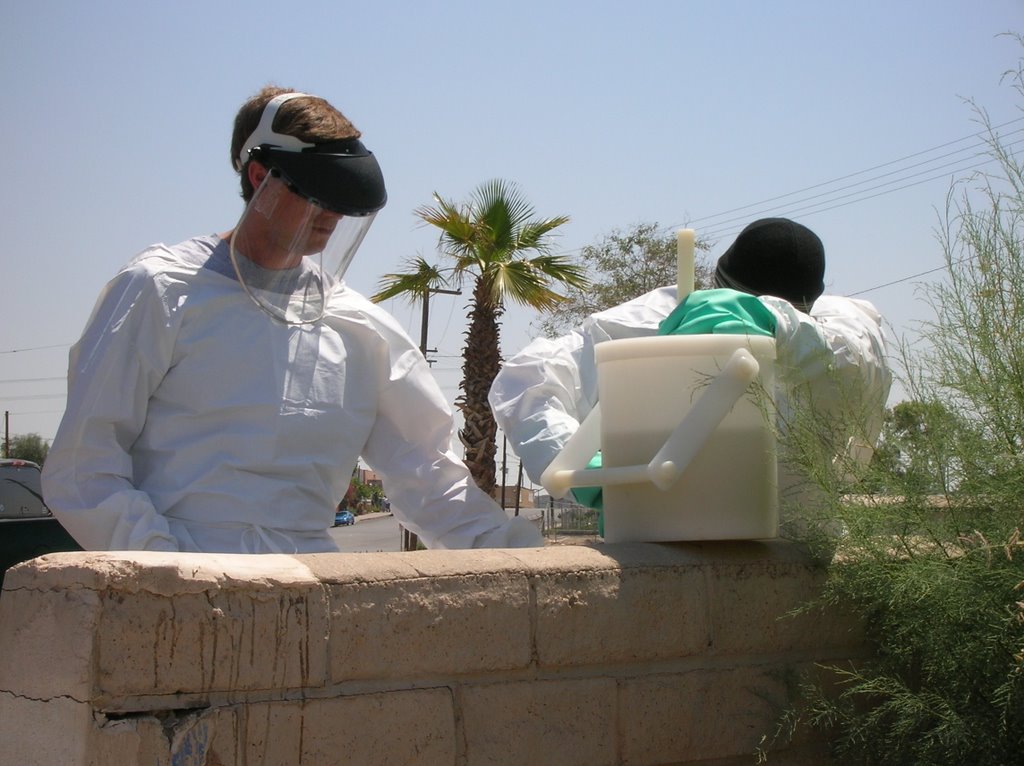
How many people get to say this in their methods section? (Thanks to my dear SuperGeneticist for the inspiration.)
Safety measures taken:
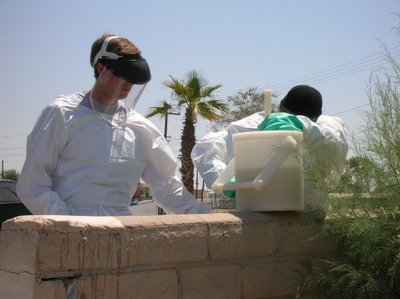
1. Put water commission decals on state car during monitoring tour to avoid being mistakenly targeted in firefights.
Sweet. I love this stuff.
Showing posts with label fieldwork. Show all posts
Showing posts with label fieldwork. Show all posts
Thursday, July 20, 2006


Monday, May 22, 2006
God's country
 Crap. Well, this was the best I could do considering I was going about 60 mph when I tried taking this (oops, Mom, don't read that part). Anyway, what you can't really make out here, through my wildlife-splattered windshield, is a bumper sticker on the back of that truck that seriously says, "Viva Bush." Yep. Viva. Bush.
Water officials here have shared their frustration with me over the county's politics. There probably aren't many other places on earth which have been hurt so badly by pro-growth, pro-development policies that put the almight dollar first, and yet this area remains Republican owned-and-run. Only 5% of the county votes, and they're the 5% who happen to be white and conservative (and it is true that most white folks here are conservative). A large proportion of people here are illegal, according to everyone I've talked to -- not so much in
Calexico, but further north where the Border Patrol isn't quite so visible. Still, you see empty cars strewn up and down the highways here, signs that la migra pulled over a car full of migrants on its way to safer ground.
The majority of elected officials live in San Diego and other areas out of the county; this is changing slowly, but not fast enough to alter the political terrain before the Salton Sea dries up and blows down the valley.
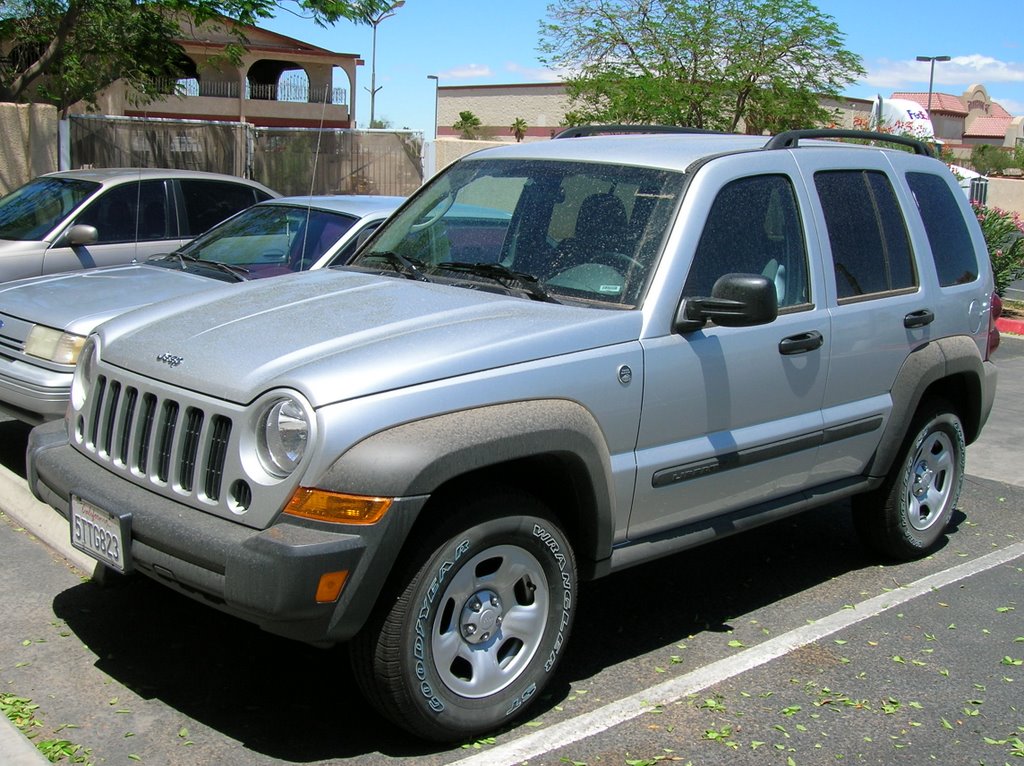
I'm really disappointed, by the way, that you can't see how much dirt is on my car right now. I'll have to take a picture from the right angle so you can see the full speckling on the exterior. I'm not sure what's gotten into me, but there's something addicting about rolling around in the dirt. It helps that this car isn't much bigger than my Jetta, which makes it easy to spin around offroad.

At the same time, Calexico is a happening place. On Saturday, I went to the 15th Annual Mariachi sin Fronteras festival, which brought in famous mariachi acts from around Latin America. My two favorites? Los Reyes del Valle and Mariachi Divas. I'd highly recommend checking out either, even if you don't like mariachi -- I hadn't realized how diverse the contemporary sound could be. This very blurred photo is of Mariachi Divas. I had to shoot it from about 1000 feet away, through a fence and without a flash...so you get what you can at that point, especially when you're working with a mediocre digital camera. Anyway, they were a fantastic group. Gotta go get some CDs before I leave...but that requires another trip to the g-d Walmart, and I'm trying to avoid that. I'm actually running low on food, but I refuse to go back there again, and I've taken to shopping at the highly questionable dollar (peso) grocery store in town. I've also developed a strong predilection for sangria, which I blame entirely on that store, as it sells the stuff at a ridiculously low price.
The festival drew people from all over Imperial County, the Mexicali Valley, southern California and Baja California, Mexico. I was outside the actual event, sitting with a lot of families and couples in the section for people who were too cheap (or too confused) to buy tickets, and the atmosphere was incredibly relaxed. Lots of kids kicking soccerballs around, friends passing beers, overly eager young security guys pacing the perimeter like they expected us to dash across en masse...then again, we are on the border, so maybe they're just jumpy...
Back to work for me (not really, but I'm trying). Tomorrow, I get to interview Mexican water officials en español, which should be fantastic since my Spanish isn't good enough to discuss policy. Add in the fact that my guide only speaks Spanish, AND the officials are probably guarded already because of a recent international incident involving an LA television crew, and you're pretty much guaranteed an interesting evening. Wish me luck. If I wind up in jail, send sangria.
Sigh...
It's a quiet day here again; I had two interviews and am looking at another evening of working in the hotel room (Calexico isn't exactly a happening town). I just realized I have 10 days left until I go back to England. On the one hand, it will be amazing to see the Husband -- I don't think we've been apart this long since we started dating! On the other, I'd give anything to stay home (with him here too, of course). I leave so soon. Too soon.
Stupid emotions.
Stupid emotions.
Sunday, May 21, 2006
Thesis agony (and a REALLY long post)
This is the way my summer is going to go, I know. I hammered out around 2000 words this weekend but feel like that wasn't much. The joys of being completely overly obsessed with perfection. Trust me, it's not worth it!
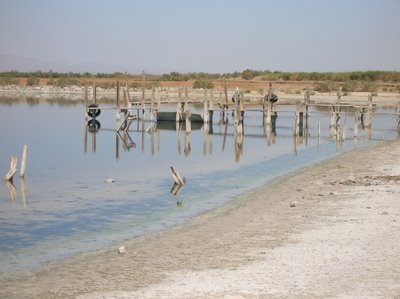
On Thursday, I visited the Salton Sea with a couple of local authorities and advocates for saving what remains of this vast inland body of water. The bad news for the Sea is that "saving" it is almost impossible. The plan to restore it costs upward of $50 billion, and there's just no money available that could ever meet the cost. The Salton has been our dumping ground for sewage and agricultural chemicals and pesticides since the turn of the last century; with the decision to divert vast quantities of local water to San Diego and central California, what little flow it still receives will be reduced almost entirely over the next 15 years. Because the Salton is an inland waterway dependent on ag off-flow, it can't replenish itself. The toxins build and build until the combination precipitates massive avian die-offs, made worse because the sea is also the only layover for migratory birds now that the Colorado Delta runs dry. (The United States utilizes almost all of the Colorado, and what little remains goes to Mexico for agriculture -- the great river of old is now a muddy brown trickle miles before its original delta begins.)
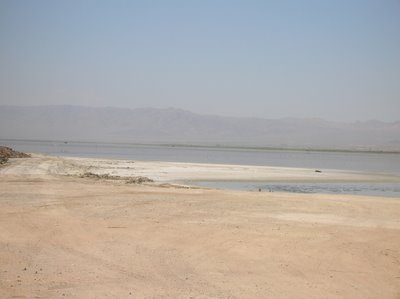
Out in the distance there? That dark spot? Yeah, that's a tire someone dumped. After careful scientific inquiry, I've concluded that there is no place on earth too ludicrous or remote that it can avoid becoming a tire dumping ground. Who the hell drives all the way out over a gravel berm in the middle of absolutely nowhere in 100+ degree heat to dump a tire by the seashore?
That white area used to be covered by the Sea, but because the body of water is so shallow, the smallest change reduces its total surface area dramatically. The 15 year water plan is meant to reduce its depth by about 10 feet, but this will actually move the water's edges about 1 mile away from where they currently lap the shores. The water is also going to become hypersaline as freshwater inflows disappear, meaning that it will become a super-salty body of water that works for some migratory birds...but not for all.
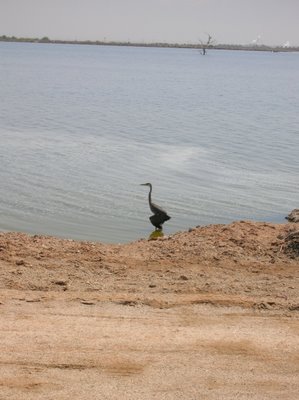
Blue herons should be okay, although this juvenile's wing indicates that he had an awful run-in with a boat (apparently it happens a lot) or a coyote. We called the refuge to see if they'd come pick it up, but who knows. The water is so shallow that he could run far from the shoreline if he decided that people were getting too close, so a rescue seems difficult.
The migratory birds are a huge issue, but the greater concern is over air quality. See that white stuff around the edges of the lake in the picture before the heron? That's a crust of chemicals, salt, and toxins left behind when the water level dropped. When you walk on it, the earth crunches like bubble wrap. It's extremely windy around Imperial Valley, and the constant breezes pick that stuff up and carry it over local communities and crops. Your California produce likely comes from the IV, and now some of it risks being dusted with a toxic powder every day. The air quality in the area is already some of the worst in the state (note how the sky isn't actually blue in this photo -- actually, the mountains are more visible here than they've been anywhere else I've driven). The "do nothing" scenario to "save" the Salton Sea still costs about $5 billion, largely because of mitigation measures required to reduce the risks from airbourne pollutants. Some people argue that it won't be that bad, but look at how quickly the earth blows away when we drive through it:
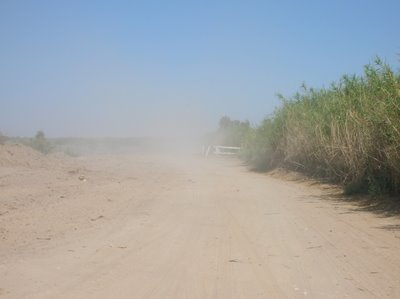
This is at least 30 seconds after the truck in front of us passed my Jeep. At first, you can't even open the car doors because the dust is so thick. Want to inhale these particles every day? Move to one of the towns downwind from the sea.
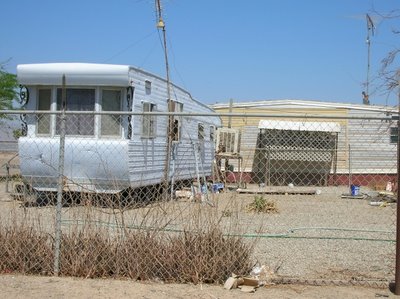
Perhaps a town like Bombay Beach, home to many ancient, dilapidated, rusting hulks like these. About 30 years ago, these towns were supposed to be the next big thing for retirement communities whose residents wanted year-round sun in the great outdoors. Then, the funding dried up, the sea grew more polluted, and people realized it wasn't such a great place to live after all. Still, die-hard residents hold out, peering from the doors of their sweltering metal boxes when newcomers roll down the streets.
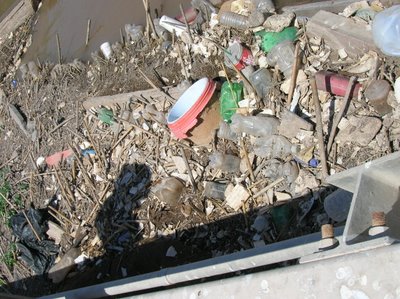
But hey, it could be worse. You could live along the banks of the Alamo River! The Alamo isn't as polluted as the New, but it receives a LOT of pesticides and pollution from the IV's farms...and its condition isn't being helped by the refuse dumped into it, all of which appears to have jammed up against this low-lying bridge next to the Salton Sea. Don't worry, there are tires here, too -- they're just out of my camera's lens.
The quality of the Alamo is further degraded by the dark lumpy blob underneath the shadow of the man standing on the bridge. I know you can't see it, but crushed against the bridge supports is a very dead, very much decaying horse. I tell you, I'm taking the complete olfactory tour of the Imperial Valley. Ridiculously briney, toxic-smelling Salton Sea? Check. Noxious New River? Check. Stomach-turning equine carcass? Oh yeah, baby. I don't really want to think about how long that horse had been there or what the hell had leached into the water from its remains, but one of my companions just about went out of his skull when he saw it. He's been working on water issues in the IV for years, and as he said, "You think you're worried about the sea? Who cares until we clean this shit up! This is absolutely inexcusable, to have this going on in the United States while we blame Mexico for what's going on." The Alamo does come into the US from Mexico, but it's so small at the international boundary that there's no way a fully grown dead horse could wash all the way up to the end of the river. This is godforsaken country...
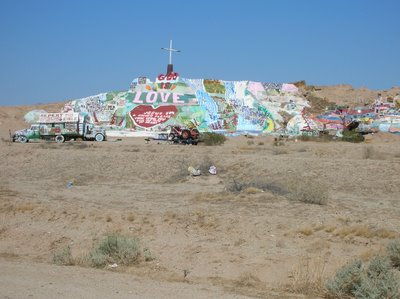
...except not for everyone. Meet Sacred Mountain, aka Salvation Mountain, located just outside the remarkably post-apocalyptic town of Niland, California, home of Deliverance's cousins. Niland, population 1200 or so, will forever exist in my memory as the place where I met a guy wearing pant fragments. He had on denium cutoffs that were split all the way to the waistband on both legs. This east-of-Salton style was accentuated by a stained, mussed t-shirt and a wild-eyed stare, accompanied by a litany of "God Bless you's" and rambling commentary only somewhat directed at me as I left the local convenience store ("Thank you very much, are you having a good day 'cause I'm having a good day you know you're just like the doctor what he ordered I mean God bless you, no God bless you...") This is after I spent 10 minutes inside the store having one of the strangest "conversations" of my life with the desk clerk and a wizened middle-aged man buying a 24-pack. Both of them materialized from the store's dark interior after I walked in and saw absolutely no one inside the shadowy cavern -- no lights, of course, because having lights on in the store would imply normalcy, and that's not the image the good people of Niland want to project. The conversation went something like this:
Me (to the Latino clerk): "Hola. Esto es todo."
Clerk: What?
Me: Sorry, I just want to buy this
Clerk: (silence)
Me: Um. Can I buy this?
Clerk: ...Do you speak English?
Me, backpedaling slowly and wondering if I can sprint out the door before he gets me: Um. Yep.
Clerk: Oh, I thought you were German or something.
Finally, we went over to the counter, where the beer-toting customer was waiting. He was a short Asian American man in worn jeans and a cowboy-style shirt, wearing a cowboy hat (of course).
Me: Go ahead.
Beer Guy: (silence, followed by suspicious staring in my direction)
Me: (confused silence)
Beer Guy: She can go first.
Beer Guy then directed all of his comments to the clerk, even though I was standing approximately 18 inches away.
Me: Hey, do you know where Sacred Mountain is?
Clerk: Sacred Mountain?
Me: Sacred Mountain.
Clerk: Sacred Mountain?
Me: (give up speaking. nod.)
Beer Guy: What's she looking for?
Clerk: Yeah, it's about two miles from here. Just take a right.
Me: Take a right? Where?
Beer Guy: Why would she want to go to Sacred Mountain?
Beer Guy is now looking at the clerk as though I am some sort of threatening alien life form sent to rob him of his alcohol. He also looks just scary enough for me to think I should leave and drive roughly 15 miles north to ask directions from the slightly less frightening trailer folk at Bombay Beach. At least there, most of them are old enough to outrun.
Clerk: Take a right.
Me: WHERE?!?
Beer Guy: What's she want?
Clerk: Anywhere.
I give up, snatch my stupid Gatorade off the counter -- which I only purchased to avoid being rude by asking for directions without buying anything -- and start to head out the door. Finally, Beer Guy turns and asks me why I don't know where the mountain is.
Me: Well, I just want to see it. I'm not from here. (winning smile)
Beer Guy: Oh. You aren't? (withering glare that sends smile to my toes)
I don't even bother with a response, instead electing to run for the door. Alas, as I reach the smeary glass door with its rusty iron bars, the spectre of Semi-Shredded Shorts Man looms on the other side...
So the deal with Salvation Mountain is laid out in a great book called Salt Dreams, which I highly recommend reading. It also goes into great detail about Slab City, the other Niland attraction and the only pseudo-town to rival Bombay Beach and Niland for the most authentic post-apocalyptic atmosphere. Slab City is basically a jumble of concrete and half-destroyed trailers now inhabited by anti-government anarchists and survivalists from the US and Canada. I really wanted to find it, but after the Niland Encounter I decided maybe I should wait until I owned a large, potentially rabid Doberman. The Niland Encounter wasn't finished, of course, because I still had to reach Salvation Mountain (sculpted and painted entirely by one man's hands -- and, of course, the man decided to use lead paint for most of his work). This entailed driving through one of Niland's main streets, where I saw a church which had what I almost swear was a beer keg on the front porch.
As soon as I got onto the street, the handful of people in it stopped and stared. Most of them were kids on bicycles, which meant that I now had to maneuver the car around a bunch of squinty-eyed children who were sitting in the middle of the goddamned road looking at my car like they'd never seen one in their lives and didn't know if they should worship it or kill it. Naturally, a whole flock of Niland residents started coming out of the shadows of their front porches and moving towards their fences (if they had fences), also staring at my car in some sort of trance-like state.
By this point, I was essentially ready to turn around and burn rubber all the way to Calexico. My gas gauge looked a little low, but I decided I'd rather brave the desert on foot than step outside my car again. Finally, I bumped over the train tracks and saw a scattering of trailers (and discarded tires!) in the distance...and a garish mound rising from the earth.
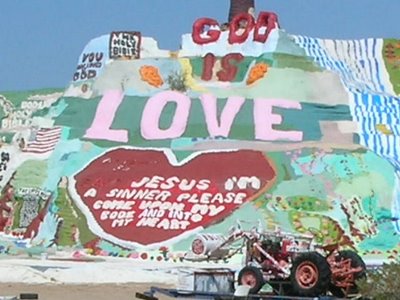
The guy who did this is supposed to be harmless, genuine, and interesting, but heads are peering from trailer interiors again and I decide I'm perfectly happy snapping a few pictures and getting the hell out of the area forever. The Jeep and I roared back over the train tracks, shot through town (more gaping kids on bikes) and straight back onto the highway.
I hope no one from Niland ever reads this, but if they do I just want to advise you that it might be wise to chain half the population up inside when strangers come through town, unless you really think that "Niland: Deliverance, but Warmer" is a good tourism slogan.
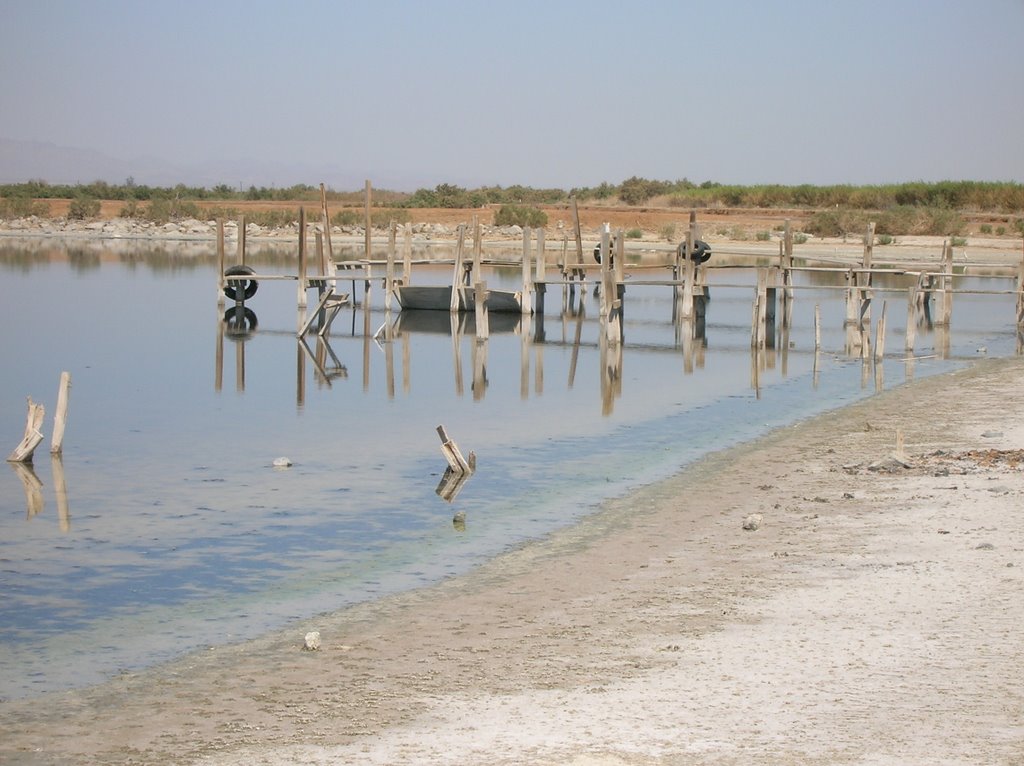
On Thursday, I visited the Salton Sea with a couple of local authorities and advocates for saving what remains of this vast inland body of water. The bad news for the Sea is that "saving" it is almost impossible. The plan to restore it costs upward of $50 billion, and there's just no money available that could ever meet the cost. The Salton has been our dumping ground for sewage and agricultural chemicals and pesticides since the turn of the last century; with the decision to divert vast quantities of local water to San Diego and central California, what little flow it still receives will be reduced almost entirely over the next 15 years. Because the Salton is an inland waterway dependent on ag off-flow, it can't replenish itself. The toxins build and build until the combination precipitates massive avian die-offs, made worse because the sea is also the only layover for migratory birds now that the Colorado Delta runs dry. (The United States utilizes almost all of the Colorado, and what little remains goes to Mexico for agriculture -- the great river of old is now a muddy brown trickle miles before its original delta begins.)
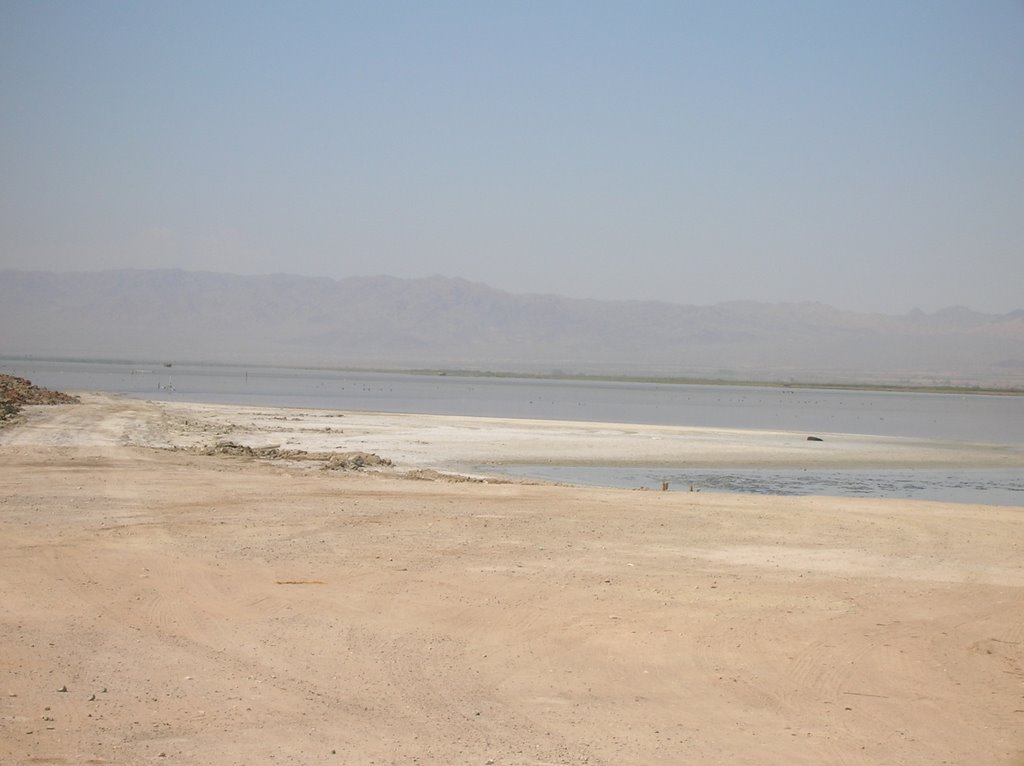
Out in the distance there? That dark spot? Yeah, that's a tire someone dumped. After careful scientific inquiry, I've concluded that there is no place on earth too ludicrous or remote that it can avoid becoming a tire dumping ground. Who the hell drives all the way out over a gravel berm in the middle of absolutely nowhere in 100+ degree heat to dump a tire by the seashore?
That white area used to be covered by the Sea, but because the body of water is so shallow, the smallest change reduces its total surface area dramatically. The 15 year water plan is meant to reduce its depth by about 10 feet, but this will actually move the water's edges about 1 mile away from where they currently lap the shores. The water is also going to become hypersaline as freshwater inflows disappear, meaning that it will become a super-salty body of water that works for some migratory birds...but not for all.

Blue herons should be okay, although this juvenile's wing indicates that he had an awful run-in with a boat (apparently it happens a lot) or a coyote. We called the refuge to see if they'd come pick it up, but who knows. The water is so shallow that he could run far from the shoreline if he decided that people were getting too close, so a rescue seems difficult.
The migratory birds are a huge issue, but the greater concern is over air quality. See that white stuff around the edges of the lake in the picture before the heron? That's a crust of chemicals, salt, and toxins left behind when the water level dropped. When you walk on it, the earth crunches like bubble wrap. It's extremely windy around Imperial Valley, and the constant breezes pick that stuff up and carry it over local communities and crops. Your California produce likely comes from the IV, and now some of it risks being dusted with a toxic powder every day. The air quality in the area is already some of the worst in the state (note how the sky isn't actually blue in this photo -- actually, the mountains are more visible here than they've been anywhere else I've driven). The "do nothing" scenario to "save" the Salton Sea still costs about $5 billion, largely because of mitigation measures required to reduce the risks from airbourne pollutants. Some people argue that it won't be that bad, but look at how quickly the earth blows away when we drive through it:
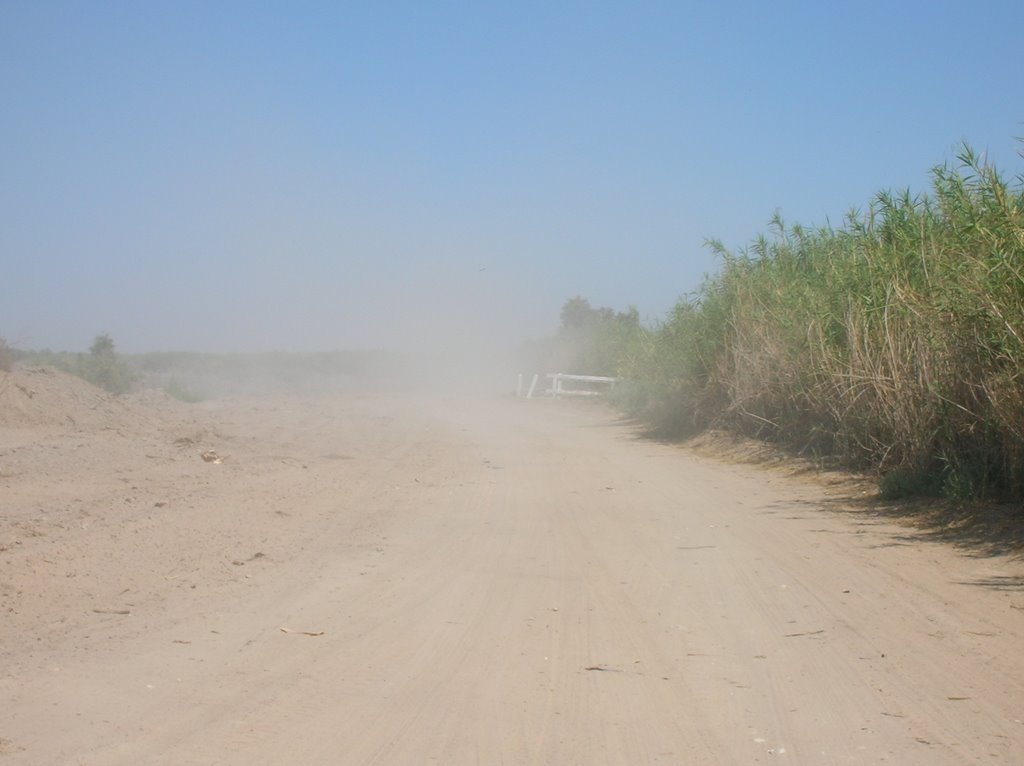
This is at least 30 seconds after the truck in front of us passed my Jeep. At first, you can't even open the car doors because the dust is so thick. Want to inhale these particles every day? Move to one of the towns downwind from the sea.

Perhaps a town like Bombay Beach, home to many ancient, dilapidated, rusting hulks like these. About 30 years ago, these towns were supposed to be the next big thing for retirement communities whose residents wanted year-round sun in the great outdoors. Then, the funding dried up, the sea grew more polluted, and people realized it wasn't such a great place to live after all. Still, die-hard residents hold out, peering from the doors of their sweltering metal boxes when newcomers roll down the streets.

But hey, it could be worse. You could live along the banks of the Alamo River! The Alamo isn't as polluted as the New, but it receives a LOT of pesticides and pollution from the IV's farms...and its condition isn't being helped by the refuse dumped into it, all of which appears to have jammed up against this low-lying bridge next to the Salton Sea. Don't worry, there are tires here, too -- they're just out of my camera's lens.
The quality of the Alamo is further degraded by the dark lumpy blob underneath the shadow of the man standing on the bridge. I know you can't see it, but crushed against the bridge supports is a very dead, very much decaying horse. I tell you, I'm taking the complete olfactory tour of the Imperial Valley. Ridiculously briney, toxic-smelling Salton Sea? Check. Noxious New River? Check. Stomach-turning equine carcass? Oh yeah, baby. I don't really want to think about how long that horse had been there or what the hell had leached into the water from its remains, but one of my companions just about went out of his skull when he saw it. He's been working on water issues in the IV for years, and as he said, "You think you're worried about the sea? Who cares until we clean this shit up! This is absolutely inexcusable, to have this going on in the United States while we blame Mexico for what's going on." The Alamo does come into the US from Mexico, but it's so small at the international boundary that there's no way a fully grown dead horse could wash all the way up to the end of the river. This is godforsaken country...

...except not for everyone. Meet Sacred Mountain, aka Salvation Mountain, located just outside the remarkably post-apocalyptic town of Niland, California, home of Deliverance's cousins. Niland, population 1200 or so, will forever exist in my memory as the place where I met a guy wearing pant fragments. He had on denium cutoffs that were split all the way to the waistband on both legs. This east-of-Salton style was accentuated by a stained, mussed t-shirt and a wild-eyed stare, accompanied by a litany of "God Bless you's" and rambling commentary only somewhat directed at me as I left the local convenience store ("Thank you very much, are you having a good day 'cause I'm having a good day you know you're just like the doctor what he ordered I mean God bless you, no God bless you...") This is after I spent 10 minutes inside the store having one of the strangest "conversations" of my life with the desk clerk and a wizened middle-aged man buying a 24-pack. Both of them materialized from the store's dark interior after I walked in and saw absolutely no one inside the shadowy cavern -- no lights, of course, because having lights on in the store would imply normalcy, and that's not the image the good people of Niland want to project. The conversation went something like this:
Me (to the Latino clerk): "Hola. Esto es todo."
Clerk: What?
Me: Sorry, I just want to buy this
Clerk: (silence)
Me: Um. Can I buy this?
Clerk: ...Do you speak English?
Me, backpedaling slowly and wondering if I can sprint out the door before he gets me: Um. Yep.
Clerk: Oh, I thought you were German or something.
Finally, we went over to the counter, where the beer-toting customer was waiting. He was a short Asian American man in worn jeans and a cowboy-style shirt, wearing a cowboy hat (of course).
Me: Go ahead.
Beer Guy: (silence, followed by suspicious staring in my direction)
Me: (confused silence)
Beer Guy: She can go first.
Beer Guy then directed all of his comments to the clerk, even though I was standing approximately 18 inches away.
Me: Hey, do you know where Sacred Mountain is?
Clerk: Sacred Mountain?
Me: Sacred Mountain.
Clerk: Sacred Mountain?
Me: (give up speaking. nod.)
Beer Guy: What's she looking for?
Clerk: Yeah, it's about two miles from here. Just take a right.
Me: Take a right? Where?
Beer Guy: Why would she want to go to Sacred Mountain?
Beer Guy is now looking at the clerk as though I am some sort of threatening alien life form sent to rob him of his alcohol. He also looks just scary enough for me to think I should leave and drive roughly 15 miles north to ask directions from the slightly less frightening trailer folk at Bombay Beach. At least there, most of them are old enough to outrun.
Clerk: Take a right.
Me: WHERE?!?
Beer Guy: What's she want?
Clerk: Anywhere.
I give up, snatch my stupid Gatorade off the counter -- which I only purchased to avoid being rude by asking for directions without buying anything -- and start to head out the door. Finally, Beer Guy turns and asks me why I don't know where the mountain is.
Me: Well, I just want to see it. I'm not from here. (winning smile)
Beer Guy: Oh. You aren't? (withering glare that sends smile to my toes)
I don't even bother with a response, instead electing to run for the door. Alas, as I reach the smeary glass door with its rusty iron bars, the spectre of Semi-Shredded Shorts Man looms on the other side...
So the deal with Salvation Mountain is laid out in a great book called Salt Dreams, which I highly recommend reading. It also goes into great detail about Slab City, the other Niland attraction and the only pseudo-town to rival Bombay Beach and Niland for the most authentic post-apocalyptic atmosphere. Slab City is basically a jumble of concrete and half-destroyed trailers now inhabited by anti-government anarchists and survivalists from the US and Canada. I really wanted to find it, but after the Niland Encounter I decided maybe I should wait until I owned a large, potentially rabid Doberman. The Niland Encounter wasn't finished, of course, because I still had to reach Salvation Mountain (sculpted and painted entirely by one man's hands -- and, of course, the man decided to use lead paint for most of his work). This entailed driving through one of Niland's main streets, where I saw a church which had what I almost swear was a beer keg on the front porch.
As soon as I got onto the street, the handful of people in it stopped and stared. Most of them were kids on bicycles, which meant that I now had to maneuver the car around a bunch of squinty-eyed children who were sitting in the middle of the goddamned road looking at my car like they'd never seen one in their lives and didn't know if they should worship it or kill it. Naturally, a whole flock of Niland residents started coming out of the shadows of their front porches and moving towards their fences (if they had fences), also staring at my car in some sort of trance-like state.
By this point, I was essentially ready to turn around and burn rubber all the way to Calexico. My gas gauge looked a little low, but I decided I'd rather brave the desert on foot than step outside my car again. Finally, I bumped over the train tracks and saw a scattering of trailers (and discarded tires!) in the distance...and a garish mound rising from the earth.
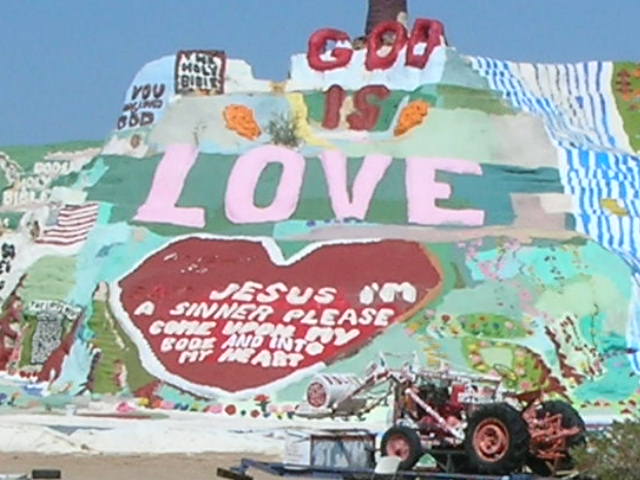
The guy who did this is supposed to be harmless, genuine, and interesting, but heads are peering from trailer interiors again and I decide I'm perfectly happy snapping a few pictures and getting the hell out of the area forever. The Jeep and I roared back over the train tracks, shot through town (more gaping kids on bikes) and straight back onto the highway.
I hope no one from Niland ever reads this, but if they do I just want to advise you that it might be wise to chain half the population up inside when strangers come through town, unless you really think that "Niland: Deliverance, but Warmer" is a good tourism slogan.
Friday, May 19, 2006
Sweating it up in low-down California
Yesterday, I drank two liters of water and didn't use the bathroom once. This concerned me until I found out today that yesterday's high was 109 degrees. Considering that I spent about four hours of that tramping around outside, I think my camel-like consumption was probably a good thing.
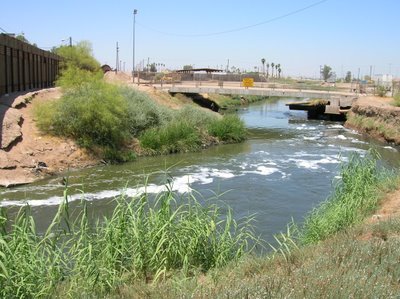
Welcome to Imperial County, California, the poorest, hottest, heaviest water-consuming county in the state. I've been here for a week and will be in town for one more, studying the New River, which has earned the dubious distinction of being the dirtiest river in the United States (some also say it's the dirtiest in North America, but the jury has yet to reach a verdict). Those are phosphates flowing across the international boundary with Mexico, which is just to the left of my photo. In Mexico, it's still acceptable to use phosphates in detergent and other products, which wouldn't actually be a huge deal...except that the toxicity of the river means the foam has come into contact with all sorts of nasty viruses, fecal coliform, VOCs (volatile organic compounds) and chemicals...which still wouldn't be too much of a problem, except that it's windy here in the IC, and the foam tends to blow across the street into the parking lot of the adjacent grocery store. When the foam blobs are house-sized and blat onto produce stands by the front door, people tend to get upset.
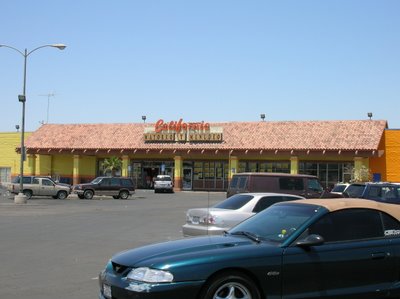
This is the grocery store with the foam blat problem. I'm incredibly disappointed that I haven't seen any house-sized blobs yet, but I don't really want to stick around until one rolls across the pavement, since the summertime highs here get into the 120-range. What have I seen in the river? Well...
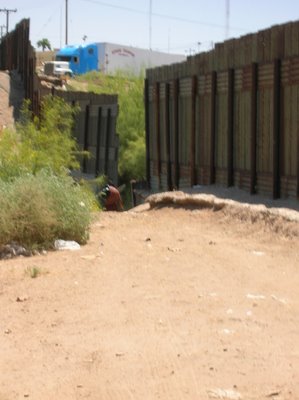
It's a terrible shot, but I was in a sprint to snap the photo before he disappeared back across the border. There was a film crew in town from PBS in LA, and I joined them to listen in as they shot a documentary on the pollution situation here. Apparently, as we worked near the border, we flushed a migrant who'd been hiding in the bushes next to the river. He trudged out slowly, clad only in a pair of maroon shorts, holding a black plastic garbage bag filled with belongings. None of us even noticed him until one of the local water experts, Jose, said, "Hey, look what we found!" Most of Calexico, the town where I'm staying, is Latino; the majority are recent immigrants from Mexicali, Guadalajara, or further south -- but they have ambivalent feelings about the influx of illegal immigrants who cross the New River every night. Anyway, Jose told me to go take a picture, so I started towards him, which is when he started running. Before we knew it, he'd splashed straight into the river and waded back into Mexico. See, the river is so toxic that the Border Patrol won't go in after you, so it's a popular aquatic highway for migrants to use. I've been bugging the patrol all week to let me ride along and watch people cross, but I think I'm just going to drive down to the bridge myself and sit there for a couple of hours tomorrow night.
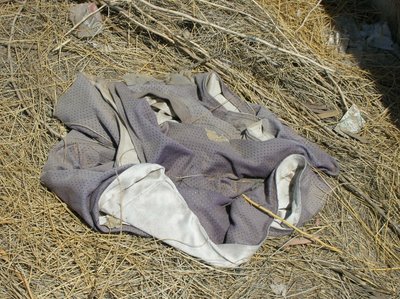
The banks of the river are lined with discarded clothing, underwear, plastic bags and garbage. The Border Patrol estimates that 40 - 60 people cross here each night, with a peak of 100 - 150 during the cooler season. Right now, it's getting brutal outside during the day (although people here think it's pretty cool, all things considered). It won't be long before the weather takes its toll on people crossing; each year, several dozen immigrants die in the deserts. I've driven within walking distance of places where it's happened.
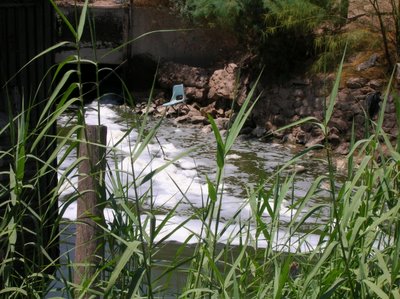
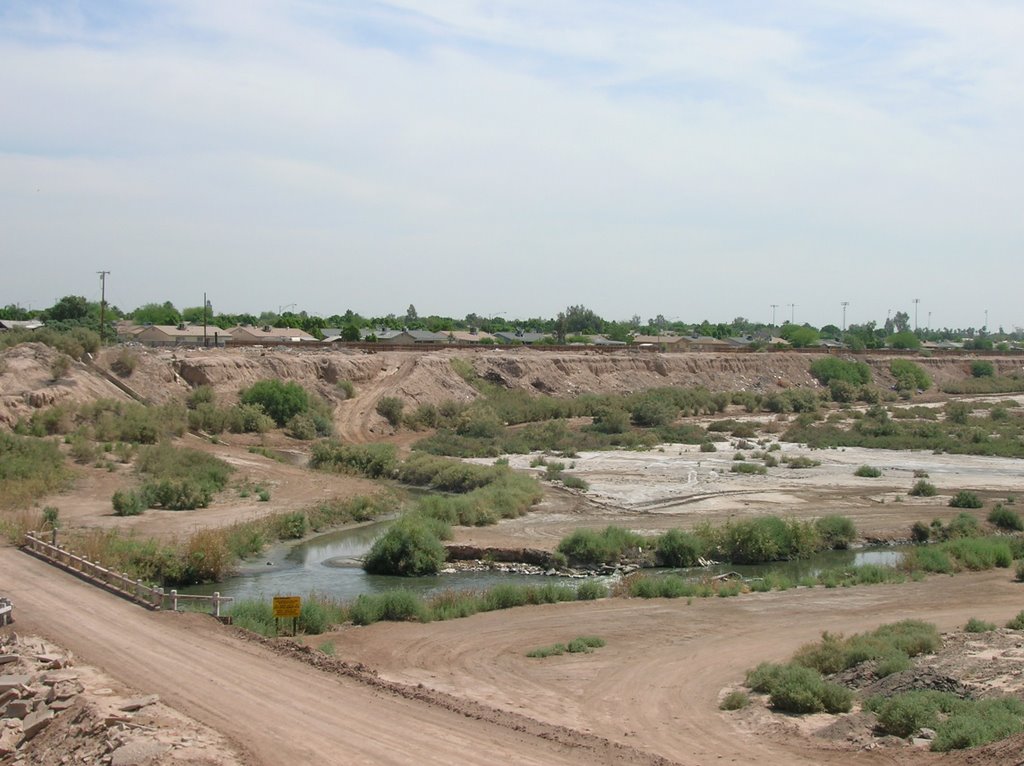
This is the international boundary. The area where the foam originates is actually not the New River -- it's an outlet for a lot of the wastewater from Mexicali. Right now, they're completing a wastewater treatment plant with help from BECC and NADBank, two environmental development agencies created by side agreements in NAFTA. Once that goes online at the end of the year, pollution should decline to a level where it will be easier to confront on the US side. Everyone here talks about Mexican sewage, but it's easy to forget that an equal number of problems originate in the US. The IC is the heart of agriculture country -- and where there's ag land, there are pesticides by the ton. I've driven past fields of melons, onions, sawgrass, sugar beets, oranges, lettuce...you name it, it's grown here. You buy it? It probably came from here, too. On every field, I've seen men clad in heavy gloves and protective clothing, spraying a brightly colored assortment of liquids onto the food. Between that and the endless feedlots with thousands upon thousands of cattle, it's enough to make me swear off eating for life.
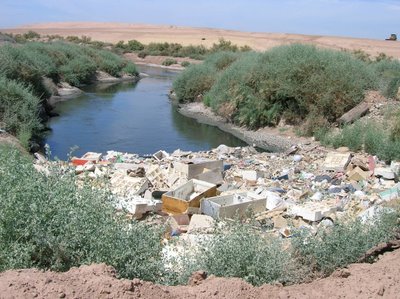
The chemicals and sewage are problematic, but dumping is another problem. The PBS crew filmed in Mexicali on Wednesday and saw huge trucks pumping gallons of murky brown substances into the water...but this shot is from Calexico, and there's a river under all that crap that flows north to the Salton Sea. Everyone treats this river like an open sewer, a place to get rid of all the refuse you don't want anymore. They've put up fences to block dumpers from throwing their refrigerators into the river, but so far it seems like people just peel back the chain link and drive right up to the shore. Or, they go around the fence. IC has unique attitudes about the environment that are too complex to parse out here without a lot of writing. Long story short, the Imperial Valley has long had access to the cheapest water in the world, thanks to its reliance on Colorado River water. I think the IV uses something like 75% of the water allocated to California, and it's all for 500,000 acres of farmland. With increasing demand for water in urban areas like San Diego and Los Angeles, pressure's on for the state to pay farmers not to farm, diverting water to the cities. See, Cali's exceeded its share of the Colorado by an incredible amount, and now the other basin states are forcing it to stick to its original allocation. This means that people here are feeling incredibly defensive about their water. The county may be poor, but some people are very, very rich, and they're used to the environment doing whatever they want it to do. The population is growing, the water is diminishing...the area is a powder keg in many ways, and dumping is only one indication of the work that needs to be done to teach residents that there's just nothing left to abuse anymore.
Alas, what you can't experience through these photos is the smell of the New River. It's a legendary odor, cited for decades by Calexico developers who blame it for their stagnant growth. I have a terrible sense of smell, but even I grew a little ill when I spent an afternoon touring sites around Calexico (in sandals, because I am stupid -- I'm sure my feet classify as a Superfund site now). I couldn't get the smell out of my clothes, my skin, my nose for two days. It's a combination of tar, garbage, sewage, decay and chemicals that scorches the back of your nasal passages. It takes your breath away, but you can't hold it long enough to avoid getting a whiff. In the stifling late spring heat, when the wind blows the right way, it's enough to make you feel light-headed within minutes. There are people who live within 200 feet of the river. When they go on vacation, they literally seal off their houses: tape the windows, block the doors. It doesn't work. Upon their return, the houses reek of the river, and there's nothing they can do about the odor once it gets inside. Maybe that's why there are so many household items in the makeshift dumps...
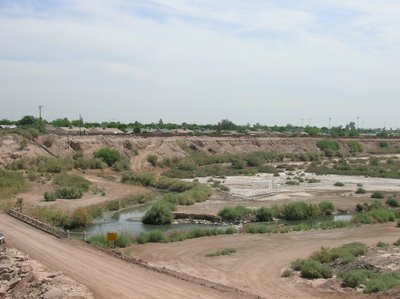
The up-side to all of this? I'm learning a ton, perversely enjoying the experience....and I get to offroad all the time. I had no idea that driving a 4x4 around a bunch of sandy, rutted "roads" and spinning out in the dirt could be so damned fun. After a few days, I'm now on a mission to see how filthy the exterior of a rental Jeep can become. So far, I'm doing pretty well. People here have gone from giving my car a double-take because it's new (trust me, I wanted an old one) to looking twice because I'm pretty sure it resembles a ball of dirt on wheels. I'll get a photo before I'm forced to wash the windshield, which has so many bug splatters on it that I'm having trouble seeing at dusk.
I've also been forced to use my Spanish like never before, and it's been great. I went to Calexico's sister city of Mexicali (Baja California, Mexico) last night and managed to carry on a very long conversation with Jose and his friend without completely embarrassing myself. Speaking Spanish is important here: as a white person, I already stand out in a fairly negative way. If I can speak both languages, I've been told, it lets people know that I'm "not a racist." It's always awkward deciding which language I should use when I have to initiate a conversation -- I don't want to offend anyone by assuming they don't speak English, but at the same time I don't want them to feel like they have to speak English because there's another dumb gringa who just wandered into the local store. So far, I've managed to get by without too many problems...except for that first afternoon, when I ordered bread and wound up eating something that was either pumpkin or dead animal. I'm still not sure.
There's so, so much to write. I saw colonias in Mexicali, the makeshift shantytowns on the edges of the maquiladoras, and I want to describe them because I think it helps people understand why water quality really isn't a top priority there right now. I want to write about how this region feels like a country unto itself, somehow both American and Mexican, completely amazing and entirely integrated. I want to write about the Salton Sea and its slow, painful demise; about the efforts people are making to save what they can; about Niland, California, which you sort of have to see to believe (let's just say Deliverance, but tanner). So I promise to write more this weekend, in between study breaks. Tomorrow night, I'm off to the 15th annual Mariachi sin Fronteras (Mariachi without borders) festival in Calexico. I have no idea what to expect, but apparently it's a gigantic event that draws people from all over the region. Full report coming soon.

Welcome to Imperial County, California, the poorest, hottest, heaviest water-consuming county in the state. I've been here for a week and will be in town for one more, studying the New River, which has earned the dubious distinction of being the dirtiest river in the United States (some also say it's the dirtiest in North America, but the jury has yet to reach a verdict). Those are phosphates flowing across the international boundary with Mexico, which is just to the left of my photo. In Mexico, it's still acceptable to use phosphates in detergent and other products, which wouldn't actually be a huge deal...except that the toxicity of the river means the foam has come into contact with all sorts of nasty viruses, fecal coliform, VOCs (volatile organic compounds) and chemicals...which still wouldn't be too much of a problem, except that it's windy here in the IC, and the foam tends to blow across the street into the parking lot of the adjacent grocery store. When the foam blobs are house-sized and blat onto produce stands by the front door, people tend to get upset.
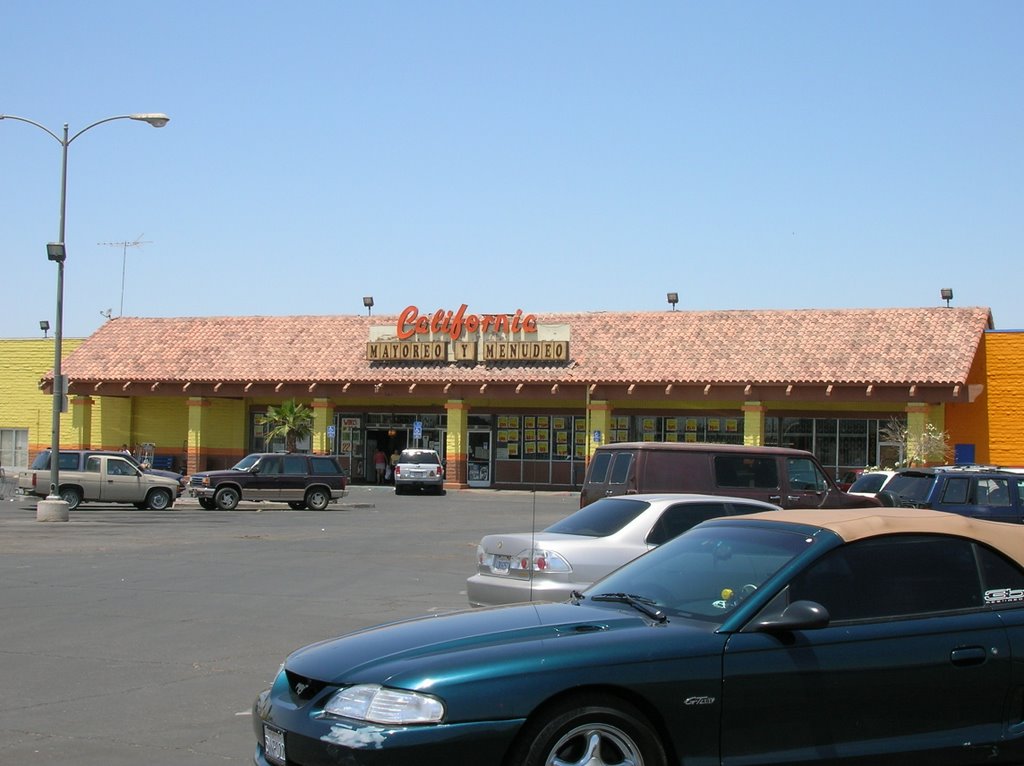
This is the grocery store with the foam blat problem. I'm incredibly disappointed that I haven't seen any house-sized blobs yet, but I don't really want to stick around until one rolls across the pavement, since the summertime highs here get into the 120-range. What have I seen in the river? Well...
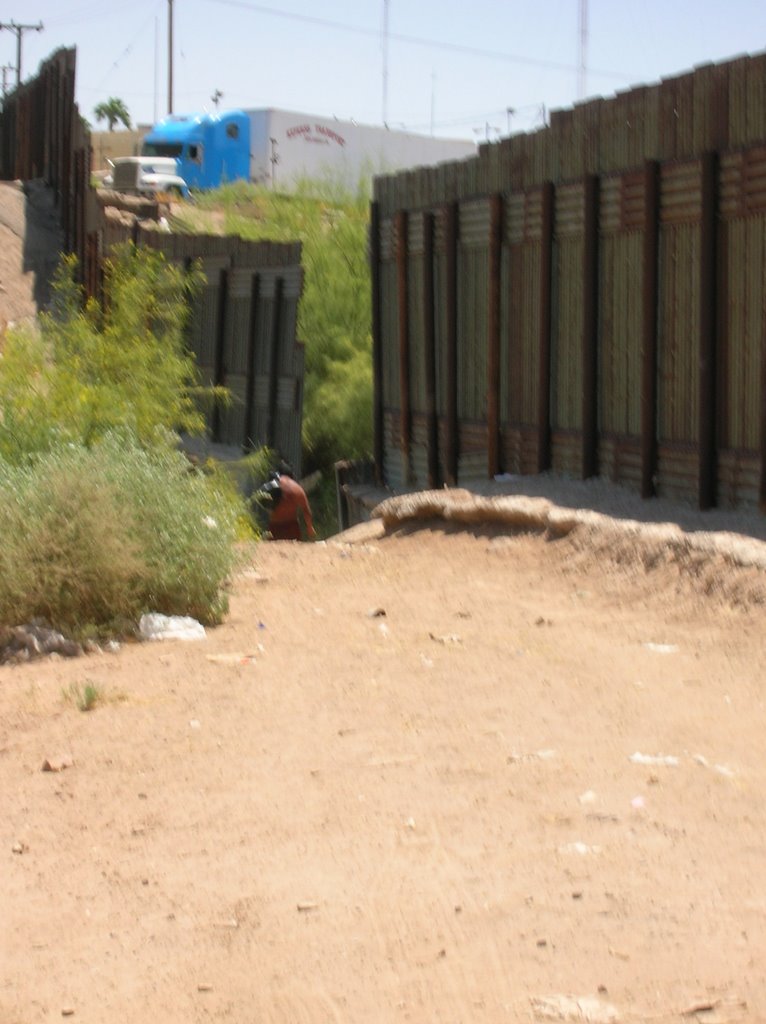
It's a terrible shot, but I was in a sprint to snap the photo before he disappeared back across the border. There was a film crew in town from PBS in LA, and I joined them to listen in as they shot a documentary on the pollution situation here. Apparently, as we worked near the border, we flushed a migrant who'd been hiding in the bushes next to the river. He trudged out slowly, clad only in a pair of maroon shorts, holding a black plastic garbage bag filled with belongings. None of us even noticed him until one of the local water experts, Jose, said, "Hey, look what we found!" Most of Calexico, the town where I'm staying, is Latino; the majority are recent immigrants from Mexicali, Guadalajara, or further south -- but they have ambivalent feelings about the influx of illegal immigrants who cross the New River every night. Anyway, Jose told me to go take a picture, so I started towards him, which is when he started running. Before we knew it, he'd splashed straight into the river and waded back into Mexico. See, the river is so toxic that the Border Patrol won't go in after you, so it's a popular aquatic highway for migrants to use. I've been bugging the patrol all week to let me ride along and watch people cross, but I think I'm just going to drive down to the bridge myself and sit there for a couple of hours tomorrow night.

The banks of the river are lined with discarded clothing, underwear, plastic bags and garbage. The Border Patrol estimates that 40 - 60 people cross here each night, with a peak of 100 - 150 during the cooler season. Right now, it's getting brutal outside during the day (although people here think it's pretty cool, all things considered). It won't be long before the weather takes its toll on people crossing; each year, several dozen immigrants die in the deserts. I've driven within walking distance of places where it's happened.
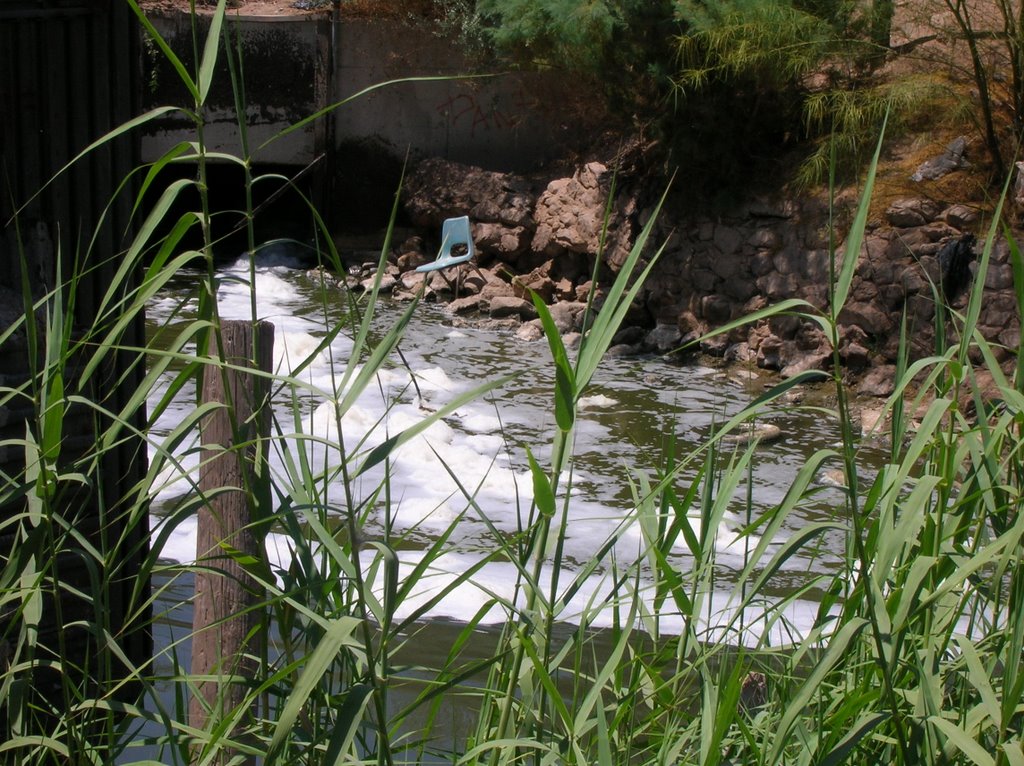
This is the international boundary. The area where the foam originates is actually not the New River -- it's an outlet for a lot of the wastewater from Mexicali. Right now, they're completing a wastewater treatment plant with help from BECC and NADBank, two environmental development agencies created by side agreements in NAFTA. Once that goes online at the end of the year, pollution should decline to a level where it will be easier to confront on the US side. Everyone here talks about Mexican sewage, but it's easy to forget that an equal number of problems originate in the US. The IC is the heart of agriculture country -- and where there's ag land, there are pesticides by the ton. I've driven past fields of melons, onions, sawgrass, sugar beets, oranges, lettuce...you name it, it's grown here. You buy it? It probably came from here, too. On every field, I've seen men clad in heavy gloves and protective clothing, spraying a brightly colored assortment of liquids onto the food. Between that and the endless feedlots with thousands upon thousands of cattle, it's enough to make me swear off eating for life.
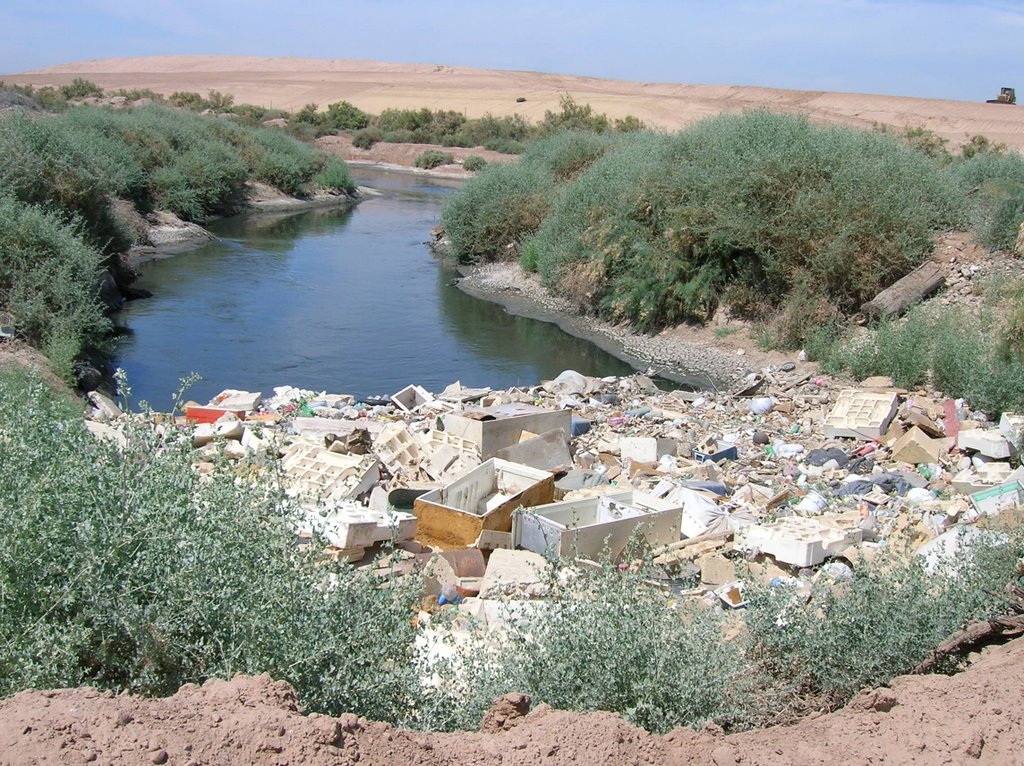
The chemicals and sewage are problematic, but dumping is another problem. The PBS crew filmed in Mexicali on Wednesday and saw huge trucks pumping gallons of murky brown substances into the water...but this shot is from Calexico, and there's a river under all that crap that flows north to the Salton Sea. Everyone treats this river like an open sewer, a place to get rid of all the refuse you don't want anymore. They've put up fences to block dumpers from throwing their refrigerators into the river, but so far it seems like people just peel back the chain link and drive right up to the shore. Or, they go around the fence. IC has unique attitudes about the environment that are too complex to parse out here without a lot of writing. Long story short, the Imperial Valley has long had access to the cheapest water in the world, thanks to its reliance on Colorado River water. I think the IV uses something like 75% of the water allocated to California, and it's all for 500,000 acres of farmland. With increasing demand for water in urban areas like San Diego and Los Angeles, pressure's on for the state to pay farmers not to farm, diverting water to the cities. See, Cali's exceeded its share of the Colorado by an incredible amount, and now the other basin states are forcing it to stick to its original allocation. This means that people here are feeling incredibly defensive about their water. The county may be poor, but some people are very, very rich, and they're used to the environment doing whatever they want it to do. The population is growing, the water is diminishing...the area is a powder keg in many ways, and dumping is only one indication of the work that needs to be done to teach residents that there's just nothing left to abuse anymore.
Alas, what you can't experience through these photos is the smell of the New River. It's a legendary odor, cited for decades by Calexico developers who blame it for their stagnant growth. I have a terrible sense of smell, but even I grew a little ill when I spent an afternoon touring sites around Calexico (in sandals, because I am stupid -- I'm sure my feet classify as a Superfund site now). I couldn't get the smell out of my clothes, my skin, my nose for two days. It's a combination of tar, garbage, sewage, decay and chemicals that scorches the back of your nasal passages. It takes your breath away, but you can't hold it long enough to avoid getting a whiff. In the stifling late spring heat, when the wind blows the right way, it's enough to make you feel light-headed within minutes. There are people who live within 200 feet of the river. When they go on vacation, they literally seal off their houses: tape the windows, block the doors. It doesn't work. Upon their return, the houses reek of the river, and there's nothing they can do about the odor once it gets inside. Maybe that's why there are so many household items in the makeshift dumps...
The up-side to all of this? I'm learning a ton, perversely enjoying the experience....and I get to offroad all the time. I had no idea that driving a 4x4 around a bunch of sandy, rutted "roads" and spinning out in the dirt could be so damned fun. After a few days, I'm now on a mission to see how filthy the exterior of a rental Jeep can become. So far, I'm doing pretty well. People here have gone from giving my car a double-take because it's new (trust me, I wanted an old one) to looking twice because I'm pretty sure it resembles a ball of dirt on wheels. I'll get a photo before I'm forced to wash the windshield, which has so many bug splatters on it that I'm having trouble seeing at dusk.
I've also been forced to use my Spanish like never before, and it's been great. I went to Calexico's sister city of Mexicali (Baja California, Mexico) last night and managed to carry on a very long conversation with Jose and his friend without completely embarrassing myself. Speaking Spanish is important here: as a white person, I already stand out in a fairly negative way. If I can speak both languages, I've been told, it lets people know that I'm "not a racist." It's always awkward deciding which language I should use when I have to initiate a conversation -- I don't want to offend anyone by assuming they don't speak English, but at the same time I don't want them to feel like they have to speak English because there's another dumb gringa who just wandered into the local store. So far, I've managed to get by without too many problems...except for that first afternoon, when I ordered bread and wound up eating something that was either pumpkin or dead animal. I'm still not sure.
There's so, so much to write. I saw colonias in Mexicali, the makeshift shantytowns on the edges of the maquiladoras, and I want to describe them because I think it helps people understand why water quality really isn't a top priority there right now. I want to write about how this region feels like a country unto itself, somehow both American and Mexican, completely amazing and entirely integrated. I want to write about the Salton Sea and its slow, painful demise; about the efforts people are making to save what they can; about Niland, California, which you sort of have to see to believe (let's just say Deliverance, but tanner). So I promise to write more this weekend, in between study breaks. Tomorrow night, I'm off to the 15th annual Mariachi sin Fronteras (Mariachi without borders) festival in Calexico. I have no idea what to expect, but apparently it's a gigantic event that draws people from all over the region. Full report coming soon.
Thursday, May 11, 2006
Warming up
It's 7am and already 70 degrees where I'm headed on Saturday.
Doing research in your own country: $4000. Having your shoes stick to the asphalt in May? Priceless.
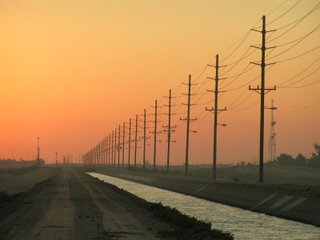
Sure, it looks pretty. This is the calm before the 100+ degree storm. It's supposed to reach 104 degrees today and stay around 100 the rest of the week. So much for the 93 degree average in May.
A population of 30,000 a downtown boasting little more than a McDonalds and a WalMart, and more people passing through the border each day than live in the town. Yippee.
Doing research in your own country: $4000. Having your shoes stick to the asphalt in May? Priceless.

Sure, it looks pretty. This is the calm before the 100+ degree storm. It's supposed to reach 104 degrees today and stay around 100 the rest of the week. So much for the 93 degree average in May.
A population of 30,000 a downtown boasting little more than a McDonalds and a WalMart, and more people passing through the border each day than live in the town. Yippee.
Monday, April 17, 2006
T-Minus 10 Days
To-do list:
1. Rent hotel. Preferably other than the "Don Juan Motel," which apart from its name has the utter misfortune to be located within smelling distance of the most polluted river in North America.
2. Discover destination is so overlooked that both Travelocity and Hotwire do not list it. Learn that none of the hotels are online. Reconsider Don Juan. Reconsider olfactory-offending river. Stop considering Don Juan.
3. Rent car. Look at rental car company reviews online and discard every affordable option because reviews of budget companies run the gamut from, "Threatened to sue me!" to "Car broke down in the middle of a swamp," to "Broke my knees when I returned the car with a scratch it already had." Wonder if highly overpriced but well-reviewed rental company will be angry if one takes a small compact offroading in the desert.
4. Write interview questions. Mentally lobotomize self for failing to read literature before choosing case study, thereby requiring sprain-inducing mental gymnastics to make questions fit newly discovered, completely inappropriate gaps in aforementioned literature. Silently curse prospective interviewees for wanting to know what I'd like to learn before I've figured it out.
5. Buy tape recorder that can survive 100+ degree heat, caustic chemicals in river, and blows from rocks I throw when batteries die in the middle of a key interview.
6. Figure out if there's a bug spray on this planet that protects the wearer from disease-ravaged, encephalitis-carrying, rabid mosquitoes without causing the wearer's skin to turn interesting shades of gray.
7. Purchase pay-as-you-go cell phone for communication needs when car overheats, mosquitoes corner in alley, desert roads begin looking identical, etc. Delight in words of wisdom from sage ex-San Diego resident who says that reception in destination area can be "patchy."
8. Commiserate with fellow program sufferer, soon to depart for Mozambique. Feel slightly better that land mines and crocodiles are not on my risk assessment form.
9. Contact potential interviewees to schedule meetings. Hear nothing. Wonder in mild state of panic if it is possible to spend two weeks in the field and obtain no results.
10. Check weather forecast and climate history for destination. Purchase SPF-50 sunblock and curl up in small corner of bedroom.
11. Realize that only choice of supermarkets in area is limited to a Walmart and a local store noted in many documents for the large, bacteria-laden foam blobs from river that blat onto produce during breezy days. Consider adopting a no-food diet for duration of trip. Choose foam blats and voluntary abstention from produce over manic smiley-faced spawn of Satan.
12. Contemplate chucking degree and moving to Croatia to work in national park chasing bears away from tourists.
1. Rent hotel. Preferably other than the "Don Juan Motel," which apart from its name has the utter misfortune to be located within smelling distance of the most polluted river in North America.
2. Discover destination is so overlooked that both Travelocity and Hotwire do not list it. Learn that none of the hotels are online. Reconsider Don Juan. Reconsider olfactory-offending river. Stop considering Don Juan.
3. Rent car. Look at rental car company reviews online and discard every affordable option because reviews of budget companies run the gamut from, "Threatened to sue me!" to "Car broke down in the middle of a swamp," to "Broke my knees when I returned the car with a scratch it already had." Wonder if highly overpriced but well-reviewed rental company will be angry if one takes a small compact offroading in the desert.
4. Write interview questions. Mentally lobotomize self for failing to read literature before choosing case study, thereby requiring sprain-inducing mental gymnastics to make questions fit newly discovered, completely inappropriate gaps in aforementioned literature. Silently curse prospective interviewees for wanting to know what I'd like to learn before I've figured it out.
5. Buy tape recorder that can survive 100+ degree heat, caustic chemicals in river, and blows from rocks I throw when batteries die in the middle of a key interview.
6. Figure out if there's a bug spray on this planet that protects the wearer from disease-ravaged, encephalitis-carrying, rabid mosquitoes without causing the wearer's skin to turn interesting shades of gray.
7. Purchase pay-as-you-go cell phone for communication needs when car overheats, mosquitoes corner in alley, desert roads begin looking identical, etc. Delight in words of wisdom from sage ex-San Diego resident who says that reception in destination area can be "patchy."
8. Commiserate with fellow program sufferer, soon to depart for Mozambique. Feel slightly better that land mines and crocodiles are not on my risk assessment form.
9. Contact potential interviewees to schedule meetings. Hear nothing. Wonder in mild state of panic if it is possible to spend two weeks in the field and obtain no results.
10. Check weather forecast and climate history for destination. Purchase SPF-50 sunblock and curl up in small corner of bedroom.
11. Realize that only choice of supermarkets in area is limited to a Walmart and a local store noted in many documents for the large, bacteria-laden foam blobs from river that blat onto produce during breezy days. Consider adopting a no-food diet for duration of trip. Choose foam blats and voluntary abstention from produce over manic smiley-faced spawn of Satan.
12. Contemplate chucking degree and moving to Croatia to work in national park chasing bears away from tourists.
Subscribe to:
Posts (Atom)
